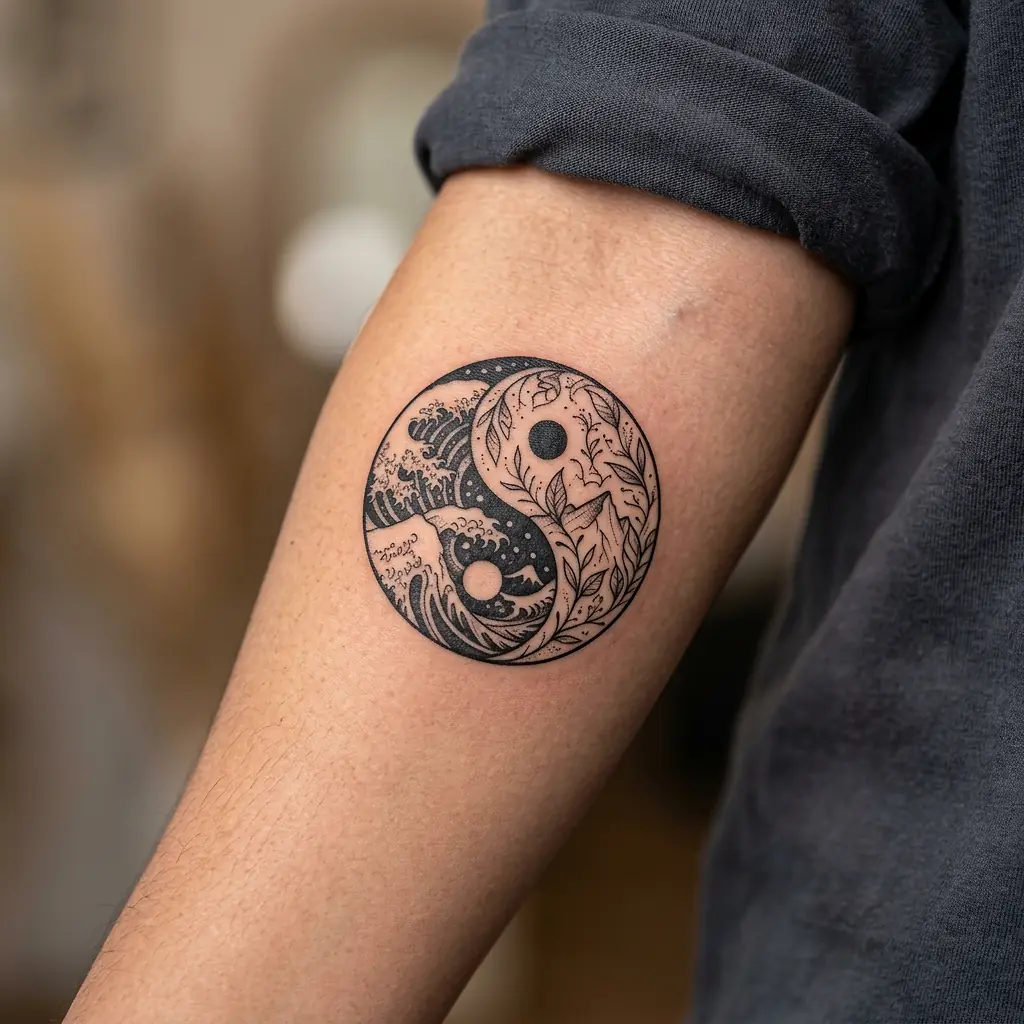
Meaning of the Yin Yang Tattoo
The yin yang is one of the most widely recognized philosophical symbols on earth, and as a tattoo it carries a depth of meaning that transcends any single culture. A yin yang tattoo represents balance, harmony, and the fundamental complementarity of opposing forces. It is a statement about how the world works and how one chooses to engage with it.
The yin yang expresses the principle that everything contains its opposite. Black (yin) and white (yang) are not adversaries: they are interdependent, each carrying within it the seed of the other, represented by the contrasting dot in each half. There is no light without shadow, no joy without sorrow, no strength without vulnerability.
Yin embodies passive, receptive forces: darkness, the moon, femininity, cold, water, earth, and introspection. Yang represents active, creative forces: light, the sun, masculinity, warmth, fire, heaven, and action. Neither is superior; both are necessary.
Getting a yin yang tattoo affirms a commitment to seeking balance. It acknowledges that equilibrium is not a fixed state but a dynamic process, a constant calibration. The sinuous line dividing the two halves is never straight: it curves, suggesting that balance is always in motion, always adjusting.
The symbol also represents perpetual transformation. As yin reaches its fullest expression, yang begins. As yang peaks, yin emerges. This is the rhythm of seasons, of breath, of life itself.
Origins and History
The concept of yin yang has roots in Chinese philosophy dating back over 3,000 years. It appears in the Yi Jing (Book of Changes), one of the foundational texts of Chinese thought, composed around the 11th century BCE.
The graphic symbol as we know it, the taijitu, was formalized by philosopher Zhou Dunyi in the 11th century CE during the Song Dynasty. Its circular form divided into two fluid parts became one of the most immediately recognizable images in human history.
Yin yang is a pillar of Taoism, where it represents the Tao, the universal way underlying all existence. Laozi, in the Tao Te Ching, describes how opposites generate each other and how harmony emerges from their perpetual dance.
The concept profoundly influenced Traditional Chinese Medicine, martial arts (tai chi takes its name from the taijitu), feng shui, and Chinese cuisine, where the balance of flavors mirrors cosmic equilibrium. It also spread to Korean culture, where the taijitu appears on the national flag, and to Japanese philosophy through Zen Buddhism.
Popular Styles
Classic blackwork is the most pure and recognizable version, with dense black ink and sharp contrast. This graphic simplicity gives the motif its power and ensures it remains timeless.
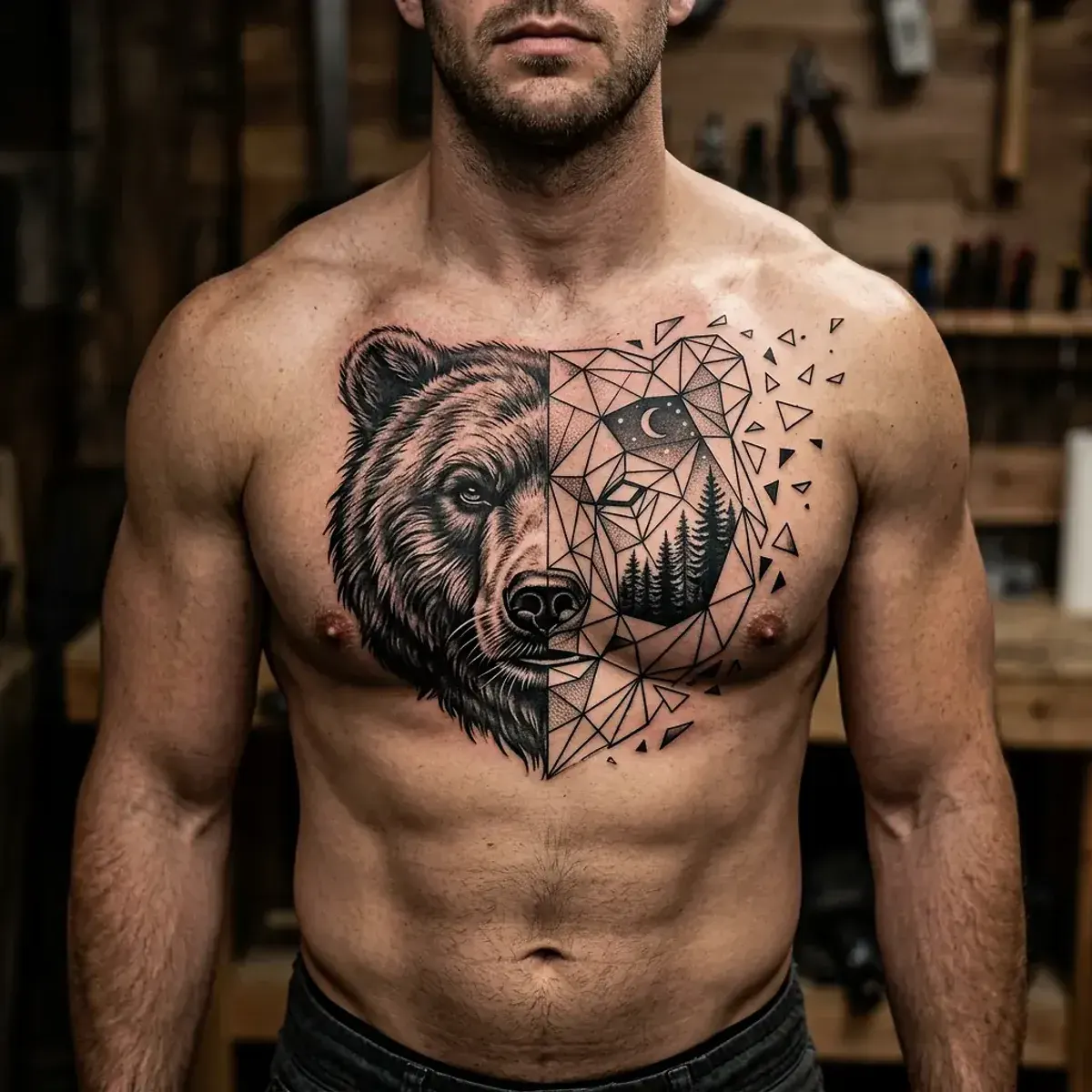
Geometric style decomposes the yin yang into polygonal shapes, lines, and angles, offering a contemporary, architectural interpretation. Dotwork builds the symbol through accumulated points, creating subtle gradients between the two halves.
Japanese style integrates the yin yang into broader compositions with waves, clouds, and natural elements, embedding the symbol within an Eastern aesthetic framework. Tribal style reinterprets the motif with organic lines and Polynesian or Maori patterns.
Watercolor replaces the traditional black and white with fluid colors, creating a vibrant, artistic yin yang. Minimalist reduces the symbol to its simplest expression, sometimes barely sketched in fine line.
Recommended Placements
The wrist is a very popular placement for a small yin yang, visible daily as a reminder of balance. The forearm allows a more detailed design with decorative elements.
The nape of the neck offers a centered, spiritual placement associated with higher chakras. The back, between the shoulder blades, hosts a large yin yang within a mandala or geometric framework.
The upper arm and shoulder are classic placements that allow integration into a sleeve. The ankle and behind the ear suit miniature, discreet versions.
The sternum and solar plexus are symbolically powerful placements, associated with the body’s energetic center.
Combinations and Associations
The yin yang traditionally combines with the dragon and tiger, representing yang and yin respectively in Chinese mythology. This composition is a classic of Chinese and Japanese tattoo art.
Natural elements enrich the symbol: waves for yin (water) and flames for yang (fire), sun and moon flanking each side, or trees whose roots and branches form the two halves organically.
A lotus surrounding the yin yang creates a spiritual composition combining Taoist balance with Buddhist enlightenment. Koi fish swimming in a circle naturally reproduce the yin yang’s form through living movement.
The yin yang integrates into a mandala to amplify its meditative dimension, or into tribal patterns for a rawer, more instinctive aesthetic.