Lotus Tattoo Meaning
Of all the botanical symbols in tattooing, the lotus stands alone in the depth and universality of its spiritual resonance. The lotus flower does something extraordinary: it grows in muddy, murky water — sometimes the thickest, most opaque mud — yet its petals, when they open, are pristine and luminous. They do not carry even a trace of the darkness from which they grew.
This is the core meaning of the lotus tattoo: you can emerge from the darkest places and still be beautiful. You are not defined by where you come from, by the mud of your past, by the difficult conditions that surrounded your growth. What matters is the flower you become.
In spiritual terms, the lotus represents enlightenment — the journey from unconscious, material existence (the dark water) through gradual awakening (the rising stem) to full illumination (the open flower in the light). This three-stage journey maps beautifully onto the human experience of spiritual development, psychological healing, or any process of emerging from ignorance or pain into clarity and peace.
The lotus also symbolizes purity of heart and mind. In Buddhist philosophy, the lotus is a reminder that we can maintain our inner purity regardless of external circumstances — that the world’s dirt need not stain us if we choose to remain open and unattached.
Color carries specific meaning in lotus symbolism. A white lotus represents purity and spiritual perfection. A pink lotus — the most sacred in Buddhist tradition — represents the Buddha himself and the highest spiritual attainment. A blue lotus symbolizes wisdom and knowledge. A red lotus speaks to the heart, love, and compassion.
Origins and History of the Lotus Symbol
The lotus (Nelumbo nucifera) is native to Asia and has been venerated as a sacred plant for at least 5,000 years. Its extraordinary biology — the ability to grow from dark mud, close its petals at night and reopen at dawn, and keep its flowers perpetually clean through a phenomenon now called the “lotus effect” — made it a natural vehicle for spiritual symbolism.
In ancient Egypt, the blue lotus (Nymphaea caerulea) was one of the most sacred plants in the entire culture. The creation myth described the first sunrise as the sun god Atum rising from a primordial lotus that floated on the waters of chaos. Lotus columns adorned temples throughout Egypt. The lotus was associated with rebirth, the sun, and creation itself.
In ancient India, the lotus became central to both Hindu and Buddhist iconography simultaneously. The Rigveda, composed around 1500 BCE, describes the lotus as the seat of the gods. The connection deepened over millennia until the lotus became perhaps the single most important sacred plant in Asian religious art.
The Lotus in Different Cultures
In Buddhism, the lotus is one of the Eight Auspicious Symbols and appears in virtually all Buddhist art. The Buddha is almost invariably depicted seated or standing on a lotus throne, symbolizing his emergence from the world of suffering (samsara) into enlightenment (nirvana). The famous Lotus Sutra takes its name from the flower, and “Om Mani Padme Hum” — the most widely recited mantra in the Buddhist world — means “the jewel in the lotus.”
In Hinduism, the lotus (padma) is the symbol of divine beauty, purity, and spiritual power. Brahma the creator god was born from a lotus growing from Vishnu’s navel. Lakshmi, the goddess of wealth and prosperity, sits upon a lotus and holds lotus flowers in her hands. Saraswati, the goddess of knowledge and arts, is similarly depicted.
In Chinese culture, the lotus (lian hua) symbolizes purity, perfection, and the ability to remain unsullied by the world’s impurities. The great Confucian philosopher Zhou Dunyi wrote his famous essay “Love of the Lotus” in 1061 CE, describing the lotus as the flower of the gentleman who maintains moral integrity in a corrupt world.
In Egyptian art, the lotus appears everywhere — on capitals of columns, in tomb paintings, on jewelry, and as a symbol held by deities. The lotus hieroglyph represented the number 1,000 and was associated with Upper Egypt.
Lotus Tattoo Styles
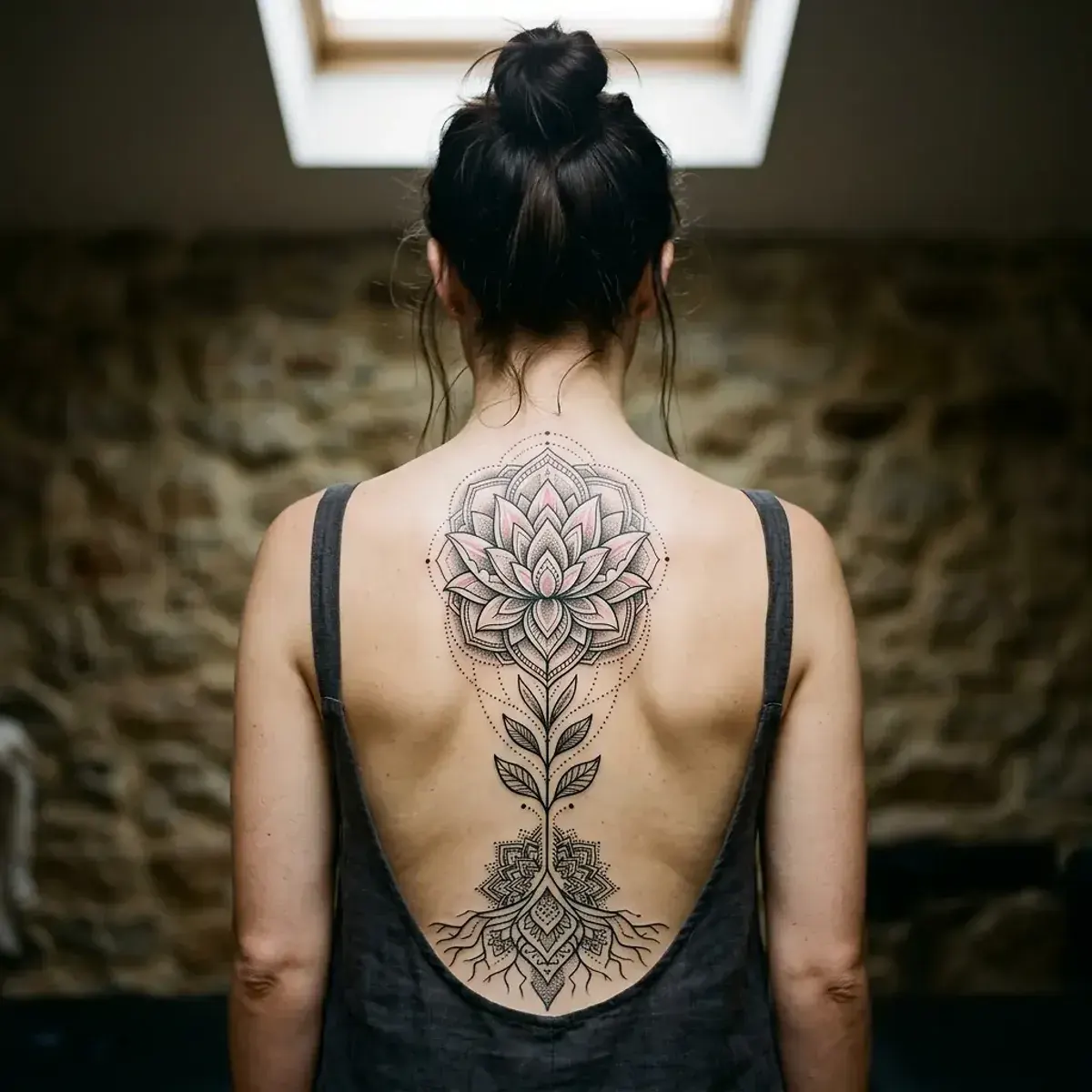
Geometric lotus within a mandala circle is perhaps the most popular style — the lotus petals integrated into a complex, symmetrical geometric composition creates a design of extraordinary beauty and mathematical precision.
Watercolor lotus tattoos use soft, flowing color washes to capture the delicate translucency of the petals. A watercolor lotus in pink and purple tones is one of the most sought-after designs in contemporary tattooing.
Fine-line minimalist lotus designs are popular for their elegant simplicity — a single unbroken line creating the lotus silhouette, or minimal linework suggesting the flower with maximum economy of means.
Blackwork lotus designs create striking compositions through bold, high-contrast outlines and heavy negative space. A fully blackwork lotus mandala is a dramatic and deeply beautiful design.
Dotwork and stippling create lotus designs of subtle beauty through thousands of carefully placed dots, building form and shadow with meditative precision.
Popular Placements
The wrist is a common placement for a small lotus — a constant visible reminder of the principle of rising above difficulty.
The spine is a powerful location for a lotus design, particularly one that grows upward from the base — literally rising from the earth toward the crown of the head, mirroring the chakra energy system.
The shoulder blade or upper back suits larger lotus compositions, particularly those incorporating mandala elements.
The sternum and chest center are increasingly popular for lotus designs, particularly for women, as the placement connects the symbol to the heart chakra.
The ankle and foot suit small, delicate lotus designs for those who want a subtler, more private placement.
Combinations and Associations
A lotus within a mandala creates one of the most complete spiritual tattoo compositions available — the individual flower of enlightenment within the cosmic map of the universe.
The unalome symbol — a spiral representing the path to enlightenment — combined with a lotus is an extremely popular design, often placed on the spine or sternum.
A lotus and phoenix together create a composition where two great symbols of emergence from adversity reinforce each other with complementary energy.
The lotus paired with a butterfly speaks to transformation at every scale — from the intimate metamorphosis of the insect to the profound spiritual awakening of the flower.
Sanskrit text or Om symbols incorporated with a lotus design create a deeply spiritual tattoo that honors the traditions from which the lotus symbol originates.