Phoenix Tattoo Meaning
There is no more powerful symbol of rising from the ashes than the phoenix. This mythical bird that dies in fire and is reborn from its own flames has captured human imagination for millennia, and its meaning resonates with extraordinary depth for anyone who has navigated the kind of destruction that ultimately makes us stronger.
A phoenix tattoo says: I have been burned. I have been reduced to nothing. And I rose anyway. It is a testament to survival, to the stubborn insistence of life on continuing, and to the counterintuitive truth that some of the most devastating moments in a life are also the necessary preconditions for becoming who we were always meant to be.
Beyond personal narrative, the phoenix represents the universal cycle of death and rebirth — the fundamental rhythm underlying all existence. Seasons die and return. Stars explode and their material seeds new ones. Civilizations fall and their remnants fertilize what comes next. The phoenix is the mythological face of this eternal pattern.
The phoenix also carries meanings of immortality and transcendence. Unlike other living things, the phoenix cannot truly die — it simply transforms. Its death is always already its rebirth. This makes it a powerful symbol for those who view death itself as not an ending but a transformation.
Courage is another dimension of the phoenix’s meaning. To burn is terrifying. To trust that you will rise requires extraordinary faith in yourself and in the process of transformation. A phoenix tattoo honors that courage.
Origins and History of the Phoenix Symbol
The phoenix has independent origins in at least four major civilizations, suggesting that this symbol emerged naturally from humanity’s observation of fire, the sun, and the cycles of nature.
The ancient Egyptian Bennu bird was the inspiration for the classical phoenix. The Bennu was a heron-like deity associated with the sun god Ra and with the primordial moment of creation. It was said to live in the sacred persea tree at Heliopolis, and its cry at the dawn of creation set time itself in motion.
The Greek phoenix — the name comes from the Greek phoinix, meaning crimson or Phoenicia — was a unique bird said to live for 500 years before building a nest of aromatic wood, igniting it, and burning to ash, from which a new phoenix would emerge. Ancient sources like Herodotus described it as resembling an eagle with red and gold plumage.
In Chinese mythology, the Fenghuang (often called the Chinese phoenix) is one of the four sacred creatures of Chinese cosmology. Unlike the Western phoenix, the Fenghuang does not necessarily involve death and rebirth — it is an immortal bird associated with the south, summer, fire, and the empress. When depicted together with the dragon, they represent the emperor and empress, yin and yang, perfect cosmic balance.
In Persian and Islamic traditions, the Simurgh — a benevolent, phoenix-like bird of immense age and wisdom — lived at the top of the world tree and knew all the secrets of the universe. In the great Sufi poem Conference of the Birds by Farid ud-Din Attar, the Simurgh represents the divine self that spiritual seekers discover at the end of a long journey.
The Phoenix in Different Cultures
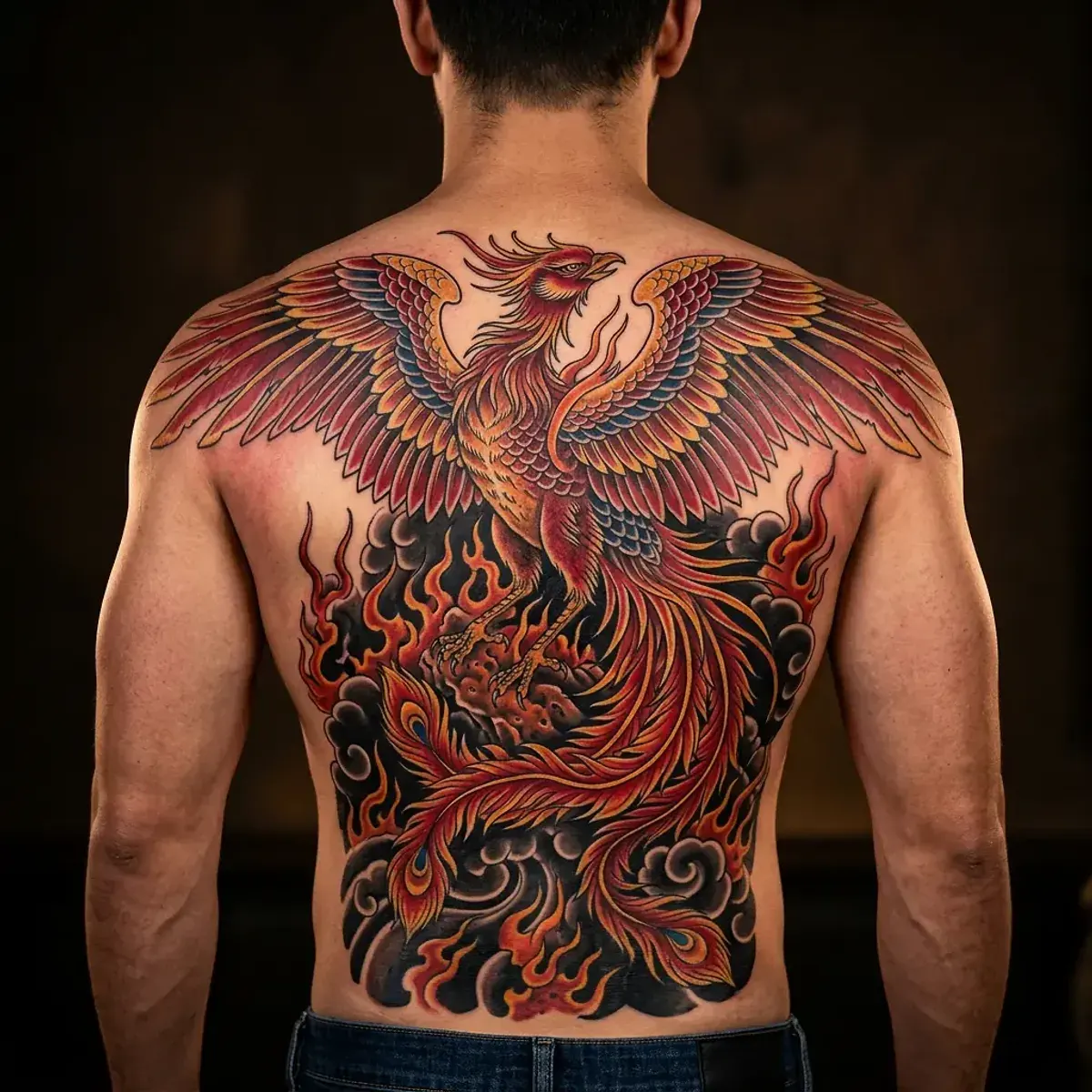
In Japanese culture, the Hōō (or Fenghuang adopted into Japanese tradition) is an auspicious bird that appears only in times of peace and prosperity under a virtuous ruler. It is associated with the sun, justice, obedience, and fidelity. In irezumi, the phoenix is one of the most magnificent subjects, rendered with blazing feathers in red, orange, and gold.
In Native American traditions, the Thunderbird — while distinct from the phoenix — shares many of its characteristics: a great bird associated with fire, power, and cosmic renewal. The Lakota Wakinyan and other Thunderbird figures carry echoes of the phoenix archetype.
In Alchemical symbolism, the phoenix represents the final stage of the magnum opus — the Great Work. The philosopher’s stone was thought to grant immortality, and the phoenix was its living symbol. Rising from ash, the phoenix embodies the alchemical principle of transformation through destruction.
Phoenix Tattoo Styles
Japanese (irezumi) style produces some of the most breathtaking phoenix tattoos in existence. The traditional Japanese phoenix features elaborate, feather-scale detailing, dramatic flame elements, and compositions that flow naturally across large areas of skin. The color palette — deep reds, oranges, golds, and accents of blue and green — makes these tattoos visually stunning.
Watercolor phoenix tattoos capture the fire and incandescence of the bird beautifully. Flowing washes of orange, red, and yellow that blur at the edges suggest the heat and light of transformation without the constraints of a hard outline.
Neo-traditional phoenix tattoos combine bold outlines with rich color and decorative feather detailing, creating designs with both classical tattoo energy and contemporary artistic flair.
Geometric phoenix tattoos abstract the bird’s form into crystalline, angular patterns — fire reimagined as mathematics, transformation rendered as sacred geometry.
Blackwork phoenix tattoos use the contrast of heavy black ink against skin to create dramatic silhouettes, often with highly detailed feather patterns in negative space.
Popular Placements
The back is the preeminent placement for a phoenix tattoo, allowing the wings to spread across the full canvas in all their glory. An upper back phoenix with wings spanning from shoulder to shoulder is one of tattooing’s most spectacular compositions.
The chest creates a powerful composition where the phoenix rises from the solar plexus toward the throat — the path of energy upward, from base to crown.
The thigh offers a large, private canvas for detailed phoenix work.
A spine phoenix — the bird’s body aligned with the spine, wings spread to either side — creates an extraordinarily powerful and symbolic design where the bird rises literally from the core of the body.
Combinations and Associations
A phoenix and dragon together is the supreme combination in East Asian iconography — fire and water, feminine and masculine, destruction and creation in perfect balance.
The phoenix combined with lotus creates a composition of profound beauty and meaning: two symbols of emergence from adversity, growth from the dark toward the light.
Pairing a phoenix with a butterfly explores transformation at two scales — the intimate metamorphosis of the butterfly and the cosmic conflagration of the phoenix — creating a meditation on change at every level of existence.
Fire, ash, and skull elements combined with the phoenix create a full memento mori composition where death is not the end but the door.