Meaning of the Angel Tattoo
The angel tattoo carries profound significance as one of the most symbolically charged motifs in tattoo art. Messenger between heaven and earth, the angel embodies divine protection, spirituality, and the hope of celestial guidance through life’s journey.
Angels represent first and foremost protection. The guardian angel, present in Christian, Jewish, and Islamic traditions, watches over individuals and guides them through trials. Getting an angel tattoo means carrying a permanent reminder of this protective presence on your skin.
The angel tattoo also symbolizes grief and remembrance. Many people choose an angel to honor a departed loved one, transforming the tattoo into an intimate memorial. The angel becomes the keeper of memory, a visible link between the world of the living and those who have passed.
On a personal level, the angel embodies purity, innocence, and the quest for spiritual perfection. It serves as a reminder of the luminous part that exists within everyone and the aspiration to rise above daily struggles.
The fallen angel theme explores rebellion, the fall from grace, and the complexity of human nature torn between good and evil. This duality makes angel tattoos remarkably versatile in their meaning.
Origins and History
Angels appear across the three major Abrahamic religions. In Christianity, the archangels Michael, Gabriel, and Raphael hold prominent roles. Michael is the celestial warrior, Gabriel the divine messenger, and Raphael the healer of souls.
In Renaissance art, angels became central subjects of painting. Raphael’s cherubs from the Sistine Madonna (1512) remain among the most recognizable depictions ever created. Michelangelo painted powerful, muscular angels across the ceiling of the Sistine Chapel.
The tradition of putti (chubby winged children) dates back to Greco-Roman antiquity, where winged loves (Eros/Cupid) symbolized divine love. This iconography merged with Christian cherubim over the centuries to create the familiar image we know today.
In Persian mythology, the Amesha Spentas are celestial beings closely related to the concept of archangels. In the Islamic tradition, angels (Malaika) are creatures of pure light, with Jibril (Gabriel) being the most significant.
Popular Styles
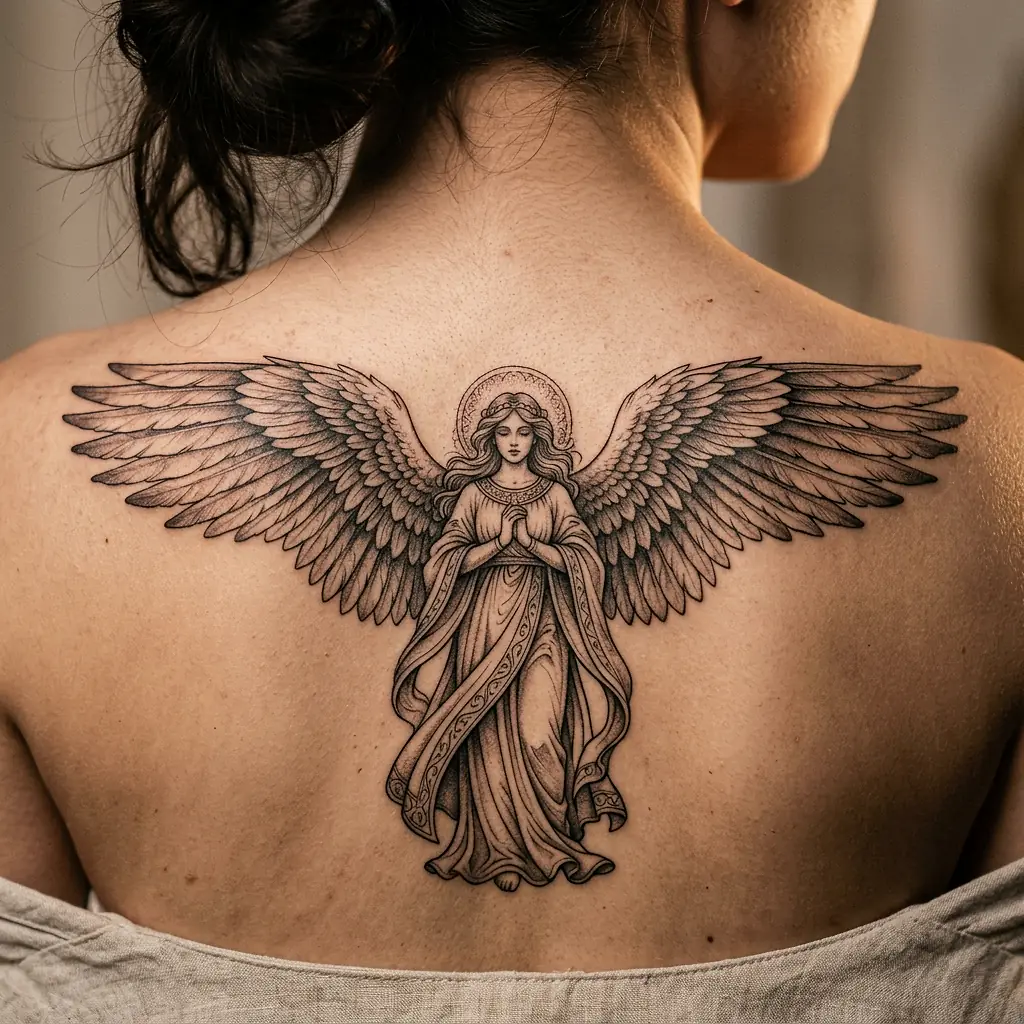
Realism in black and grey is the most sought-after style for angel tattoos. It allows for remarkable reproduction of feather textures, flowing fabric, and facial expressions with striking precision.
Neo-traditional offers expressive angels with bold outlines and vibrant colors, bringing a contemporary touch to classical imagery.
The Chicano style has developed its own distinct aesthetic around angels, often associated with the Virgin of Guadalupe, prayers, and Latino-American cultural heritage.
Blackwork and dotwork create mystical angels with captivating silhouettes. The Renaissance style directly reproduces classical paintings, transforming skin into a master’s canvas. Minimalist line work reduces the angel to a few essential strokes: a winged silhouette, a halo, or simple outlined wings.
Recommended Placements
The back is the iconic placement for an angel with outstretched wings, offering the largest surface for detailed work. A full-back angel is a truly spectacular piece.
The forearm suits praying angels, cherubs, or vertical compositions. The bicep and shoulder accommodate medium-sized angels with room for detail.
The chest allows for a symmetrical angel, often in a praying position. The calf and thigh provide space for complex scenes with background elements.
The wrist or behind the ear are perfect for small minimalist angels, a simple halo, or a simplified silhouette.
Combinations and Associations
An angel paired with a cross reinforces the spiritual and religious dimension of the design. Clouds and rays of light complete the celestial scene.
With feathers detaching from the wings, the tattoo evokes freedom and lightness. Roses surrounding the angel add a note of beauty and love.
An angel holding a clock or hourglass symbolizes the passing of time and mortality. Adding a name or date transforms the angel into a personal memorial for a cherished soul who has departed.
The angel and demon duality (half angel, half demon) is a classic composition that explores the complexity of human nature, caught between light and shadow.