Dragon Tattoo Meaning
The dragon stands apart from all other tattoo symbols in one fundamental way: it is the only major symbol that appears independently in both Eastern and Western mythology, yet means almost opposite things in each tradition. This extraordinary duality makes the dragon one of the richest and most complex symbols available for a tattoo.
In Eastern traditions — particularly Chinese, Japanese, Korean, and Vietnamese — the dragon is a benevolent divine being associated with wisdom, cosmic power, water, the sky, imperial authority, and extraordinary good fortune. The Chinese dragon (long) has no wings but flies through the sky by sheer divine power. It controls rain, rivers, and the sea. It is the patron of emperors and the guardian of treasures.
In Western traditions, the dragon is typically a fearsome adversary — a creature of fire and destruction that the hero must overcome. Saint George slaying the dragon, Beowulf fighting the fire-breathing monster, Siegfried killing Fafnir — the Western dragon represents the chaos, greed, and primal destructive force that the civilizing hero must conquer.
Contemporary tattoo culture draws primarily on the Eastern interpretation, choosing the dragon as a symbol of immense power, wisdom, and the cosmic forces that protect and guide. A dragon tattoo declares: I carry the power of ancient, primal forces. I have wisdom beyond ordinary sight. I am protected by something greater than myself.
The dragon also represents transformation and the mastery of inner power. To “tame the dragon” within — to harness one’s most powerful, potentially destructive energies and direct them toward creation rather than destruction — is a potent personal narrative. Many who choose dragon tattoos are honoring their own inner intensity and their work to channel it powerfully.
Longevity and immortality are associated with dragons in Chinese and Japanese tradition. Dragons are creatures of great age — some traditions describe them as eternal — and wearing a dragon tattoo can be an aspiration toward the wisdom that comes with age and the transcendence of ordinary mortal limitations.
Origins and History of the Dragon Symbol
Dragons appear in the earliest written records of virtually every major civilization. This has led to speculation about whether ancient humans encountered real animals — large serpents, crocodiles, komodo dragons, or even dinosaur fossils — that inspired dragon mythology. Whatever the origin, the dragon has been one of humanity’s most powerful symbolic creatures for at least 5,000 years.
In ancient Mesopotamia, the mushushu — a serpentine creature with forelegs and a horned head — decorated the walls of the Ishtar Gate of Babylon. The primordial monster Tiamat, slain by the god Marduk in the Babylonian creation myth, was a great dragon of chaos whose body became the world.
In ancient China, the earliest dragon images date to the Neolithic period (around 5000 BCE). The Hongshan culture (4700-2900 BCE) produced jade dragon artifacts that are among the most beautiful early dragon images. Chinese dragons were so central to imperial symbolism that the emperor’s throne was called the “Dragon Throne” and his robes were covered with dragon motifs.
In ancient Egypt, the great serpent Apep (Apophis) was the embodiment of chaos that the sun god Ra had to defeat each night before rising. This cosmic serpent/dragon represented the dark, formless void that threatened to overwhelm divine order.
The Dragon in Different Cultures
In Chinese culture, the dragon (long) is the supreme symbol of imperial power and divine authority. The five-clawed dragon was reserved exclusively for the emperor — nobles and officials had to use four-clawed or three-clawed dragons. The dragon controls water and weather, and prayers for rain were addressed to the dragon kings (long wang) who ruled rivers, lakes, and seas.
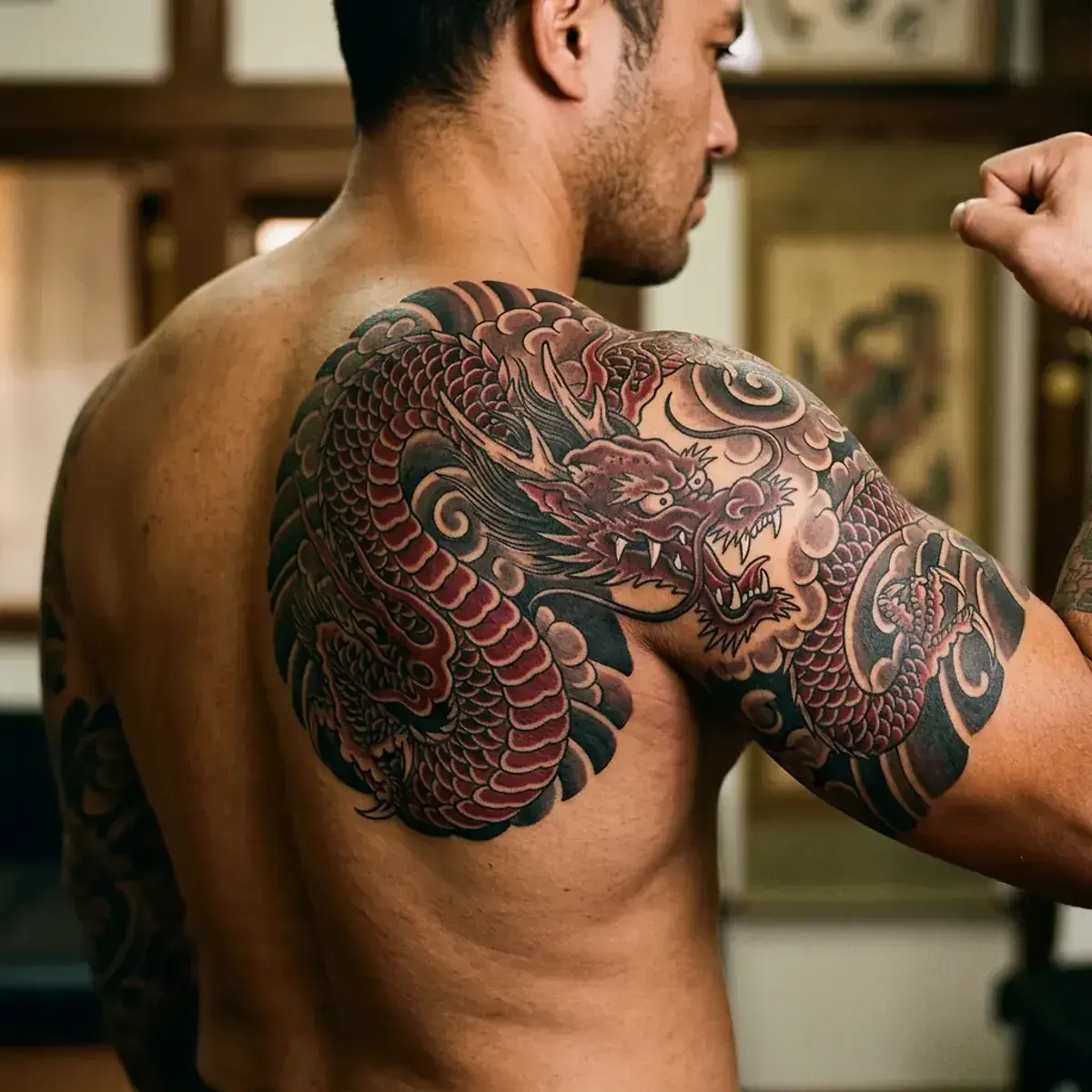
In Japanese tattooing (irezumi), the dragon (ryu) is one of the most important subjects. Japanese dragons are typically depicted as long, sinuous creatures with three-clawed feet, flowing whiskers, and often dramatic mouths. They are associated with wisdom, strength, and the sea. Japanese dragon tattoos typically incorporate cloud and wave backgrounds in dynamic, flowing compositions.
In Norse mythology, the dragon Níðhöggr gnaws eternally at the roots of Yggdrasil, the world tree. Fáfnir — a dwarf who transformed into a dragon through greed — was slain by the hero Sigurd, whose bathing in Fáfnir’s blood made him invulnerable.
In Medieval European tradition, the dragon was the supreme adversary — simultaneously terrifying and magnificent. Dragon slayers (St. George, St. Michael, Perseus) became heroes through their conquest of these primal forces of chaos and destruction.
Dragon Tattoo Styles
Japanese (irezumi) style creates some of tattooing’s most spectacular dragon compositions — the dragon flowing across a back or wrapping around an arm, surrounded by waves, clouds, and cherry blossoms, rendered in the classic Japanese palette of deep reds, blues, and blacks. This style’s dynamic energy and dramatic composition are unmatched for dragon subjects.
Chinese dragon designs emphasize the long, sinuous body — longer and more serpentine than Japanese dragons, often depicted among clouds and flames.
Western dragon designs feature wings, four legs, and a fire-breathing posture — more lizard-like and confrontational.
Geometric dragon tattoos deconstruct the ancient creature into crystalline, angular forms — a powerful combination of primal mythology and mathematical precision.
Tribal and Polynesian dragon designs use bold, graphic patterns to suggest the dragon form through cultural aesthetic frameworks.
Popular Placements
The full back is the ultimate placement for a dragon tattoo — a large-scale Japanese-style dragon covering the entire back is one of tattooing’s most ambitious and magnificent compositions.
The arm and sleeve work beautifully with the dragon’s serpentine body wrapping around the limb from wrist to shoulder.
The rib cage suits dragons in side-view profile, particularly Japanese-style compositions with wave backgrounds.
The chest and shoulder work well for dragon faces or heads combined with wing compositions.
Combinations and Associations
A dragon and phoenix together is the greatest pairing in East Asian symbolism — the celestial bird and the water dragon, feminine and masculine, fire and water, heaven and earth in perfect balance.
A dragon and tiger represents two supreme predators in dynamic opposition — one of the most powerful animal pairings in Japanese irezumi tradition.
A dragon coiled around a sword or emerging from a skull creates dramatic Western-mythology compositions of great visual power.
A snake and dragon together — two serpentine beings of different scales — creates a composition about the relationship between primal earth energy and cosmic power.