Mandala Tattoo Meaning
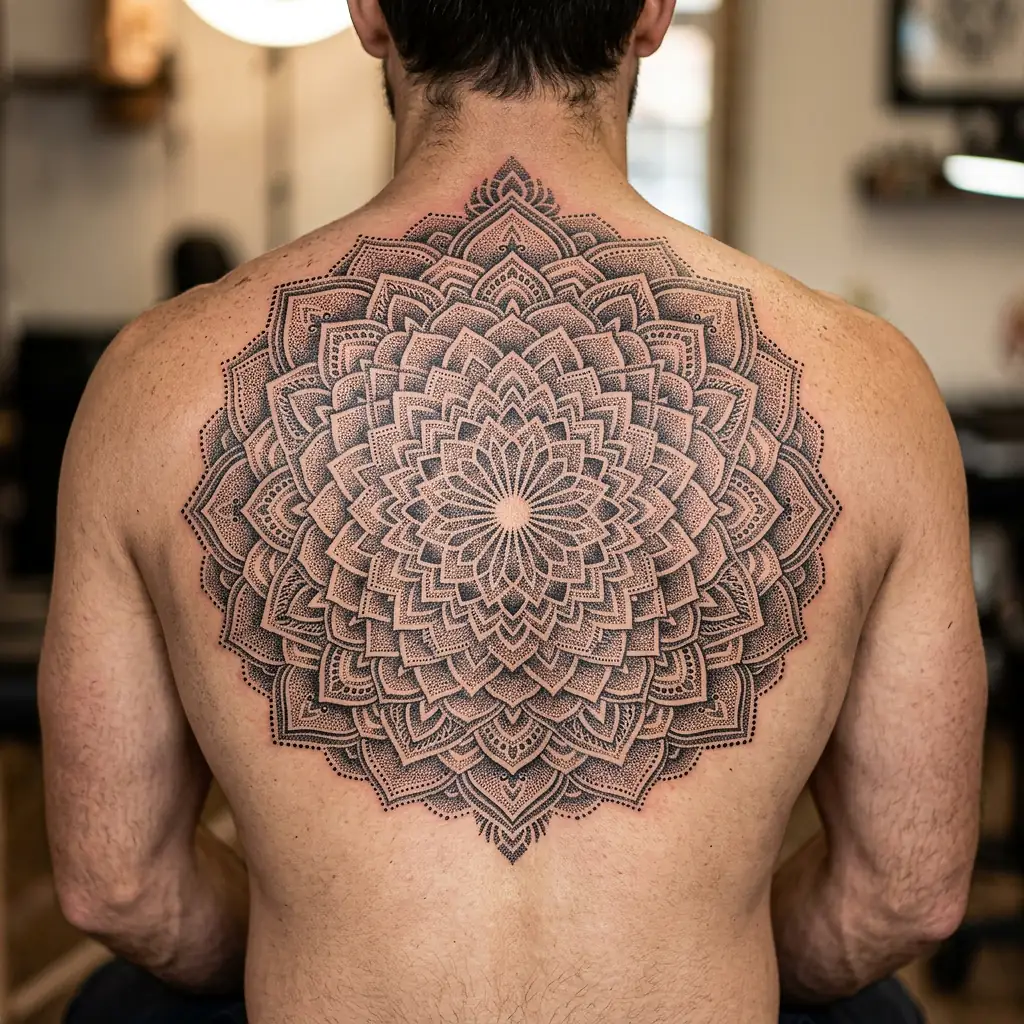
The mandala is perhaps the most geometrically perfect symbol in the human symbolic vocabulary. A circle divided and filled with concentric layers of precise geometric patterns, the mandala simultaneously represents the universe in its totality, the self at its center, and the perfect order underlying apparent chaos. As a tattoo, it is a declaration of faith in pattern, in beauty, and in the possibility of harmony.
The word mandala comes from Sanskrit and simply means “circle.” But the mandala is far more than a circle — it is a cosmogram, a map of the universe that organizes reality into a comprehensible, beautiful whole. At its center is a point (bindu) representing the individual self or the divine seed of creation. Radiating outward are concentric layers of geometric and floral patterns representing the expanding circles of reality: self, family, community, world, cosmos.
A mandala tattoo speaks to the wearer’s relationship with balance and wholeness. The mandala’s perfect symmetry — every element mirrored precisely across multiple axes — represents the balance between opposites that spiritual traditions across cultures describe as the foundation of wellbeing: masculine and feminine, light and dark, expansion and contraction, individual and collective.
The mandala also represents the meditative mind. Creating a mandala — whether painted, drawn, or tattooed — is itself a meditative practice. The process of creating and honoring precise geometric patterns is a form of focused attention that quiets the mind and opens the practitioner to deeper states of awareness. Many people who choose mandala tattoos are drawn not just to the final image but to the sacred geometry tradition from which it comes.
Impermanence is another dimension of mandala symbolism, particularly in the Tibetan Buddhist tradition where sand mandalas — created over weeks with extraordinary care — are ritually destroyed upon completion. The act of creating something perfect and then releasing it teaches detachment and the appreciation of beauty in the present moment. A permanent mandala tattoo can be seen as either the opposite of this teaching or as a daily reminder of it.
Origins and History of the Mandala Symbol
The mandala as a formal sacred art form emerged primarily in Hindu and Buddhist India beginning around 2000 BCE. The earliest mandalas appear in Vedic fire altars (agni), where the ritual space was carefully organized into geometric sections representing cosmic order.
In Buddhist tradition, mandalas became elaborately developed ritual objects beginning in the 4th century CE. The great Indian Buddhist universities — particularly Nalanda — produced extraordinarily sophisticated mandala traditions that were carried to Tibet, China, Japan, and Southeast Asia along the Silk Road.
Tibetan Buddhism developed the most elaborate mandala tradition in the world. The Kalachakra mandala — the “Wheel of Time” — requires weeks to create from colored sand and represents the entire Buddhist cosmology in precise symbolic detail. Fourteen Dalai Lamas have presided over its creation and ritual dissolution.
In the Western tradition, Carl Jung brought mandalas to psychological significance in the early 20th century. Jung observed that patients in deep psychological work spontaneously drew circular geometric patterns similar to mandalas, and he concluded that the mandala was a universal symbol of the psyche’s movement toward wholeness and integration.
The Mandala in Different Cultures
In Hinduism, the yantra is the Hindu equivalent of the Buddhist mandala — a geometric diagram used as a meditation object and a representation of a deity’s cosmic form. The Sri Yantra, with its nine interlocking triangles radiating from a central point, is one of the most revered symbols in all of Hindu tradition.
In Buddhism, different mandalas represent different Buddha fields — entire spiritual universes presided over by a central Buddha figure. These mandalas serve as both meditation supports and as maps of the path to enlightenment.
In Aztec culture, the famous Aztec Sun Stone (often called the Aztec calendar) is a massive mandala representing the cosmos, with the sun god Tonatiuh at the center and concentric rings representing different aspects of cosmic time.
In Islamic art, the geometric arabesque patterns that cover the surfaces of mosques and sacred objects are essentially non-figurative mandalas — expressions of divine order through mathematical beauty, created by artists who believed that imitating the geometry of creation was a form of worship.
In Celtic art, the interlocking knotwork patterns of the Book of Kells and similar manuscripts create mandala-like compositions through the infinite braiding of continuous lines — another tradition of sacred geometry with mathematical and spiritual depth.
Mandala Tattoo Styles
Dotwork is the most respected and common style for mandala tattoos. The technique of building form and tone through thousands of individually placed dots has a meditative quality that mirrors the mandala’s spiritual significance. The finest dotwork mandalas are works of extraordinary craft.
Fine-line geometric mandalas with crisp, clean linework create mathematically precise compositions with an almost architectural quality.
Blackwork mandalas with solid fills and heavy outlines create high-contrast, graphic compositions that are bold and visually powerful.
Color mandalas often use selective color to highlight specific layers or petals — deep blues and purples for the outer rings, warm golds for the center, creating a sense of depth and luminosity.
Popular Placements
The upper back and full back are the most majestic placements for large mandala tattoos — the body’s largest canvas allowing the full geometric complexity to unfold.
The chest and sternum create powerful placements where the mandala radiates outward from the heart center.
The shoulder and upper arm are popular for medium-sized mandalas that wrap the joint and upper arm in a way that feels naturally integrated with the body’s form.
The thigh provides a private canvas for large, detailed work.
Small mandalas on the wrist, ankle, or behind the ear create elegant, intimate designs that carry the symbol’s full meaning at a modest scale.
Combinations and Associations
A lotus within a mandala is the most classic spiritual pairing — the individual flower of enlightenment within the cosmic map of existence.
An animal totem — particularly a lion, owl, or wolf — centered within a mandala frame creates a design where wild, primal energy is contained and elevated by cosmic order.
Combining mandala patterns with geometric shapes opens infinite possibilities for sacred geometry compositions where the mathematical and the spiritual merge.
A mandala designed around a specific cultural symbol — an Om, a cross, a Star of David — honors a specific tradition while using the universal mandala structure to express cosmic dimensions.