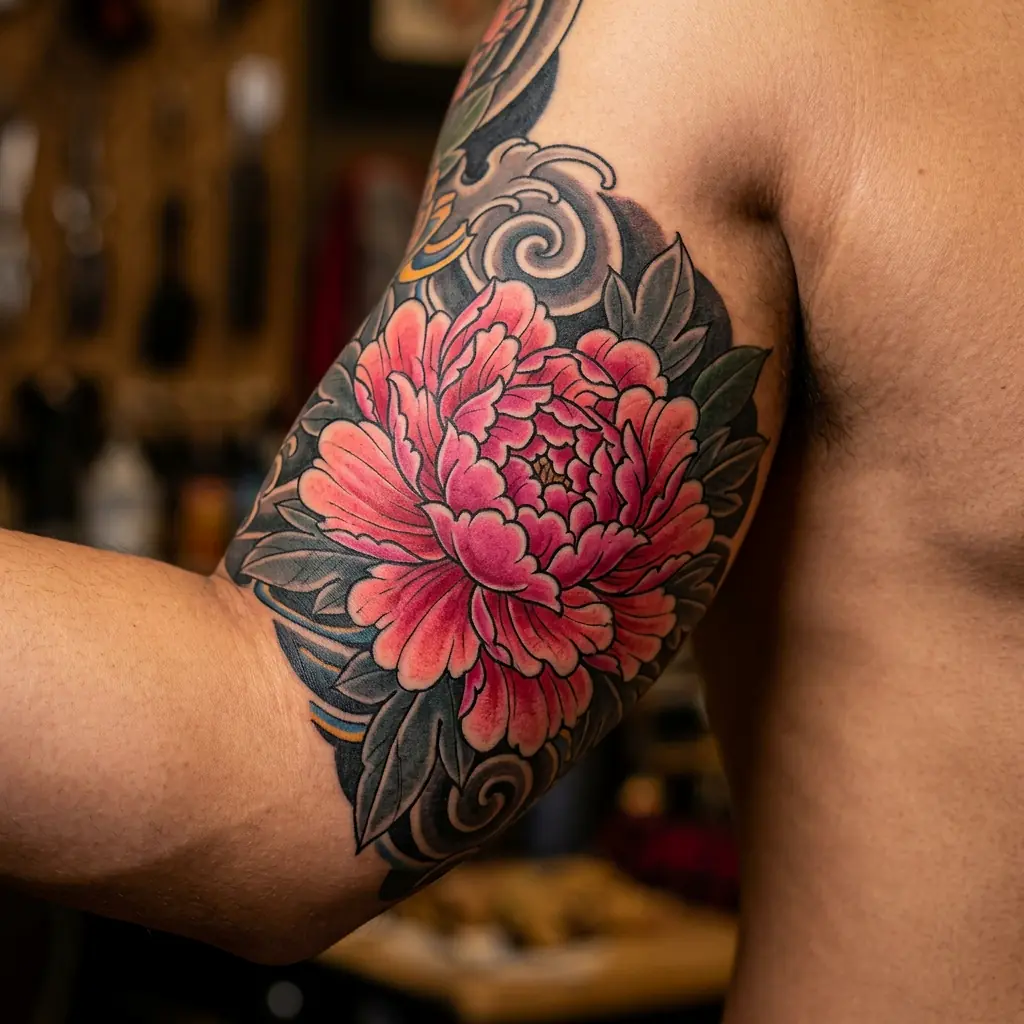
Meaning of the Peony Tattoo
The peony is one of the most prestigious flowers in tattoo art, carrying a weight of symbolism that few other blooms can match. At its core, the peony tattoo represents wealth, prosperity, beauty, and honor. It is a flower that communicates abundance and the fullness of life through its voluminous, layered petals.
In Japanese tattoo tradition (irezumi), the peony holds a particularly revered position. Known as botan, it symbolizes bravery, courage, and the bold pursuit of greatness. A warrior bearing a peony declares that he does not fear risk and embraces both beauty and danger. This paradox of outward softness and inner steel makes the peony one of the most philosophically rich tattoo motifs.
The peony also carries strong associations with feminine beauty and romance. A peony in full bloom represents a life lived fully, confidence, and self-assurance. Its colors shift the meaning: red peonies speak of passion and honor, pink of grace and gentleness, and white of purity and new beginnings.
In Chinese culture, the peony is known as the “king of flowers” and symbolizes nobility of spirit and material wealth. It is considered one of the most auspicious flowers, believed to attract fortune and elevate the status of those who display it.
Origins and History
The peony has been cultivated in China for over 2,000 years, where it achieved the status of unofficial national flower. During the Tang Dynasty (618-907), peonies were the favorite flower of the imperial court, and only nobility were permitted to grow them. The peony gardens of Luoyang were famous throughout the empire and attracted pilgrims from distant provinces.
In Japan, the peony was introduced from China in the 8th century and became a central motif in irezumi tattooing. Japanese artists paired the peony with powerful creatures, particularly the shishi (guardian lion), creating compositions that expressed the union of beauty and strength, grace and ferocity.
In Greek mythology, the peony is named after Paeon, physician to the gods of Olympus. According to legend, Paeon healed wounds using a peony root. When Asclepius grew jealous, Zeus transformed Paeon into a peony flower to protect him, giving the plant an association with healing and divine protection.
In medieval Europe, the peony was considered a magical plant capable of warding off evil spirits and protecting travelers through the night. Monks cultivated it in monastery gardens for both its beauty and its supposed protective properties.
Popular Styles
Japanese traditional (irezumi) is the natural home of the peony tattoo. Compositions are fluid and dynamic, with deep reds, pinks, and purples set against backgrounds of waves, clouds, or wind bars. The peony often fills large areas of skin in full-body or half-sleeve designs.
Neo-traditional builds on these foundations with finer gradients, more detailed petal work, and contemporary color combinations. The bold outlines remain, but the shading and depth are more nuanced.
Realism captures every fold and shadow of the peony’s petals with photographic precision. In color, the effect is stunning. In black and grey, the texture and depth become the focal point, creating dramatic, moody compositions.
Watercolor suits the peony beautifully, with colors bleeding and diffusing like fresh paint on silk. The soft edges complement the flower’s naturally layered structure. Minimalist and fine line approaches offer a contemporary take, reducing the peony to its essential contours.
Recommended Placements
The upper arm and shoulder are classic placements for a peony, providing enough canvas for detailed Japanese or neo-traditional work. A sleeve incorporating peonies alongside other Japanese elements is a bold and ambitious project.
The thigh offers generous space for a large peony in full bloom, with leaves and buds. The back, particularly the upper back, allows for monumental compositions in the irezumi tradition where the peony occupies a central position.
The ribs suit an elongated peony composition that follows the curve of the body, a placement that is both sensual and discreet. The sternum accommodates a symmetrical peony, often enhanced with ornamental details.
The forearm and calf are also excellent choices for medium-sized peonies that balance visibility with wearability.
Combinations and Associations
The peony pairs powerfully with a dragon, creating a contrast between raw power and refined beauty, strength and delicacy. This is one of the most classic combinations in Japanese tattoo art.
A tiger alongside peonies evokes warrior nobility and courage. The shishi (guardian lion) with peonies is a traditional pairing that symbolizes protection, prosperity, and the union of ferocity with grace.
Koi fish swimming among peonies represent perseverance and accomplishment. Combined with a lotus, the peony creates a dialogue between material wealth and spiritual awakening, bridging Eastern and Western floral symbolism.
Elements like waves, clouds, and maple leaves enrich the composition and anchor the peony within a cohesive Japanese aesthetic framework.