Meaning of the Om Tattoo
Om (also written Aum) is arguably the most spiritually significant symbol in the world, and as a tattoo it carries a depth of sacred meaning unmatched by almost any other motif. An Om tattoo represents the primordial vibration of the universe, cosmic unity, and spiritual awakening. It is the foundational sound from which all creation is said to have emerged.
Om is not merely a word: it is a vibration, a frequency, a fundamental resonance that underlies all existence. Getting an Om tattoo means carrying the symbol of creation itself on your skin, a permanent connection to the deepest layer of reality as understood in Eastern philosophy.
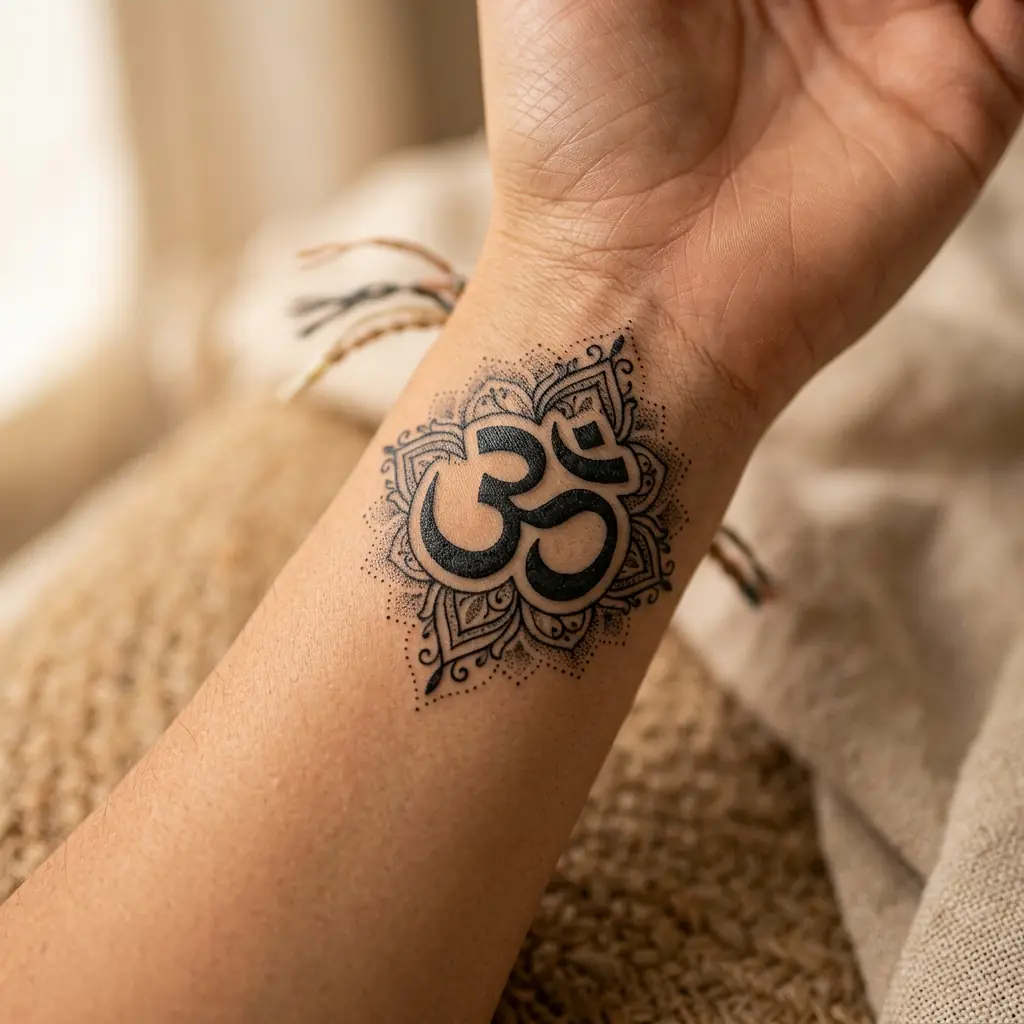
The Sanskrit grapheme for Om contains several elements, each carrying meaning. The lower curve represents the waking state (jagrat), the upper curve the dream state (swapna), and the curve between them the deep sleep state (sushupti). The dot (bindu) at the top symbolizes the fourth state (turiya), pure transcendent consciousness. The crescent beneath the dot represents the veil of maya (illusion) separating ordinary consciousness from enlightenment.
Om also embodies the Hindu trinity: Brahma (creation), Vishnu (preservation), and Shiva (destruction and transformation). It is a symbol of totality that encompasses past, present, and future in a single sacred syllable.
Origins and History
The earliest mentions of Om appear in the Upanishads, sacred Hindu texts composed between the 8th and 2nd centuries BCE. The Mandukya Upanishad is entirely devoted to the analysis of Om and its four sonic components (A-U-M and the silence that follows).
In Hinduism, Om opens and closes nearly every mantra, prayer, and sacred text. It is considered the sonic name of Brahman, ultimate reality, the absolute. Yogis practice Om meditation to reach higher states of consciousness, and the vibration is believed to align the practitioner with the cosmic frequency.
Buddhism adopted Om as a sacred syllable, most notably in the famous mantra om mani padme hum of Tibetan Buddhism, which invokes the compassion of the bodhisattva Avalokiteshvara. In Zen Buddhism, Om serves as a focal point for meditation.
Jainism considers Om the condensed form of the five salutations to enlightened beings. Sikhism uses the variant Ik Onkar (“Om is one”) as a symbol of the oneness of God, the opening phrase of the Guru Granth Sahib, the Sikh holy scripture.
Popular Styles
Traditional Sanskrit calligraphy is the most authentic approach, reproducing the Devanagari character with its classical curves and proportions. Black ink alone creates a powerful, timeless design.
Dotwork builds the Om through accumulated points, creating gradients and texture that evoke the sonic vibration of the mantra itself. Geometric style frames the symbol within sacred forms like the circle, triangle, or flower of life.
Ornamental style enriches the Om with traditional Indian motifs: paisley, mandala, henna patterns, and filigree. The result is a rich, decorative design that honors the artistic traditions of South Asia.
Minimalist offers a fine-line Om, sometimes reduced to its essential curves. Watercolor adds evocative color touches, often in purples (crown chakra) or blues (third eye chakra).
Recommended Placements
The wrist is a very popular placement for a small Om, offering a daily reminder of serenity and spiritual connection. The forearm allows a more elaborate design with decorative elements.
The nape of the neck is a spiritually meaningful placement, close to the crown chakra. The back, between the shoulder blades, hosts an Om integrated into a mandala or geometric composition.
The sternum, near the heart, is a symbolically powerful choice that connects the Om to the heart chakra (anahata). The ribs and side offer discreet, personal placements.
The shoulder and bicep are classic locations. It is worth noting that in some traditions, placing a sacred symbol below the waist is considered disrespectful.
Combinations and Associations
Om combines naturally with a lotus, creating the classic image of the sacred sound emerging from the flower of enlightenment. This pairing unites cosmic vibration with spiritual purity.
Integrated into a mandala, Om becomes the center of a meditative composition that amplifies its contemplative dimension. Mala beads (Buddhist prayer beads) framing the Om evoke the practice of mantra recitation.
Chakras arranged in a column with Om at the crown create a composition that maps the body’s energy centers. The flower of life or Sri Yantra add sacred geometry symbols.
Henna patterns and arabesques enrich the composition in a traditional Indian aesthetic, while brushstroke rendering in a calligraphic style brings a spontaneous, Zen quality.