Meaning of the Fleur-de-Lis Tattoo
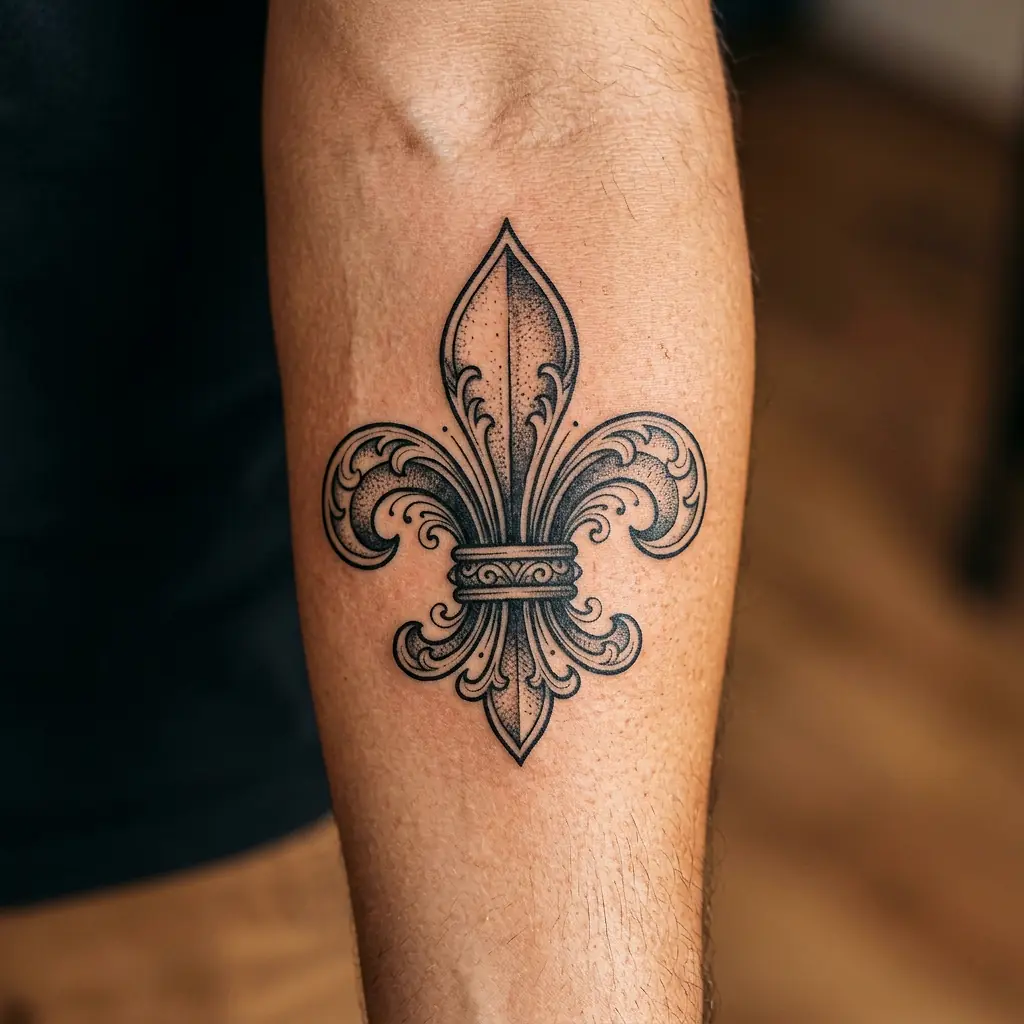
The fleur-de-lis is one of the most recognizable heraldic symbols in the world, and as a tattoo it carries centuries of accumulated meaning. A fleur-de-lis tattoo represents royalty, nobility, purity, and spiritual illumination. It is a motif that communicates authority, honor, and a sense of elevated purpose.
The fleur-de-lis is fundamentally a symbol of royal power and legitimate authority. As the emblem of the French monarchy for hundreds of years, it incarnates sovereignty, noble character, and the dignity of leadership. Choosing a fleur-de-lis tattoo declares a commitment to living with honor and integrity.
The symbol’s tripartite form carries deep meaning. Its three petals traditionally represent faith, wisdom, and chivalry, or in Christian interpretation, the Holy Trinity (Father, Son, and Holy Spirit). This triple structure makes the fleur-de-lis a symbol of spiritual completeness.
The fleur-de-lis also symbolizes purity and perfection. Its association with the white lily connects it to virtue and innocence. In Christian iconography, it frequently accompanies the Virgin Mary and the archangel Gabriel, representing divine grace.
It is equally a symbol of light and illumination. The word “lis” shares an etymological root with “light” in Old French. The fleur-de-lis points heavenward, evoking aspiration toward the divine and spiritual elevation.
Origins and History
The exact origin of the fleur-de-lis is debated among historians. Some trace it back to antiquity, where similar motifs appear in Mesopotamian, Egyptian, and Mycenaean art. The symbol may derive from a stylized iris or lily.
The most famous legend attributes the adoption of the fleur-de-lis to King Clovis I (5th century). According to tradition, at his baptism an angel presented Clovis with a golden lily as a sign of divine protection, replacing the three toads on his coat of arms with three fleurs-de-lis.
The fleur-de-lis became the official emblem of the French monarchy under Louis VII in the 12th century. It adorned royal coats of arms, cathedrals, and official documents for centuries. The French Revolution attempted to erase the symbol, but it survived in collective memory and continues to inspire.
Beyond France, the fleur-de-lis was adopted by numerous European royal houses, by the city of Florence in Italy, and by Quebec, where it appears on the provincial flag as a symbol of French heritage. It also serves as the emblem of the Scouting movement worldwide, where it represents the cardinal directions and moral compass.
Popular Styles
Heraldic style is the most classic approach, reproducing the fleur-de-lis as it appears on coats of arms and royal emblems. The lines are clean, the symmetry perfect, and the rendering immediately recognizable.
Blackwork offers a modern, powerful version with dense black fill and graphic lines. Geometric style deconstructs the motif into pure forms, creating a contemporary design that retains the symbol’s essential structure.
Neo-traditional enriches the fleur-de-lis with gradients, shadows, and ornamental details, adding depth and dimension. Ornamental style surrounds it with filigree, arabesques, and baroque patterns.
Dotwork provides unique texture through stippling, particularly effective for gradients and shadows. Minimalist offers a fine-line fleur-de-lis, stripped down and elegant.
Recommended Placements
The arm and forearm are the most popular placements, offering good visibility and a surface well-suited to the motif’s symmetry. The bicep is a classic location that evokes strength.
The nape of the neck hosts a centered, symmetrical fleur-de-lis, revealed when hair is lifted. The back, between the shoulder blades, allows for a large, imposing design.
The sternum is a bold choice for a perfectly centered fleur-de-lis. The wrist and ankle suit smaller, more discreet versions.
The calf and thigh provide generous surfaces for compositions that integrate the fleur-de-lis within a broader heraldic framework.
Combinations and Associations
The fleur-de-lis combines naturally with a crown, reinforcing royal symbolism and creating a complete heraldic composition. A shield framing the fleur-de-lis gives a medieval, noble aesthetic.
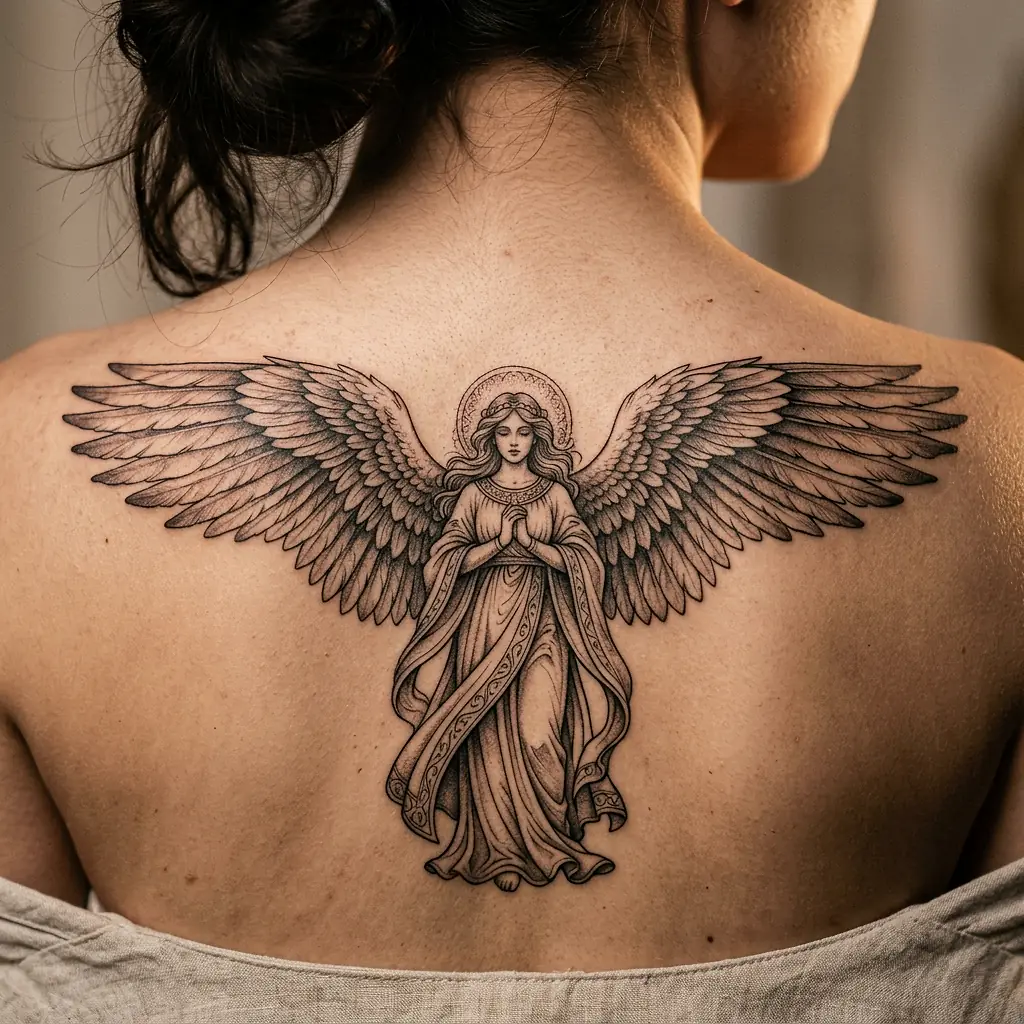
Paired with a cross, the fleur-de-lis takes on strong spiritual significance, uniting Christian faith with noble character. Wings on either side evoke angelic protection.
Ornamental elements like scrollwork, acanthus leaves, and ribbons enrich the composition in a baroque style. Chains or armor reinforce the chivalric dimension.
The fleur-de-lis can also be placed within a Quebec or Scouting context, where each community brings its own meanings of cultural pride and moral values.