Meaning of the Fire Tattoo
The fire tattoo is one of the most primal and powerful symbols in body art. Fire speaks to something deeply human: it is the first element our ancestors mastered, the force that separated humanity from every other species on the planet. As a tattoo, fire carries meanings of passion, transformation, destruction and renewal, and the vital energy that drives life itself.
At its core, fire represents transformation through destruction. Fire does not preserve what it touches. It breaks matter down into its most basic elements, releasing energy and light in the process. For this reason, a fire tattoo is often chosen by people who have been through a profound personal transformation, who have watched parts of their old life burn away and emerged on the other side fundamentally changed.
Fire also symbolizes passion in all its forms. We speak of burning desire, of being on fire with enthusiasm, of carrying a flame for someone. The fire tattoo captures this intensity, representing an inner drive that refuses to be extinguished by circumstance or opposition.
The element of fire carries a dual nature that makes it particularly rich as a tattoo symbol. Fire warms, but it also burns. It illuminates, but it also blinds. It cooks food, and it destroys forests. A person who chooses fire as their tattoo often resonates with this duality, acknowledging that their greatest strengths and their greatest dangers come from the same source.
Purification is another core meaning. Fire has been used in purification rituals across virtually every culture on Earth. Burning sage, walking over hot coals, lighting funeral pyres: all of these practices use fire to cleanse, to release, and to transform the impure into the pure.
Origins and History
The control of fire, roughly 400,000 years ago, stands as one of the defining moments in human evolution. Fire enabled cooking (which dramatically expanded brain development), protection from predators, warmth in cold climates, and the social gathering that became the foundation of culture itself. Fire was, in many ways, the first technology.
In Greek mythology, Prometheus stole fire from the gods of Mount Olympus and gave it to humanity. This act of rebellion symbolizes knowledge, civilization, and freedom, but also the price of transgression. Zeus punished Prometheus by chaining him to a rock where an eagle ate his liver daily, only for it to regenerate each night. The Promethean fire represents enlightenment that comes at a cost.
In Zoroastrianism, fire is the central sacred symbol. It represents divine truth (Asha) and the light that combats darkness. Fire temples have maintained uninterrupted flames for centuries, tended by priests as an act of devotion.
In Hindu tradition, Agni is the god of fire and the messenger between humans and gods. The sacrificial fire (yajna) is the vehicle through which offerings reach the divine realm. The cremation fire releases the soul from the cycle of rebirth.
Celtic traditions celebrated Beltane, the May fire festival, with great purifying bonfires. Fire marked the transition between seasons, protected livestock, and symbolized the return of the sun’s warmth.
In alchemy, fire was one of the four classical elements and represented the transformative process itself. The alchemist’s furnace (athanor) was where base metals were supposedly transmuted into gold, making fire the agent of ultimate transformation.
Popular Styles
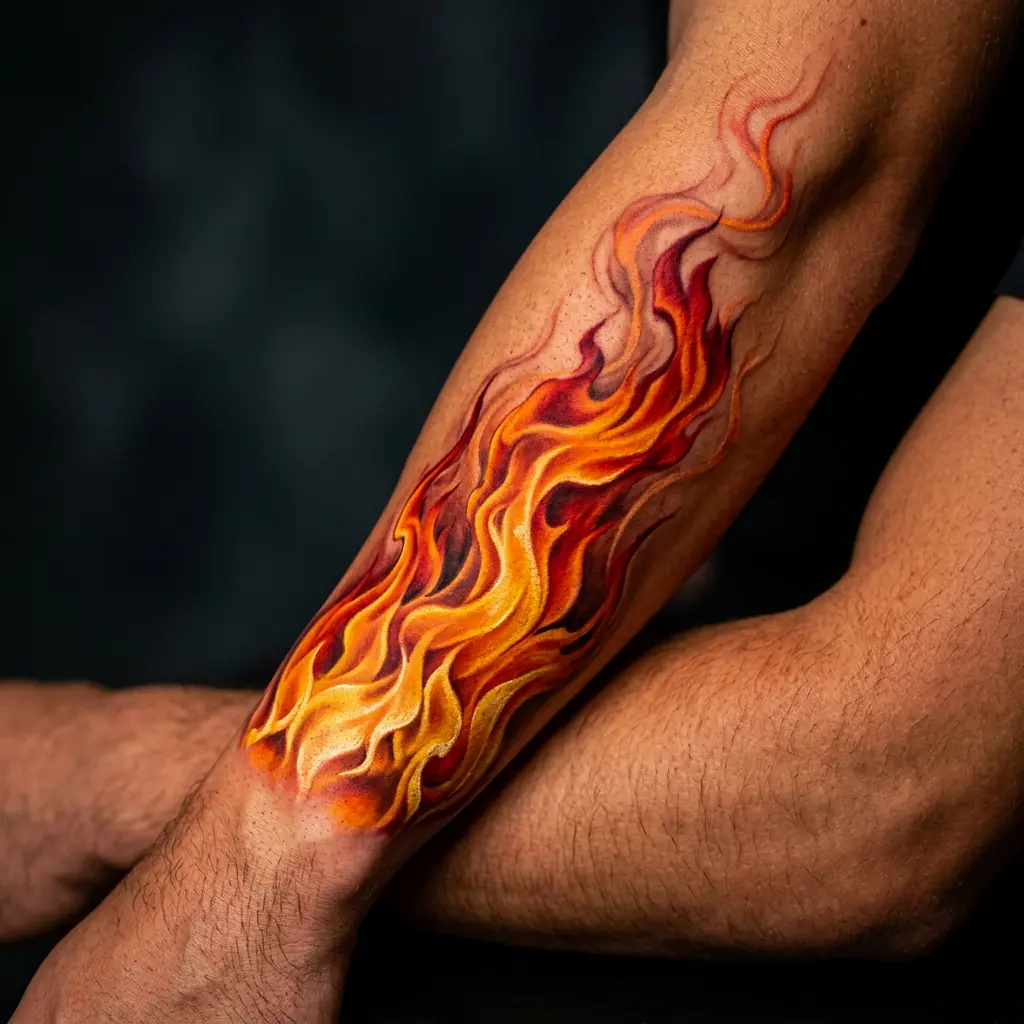
Realistic fire tattoos are the most visually striking approach, capturing the fluid movement of flames with gradients of yellow, orange, red, and deep blue at the base. Skilled artists create an almost three-dimensional effect, with highlights that seem to glow on the skin.
Japanese style (irezumi) incorporates fire into elaborate compositions with dragons or phoenixes. Japanese flames have a distinctive curling, stylized form that spirals with elegant precision, often filling backgrounds in full sleeve designs.
Blackwork flames use solid black ink for a graphic, high-contrast effect. This style strips fire down to its essential shape, creating bold, powerful designs that rely on form rather than color for their impact.
Neo-traditional fire combines thick outlines with vivid colors for stylized, impactful flames. Tribal styles transform fire into abstract patterns with sharp geometric lines, drawing from Polynesian and Maori traditions where fire symbolized ancestral connection.
Watercolor fire tattoos use loose, flowing brushstrokes of warm tones that bleed into each other, creating an impressionistic take on flames that feels dynamic and artistic.
Recommended Placements
The ribs and side are exceptional placements for fire tattoos. The vertical space allows flames to rise naturally along the body’s contour, creating an organic flow that enhances the design’s movement.
The forearm accommodates a flame sleeve that wraps around the arm, visible and dynamic. The calf provides an ideal surface for flames that appear to lick upward along the leg.
The back is the canvas of choice for the most ambitious fire compositions, where flames can spread across a wide, detailed area. Shoulders and upper arms work well for flames that frame other central motifs.
For a more subtle approach, a small wrist or ankle flame carries personal meaning without commanding attention.
Combinations and Associations
Fire and the phoenix form one of tattooing’s most powerful combinations. The mythical bird rising from flames reinforces the message of transformation and resilience, creating a composition rich with meaning.
Fire and water together represent elemental duality: passion and serenity, destruction and creation, chaos and calm. This contrast is visually compelling and philosophically rich.
Fire combined with a skull speaks to mortality and the intensity of a life fully lived. A flaming heart symbolizes passionate, consuming love. Flames surrounding a sun amplify the symbolism of power and vital energy.
Adding embers and ash beneath flames reminds the viewer that everything consumed eventually nourishes something new, in a perpetual cycle of ending and renewal.