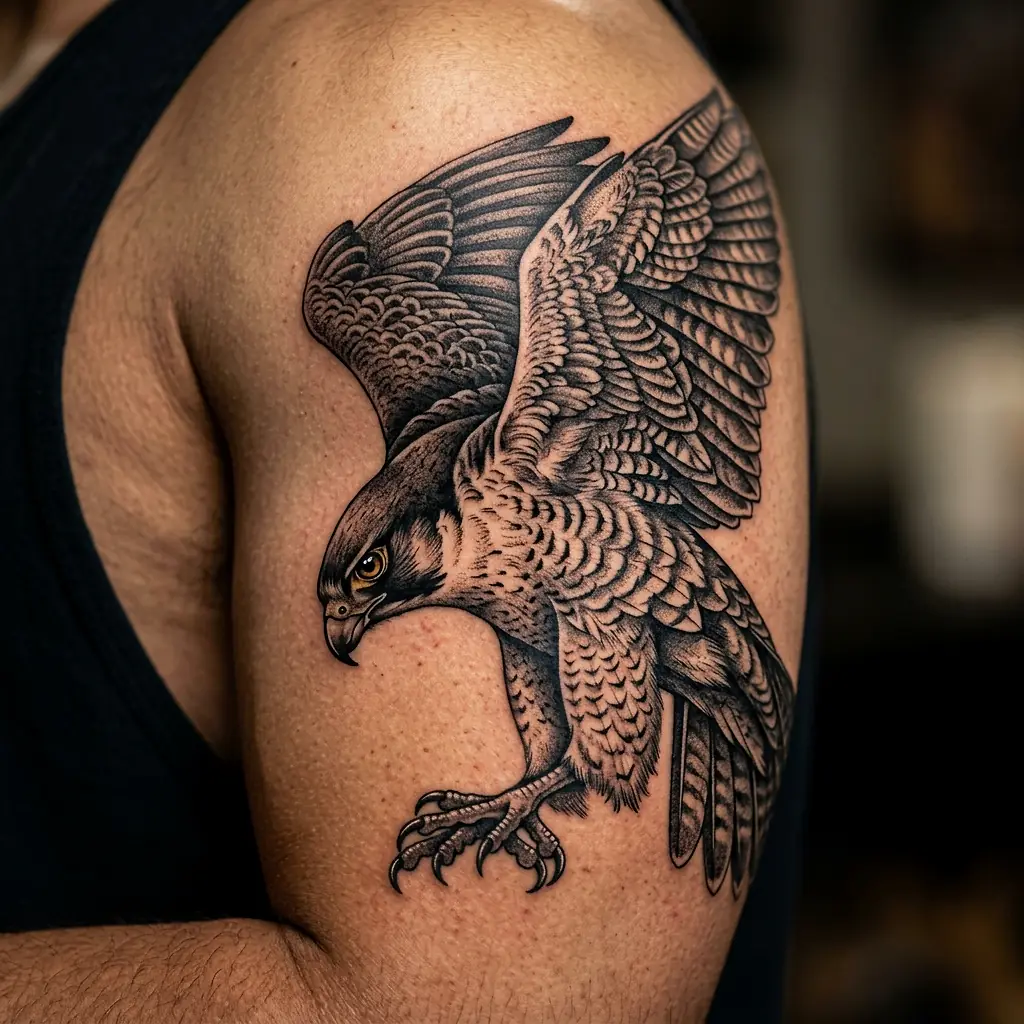
Meaning of the Falcon Tattoo
The peregrine falcon is the fastest animal on Earth, reaching speeds exceeding 300 km/h in its hunting dive. As a tattoo, it carries a powerful message of vision, precision, and noble authority. The falcon does not hesitate, does not second-guess; it identifies its target and commits with absolute focus.
A falcon tattoo represents clarity of sight and purpose. With eyesight eight times sharper than a human’s, the falcon perceives what others cannot. It symbolizes the ability to see through deception, to maintain a high perspective on life, and to cut through confusion with decisive action.
The falcon also embodies aristocratic honor. Falconry was the sport of kings, reserved for nobility and sovereigns across civilizations. A falcon perched on a gloved fist represented power tempered by intelligence, raw strength refined by discipline.
Origins and History
In ancient Egypt, the falcon held the highest position in the animal pantheon. Horus, the falcon god, was the protector of the pharaohs and the symbol of royal authority. The Eye of Horus (wedjat) remains one of history’s most powerful protective amulets, representing healing, protection, and spiritual vision.
In Arab tradition, the falcon is the noblest of birds. Falconry, practiced for millennia in the Gulf region, is inscribed on UNESCO’s list of Intangible Cultural Heritage. The falcon appears on the coat of arms of numerous Arab nations and symbolizes courage, freedom, and tribal honor.
Native American peoples regarded the falcon as a messenger between the living world and the spirit realm. Shamans wore falcon feathers to enhance their inner vision and facilitate spiritual journeys. The falcon served as a totem animal linked to keen perception and higher awareness.
In Norse mythology, the goddess Freyja possessed a cloak of falcon feathers that allowed her to fly between worlds. The falcon was associated with wisdom, magic, and the ability to transcend ordinary limitations.
Popular Styles
Realism is particularly stunning for the falcon. The intricacy of brown and cream plumage, piercing amber eyes, and razor-sharp talons create a portrait of remarkable intensity, whether in full color or black and grey.
Egyptian style transforms the falcon into Horus, complete with the wedjat eye, hieroglyphs, and pharaonic motifs. This approach creates a mystical tattoo charged with millennia of symbolism.
Neo-traditional features clean outlines and vibrant hues that highlight the falcon’s majesty. Blackwork delivers a graphic, high-impact silhouette, ideal for a falcon in a steep dive with folded wings.
Geometric style deconstructs the falcon into angular forms and precise lines, creating an intriguing contrast between the organic nature of the bird and the mathematical rigor of the design.
Recommended Placements
The upper back is a majestic placement for a falcon with outstretched wings. Centered between the shoulder blades, it produces a spectacular effect reminiscent of royal emblems. The chest offers a symmetrical placement for a heraldic or flying falcon.
The arm accommodates a perched or diving falcon that follows the natural curve of the bicep. The forearm is perfect for a falcon resting on a falconer’s gauntlet, a classic motif honoring the art of falconry.
The shoulder suits a falcon that appears to be landing, poised to take flight. For more ambitious compositions, a sleeve integrating the falcon with mountains and a stormy sky creates a powerful tableau, recalling the heights where the eagle hunts.
Combinations and Associations
The falcon pairs naturally with the Eye of Horus for an Egyptian mystical composition. Combined with pyramids and hieroglyphs, it produces a tattoo rooted in ancient spirituality.
A falcon surrounded by mountains and a rising sun evokes freedom, elevated perspective, and renewal. Storm clouds in the background add dramatic tension.
A falcon perched on a falconer’s gauntlet, complete with detailed jesses and bells, pays tribute to the noble art of hawking. Paired with geometric elements or tribal patterns, the design gains a contemporary dimension while preserving its ancestral symbolism.