The alea jacta est tattoo takes up the phrase that the historian Suetonius attributes to Julius Caesar as he crossed the Rubicon, rendered in English as "the die is cast." On the skin, this Latin phrase carries three messages: a decision made with no turning back, the acceptance of chance and the courage to cross a line.
Meaning of the alea jacta est tattoo
Word for word, alea means the die, or the game of dice, and jacta est means "has been thrown." The Larousse dictionary gives the expression a precise figurative sense: it is something decided, come what may. The person wearing it is therefore not saying they leave things to luck: they are saying they have made their choice, and what follows is no longer up to them.
A decision with no turning back
This is the most common meaning, inherited directly from the Roman episode. The motif often marks a turning point in life: a move abroad, a career change, a breakup, starting a business. Inking the phrase amounts to forbidding yourself to have regrets.
Chance accepted
Among gamblers, whether with cards or dice, the phrase keeps its original image: the throw is made, and the result is no longer up for debate. It then serves as a motto of composure rather than a tribute to luck.
Crossing a border
For ancient history enthusiasts, the phrase points above all to the Rubicon, the river that a Roman general was not allowed to cross at the head of his troops. The tattoo then celebrates the boldness of someone who breaks a rule and accepts the consequences.

Origins and history of the phrase alea jacta est
In January 49 BC, Caesar stood with his legions on the bank of the Rubicon, a small river that separated Cisalpine Gaul, his province, from the territory of Italy. The Senate demanded that he give up his army; crossing the river with it meant starting a civil war against Pompey. The exact day of the crossing is still debated.
The phrase comes down to us through Suetonius, in the life of Caesar that opens his Lives of the Twelve Caesars (chapter XXXII), written more than a century and a half after the events. Plutarch, a Greek author of the same period, reports another version: Caesar would have uttered the phrase in Greek, anerriphthô kybos ("let the die be cast"), taken from a line by the comic poet Menander.
French then fixed the image in place: "crossing the Rubicon" is used for any irreversible decision, which makes the tattoo readable even without knowing Latin.
Alea jacta est, alea iacta est, iacta alea est: which Latin variant?
Classical Latin did not have the letter J: the Romans wrote I, whether the letter was a vowel or a consonant. The J was only distinguished much later, starting in the Renaissance. Alea iacta est is therefore the spelling most faithful to Antiquity, while alea jacta est is the most widely recognized in France. Both are correct: choose just one and have it checked on the stencil.
The word order also varies in quotations: iacta alea est circulates alongside alea iacta est. Which one appears in Suetonius depends on the critical edition of the Latin text; to stay close to the ancient text, rely on a scholarly bilingual edition. In Roman capitals, the spelling ALEA IACTA EST, without a J, is the natural choice.
Alea jacta est tattoo styles
A Latin phrase is tattooed first and foremost through its lettering: the choice of typeface changes the tone as much as the meaning. Good lettering work takes care over spacing, letter height and line breaks.
Roman capitals
Serif capitals, inspired by inscriptions carved in stone, give the most solemn version. They bring the tattoo closer to an ancient dedication and can be read from a distance, which suits large areas such as the upper back.
Cursive calligraphy
Joined-up writing, drawn as if with a quill, makes the phrase more intimate: it looks more like a personal note than a motto. It calls for a tattoo artist who is comfortable with thick and thin strokes, otherwise the letters blur together over the years.
Minimalist fine line
A very thin line, in a small size on the wrist or collarbone, keeps the phrase discreet: the message becomes a reminder for yourself. Ink spreads slightly under the skin over time, so letters that are too small and tightly spaced end up clogging, especially the loops of the A and the E.
As a rough guide, many tattoo artists advise against going below 5 mm of letter height for fine line text, and allow more for a cursive with closed loops. The exact threshold depends on the typeface and the area: ask your tattoo artist for the minimum height they consider durable before approving the mockup.
Watercolor and illustrated die
Pairing the phrase with a die or a river rendered in watercolor splashes of color gives a more illustrated version. The black text stays readable, while the color tells the story of the Rubicon scene or the throw.

Placements
| Placement | Recommended size | What the placement brings |
|---|---|---|
| Forearm, inner side | 10 to 18 cm long, on one line | Readable by you and by others: the phrase becomes a displayed motto |
| Wrist | 4 to 7 cm, in fine line | Discreet reminder, right before your eyes when you are about to act or sign |
| Collarbone | 8 to 12 cm, in a slight curve | Intimate placement that follows the line of the bone, visible or hidden depending on your outfit |
| Ribs | 12 to 20 cm, on one or two lines | Hidden area, for a decision you keep to yourself |
| Upper back, between the shoulder blades | 15 to 25 cm, in Roman capitals | Large surface that strengthens the ancient inscription effect |
Print the phrase to scale and tape it to the area for a few days before deciding: a badly placed line break jumps out on paper. Also proofread the spelling letter by letter with the tattoo artist when the stencil is made, because a Latin mistake cannot be erased.
Pairing alea jacta est with other symbols
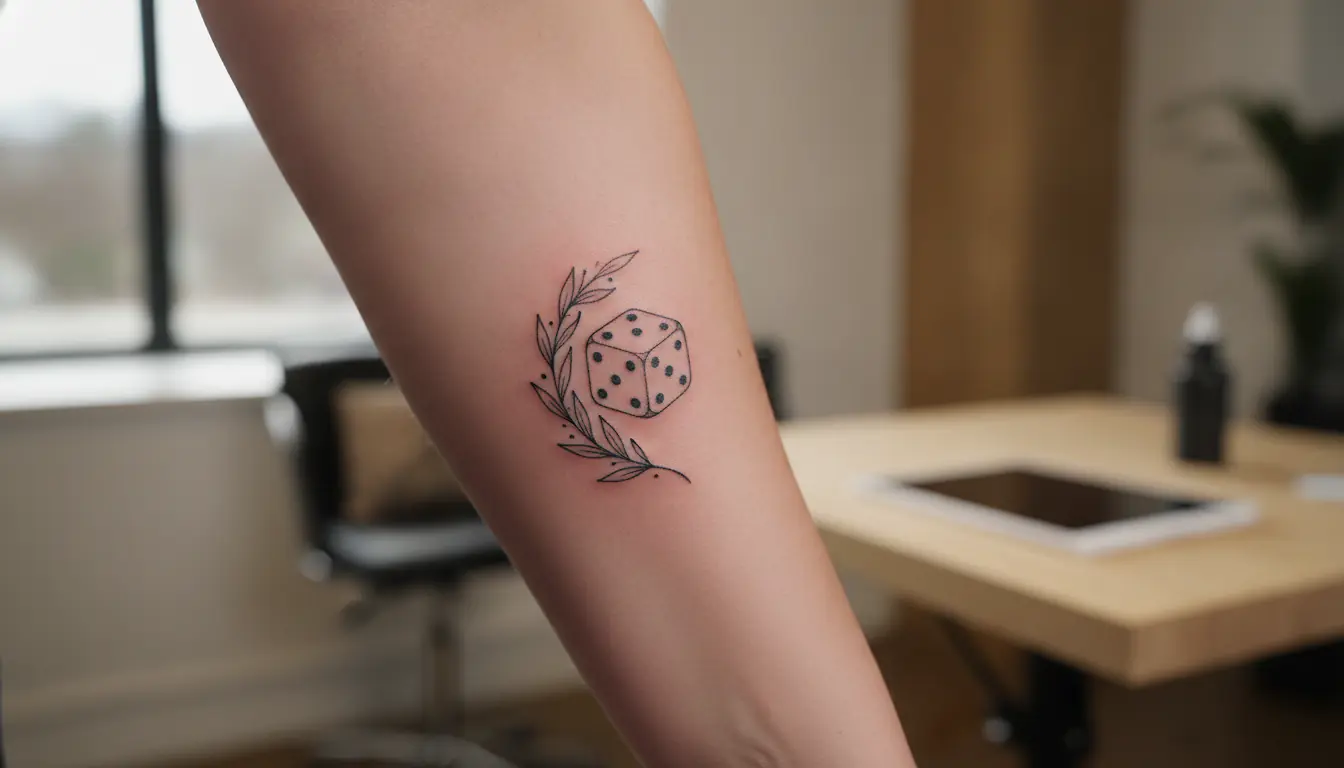
The die is the literal image of the phrase, since alea means the die itself. One or two dice next to the text make the translation visible, and the symbolism of the die in tattoos adds the idea of embraced chance.
The eagle was the emblem carried at the head of Roman legions. Placed above the phrase, it reinforces the historical and military reading, especially as the eagle tattoo itself carries meanings of power and far-sighted vision.
The compass shifts the meaning toward travel: the decision is made, and so is the direction. The pairing suits a departure or a move abroad, and the compass rose frames a short phrase well.
The hourglass stresses the irreversible: the sand that has fallen does not go back up, just as a thrown die does not return to the hand. This symbol of time running out gives the tattoo a graver tone, close to memento mori.