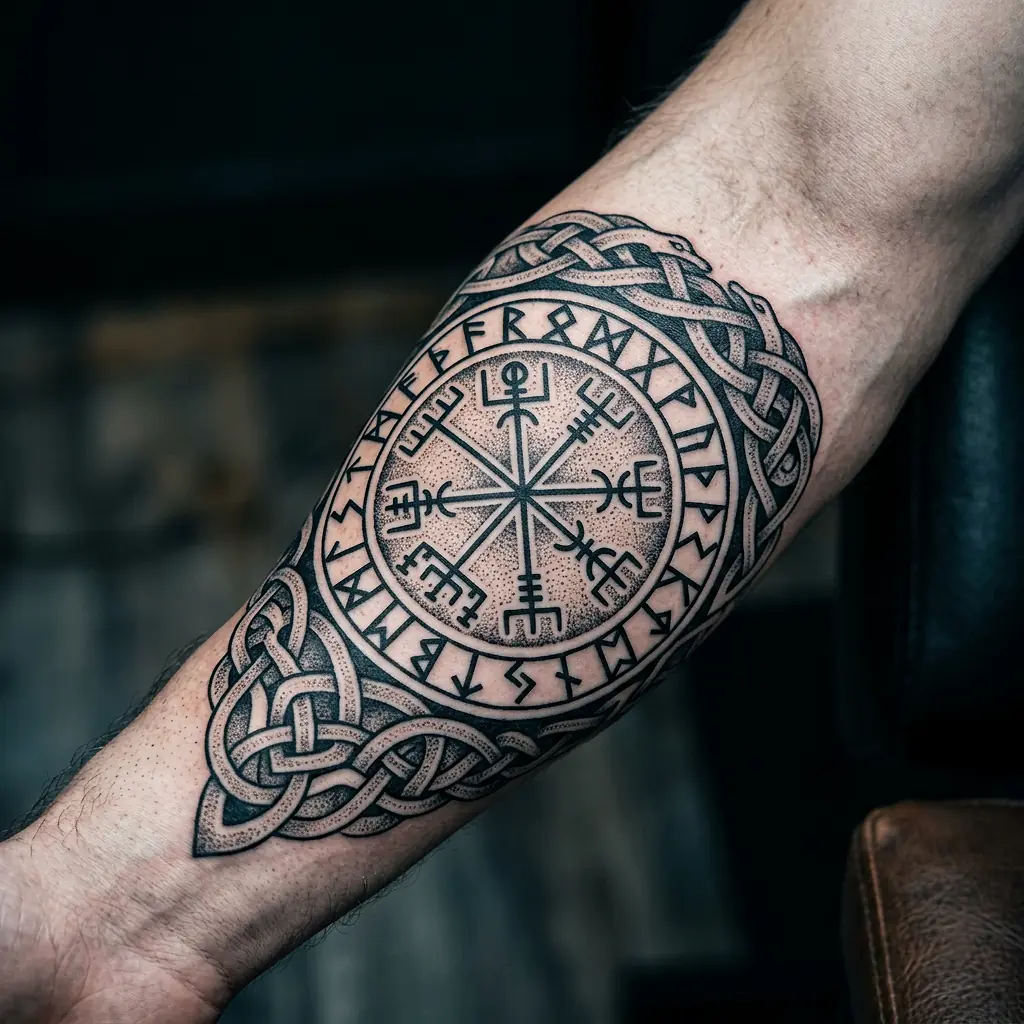
Meaning of the Viking Tattoo
The Viking tattoo draws from Norse mythology and Scandinavian warrior culture to create designs charged with strength, bravery and mystery. These symbols, worn by the seafaring warriors of the North between the 8th and 11th centuries, continue to captivate through their symbolic depth and powerful aesthetic.
The Valknut, three interlocking triangles, represents Odin and the passage between life and death. It also symbolizes the courage of warriors chosen by the Valkyries to enter Valhalla, the hall of the honored dead.
The Vegvisir, often called the Viking compass, is a symbol of guidance and protection. Norse sailors carried it to ensure they would never lose their way, even in the worst storms. It embodies the ability to find one’s path despite obstacles.
Mjolnir (Thor’s hammer) is one of the most popular Norse symbols. It represents protection, raw power and divine blessing. Thor, god of thunder, wielded his hammer to defend humanity against the forces of chaos.
The Aegishjalmur (helm of awe) is a protection symbol made of eight radiating branches. Warriors would mark it on their foreheads before battle to inspire fear in their enemies and render themselves invincible.
Origins and History
Viking tattoo culture is documented by historical sources, most notably the account of Ahmad Ibn Fadlan, a 10th-century Arab traveler who described the Rus (Eastern Vikings) as bearing patterns from their fingertips to their necks, depicting trees, figures and symbols.
Norse knotwork, inspired by the art found on runestones and Viking jewelry, forms a complex visual language. The Gotland stones and runestones of Sweden and Norway testify to this artistic tradition that blended mythological narratives with geometric patterns.
Yggdrasil, the world tree connecting the nine realms of Norse cosmology, holds a central place in Viking imagination. Its roots plunge into the wells of wisdom, and its branches touch the sky, symbolizing the connection between all worlds.
Runes, the sacred alphabet attributed to Odin, served for writing, divination and magic alike. Each rune carries its own meaning and specific power, making runic tattoos a particularly rich symbolic choice.
Popular Styles
Blackwork is the style most faithful to the original Viking aesthetic. Thick black lines and solid dark fills recall the stone and wood carvings of Norse artisans. This style suits knotwork, interlace patterns and geometric symbols perfectly.
Dotwork brings a meditative dimension to Viking motifs. Tightly packed dots create subtle gradients that add depth to symbols like the Vegvisir or Valknut.
Realism allows the depiction of mythological scenes: Odin on his throne, Thor wielding Mjolnir, Valkyries riding toward Valhalla. These narrative compositions transform the body into an epic mural.
Neo-traditional modernizes Viking motifs with vivid colors and bold outlines, creating a bridge between ancestral tradition and contemporary aesthetics.
Recommended Placements
The forearm is the preferred placement for standalone Viking symbols (Vegvisir, Valknut, Mjolnir) or knotwork bands. The full sleeve allows a complete narrative composition integrating multiple symbols and characters.
The back offers the ideal surface for Yggdrasil or a large mythological composition. The chest accommodates protective symbols like the Aegishjalmur. The ribs suit vertical runic inscriptions.
The calf and thigh are popular placements for designs inspired by Viking shields or circular knotwork patterns.
Combinations and Associations
Viking motifs form a coherent universe that allows numerous combinations. The ravens Huginn and Muninn (thought and memory) naturally accompany Odin-related symbols. The wolves Geri and Freki complete battle scenes.
The serpent Jormungandr that encircles the world lends itself to circular compositions around the arm or leg. Celtic knots share an aesthetic kinship with Norse interlace and combine harmoniously.
Pairing the Vegvisir with a classic compass creates a universal symbol of direction and quest for meaning. Runes added to any Viking motif strengthen its mystical and personal dimension.