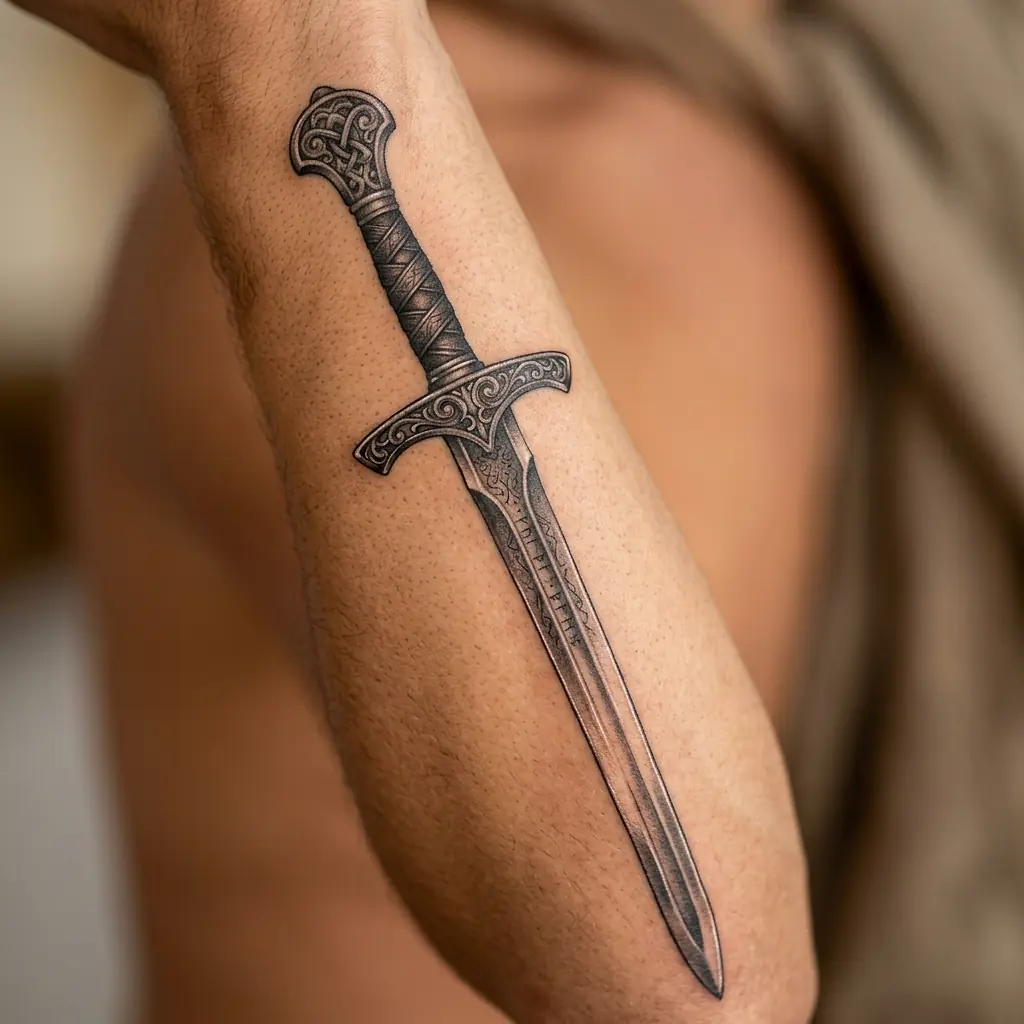
Meaning of the Sword Tattoo
The sword tattoo is a universal symbol of courage, honor, and justice. As the noble weapon par excellence, the sword represents strength placed in service of an ideal and the ability to cut through complexity with decisive action.
The sword symbolizes bravery in its most direct form. Unlike ranged weapons, the sword demands face-to-face confrontation with adversity. This direct engagement makes the sword a symbol of honest confrontation and unshielded strength.
Honor is inseparable from the sword. Across warrior cultures worldwide, the sword represents a strict moral code. The bushido of the samurai, medieval chivalry, the ethics of Celtic warriors: all these traditions place the sword at the center of a value system built on loyalty, justice, and respect.
The sword embodies justice and discernment. Its blade cuts cleanly, without ambiguity. A sword tattoo can express the will to distinguish clearly between right and wrong and to make firm decisions in difficult moments.
Protection is another essential dimension. The sword defends, shields the vulnerable, and repels threats. A sword tattoo can represent the role of protector that someone assumes toward their loved ones or toward their own convictions.
Origins and History
The sword’s history stretches back to the Bronze Age, approximately 3,300 years ago. The earliest swords were symbols of status as much as weapons, reserved for chiefs and elite warriors.
In Japan, the katana is far more than a weapon: it is the soul of the samurai. Forged through a sacred process that can take months, the katana embodies technical and spiritual perfection. Bushido teaches that the sword and its bearer are one.
In medieval Europe, the sword was the symbol of knighthood. The dubbing ceremony, where a man became a knight, involved the touching of a sword to the shoulders. Legendary swords like Excalibur and Durandal embodied legitimate power and heroic destiny.
Among the Vikings, swords were buried with their owners to accompany them to the afterlife. Swords bore proper names and were passed from generation to generation, accumulating the honor of each bearer.
In Islamic traditions, Ali ibn Abi Talib’s double-pointed sword Zulfiqar is a symbol of courage and faith, representing divine justice and strength placed in service of truth.
In Chinese culture, the jian (straight sword) represents the scholar-warrior ideal, where martial skill and intellectual refinement are united. The sword is one of the four treasures of the study alongside the brush, ink, and paper.
Popular Styles
Japanese style (irezumi) is particularly suited to katana designs. The details of the guard (tsuba), wrapped handle, and curved blade are highlighted by rich colors and traditional motifs like waves or cherry blossoms.
Realistic style reproduces the metallic gleam of the blade, light reflections on steel, and chiseled guard details. This approach creates the illusion of an actual sword resting on the skin.
Neo-traditional offers thick outlines and vivid colors for a stylized, impactful sword. Blackwork produces swords in pure silhouette, graphic and sharp as the blade they represent.
Ornamental surrounds the sword with decorative patterns, mandalas, or filigree, adding an aesthetic dimension that transcends the martial aspect. Japanese traditional style naturally integrates the sword into complex narrative scenes.
Recommended Placements
The forearm is the natural placement for a sword. The elongated shape of the blade follows the arm’s line, creating a dynamic, visible design. The sword can point toward the wrist or toward the elbow depending on the desired effect.
The calf provides ideal surface for a large vertical sword. The ribs and side allow a sword that runs along the torso with elegance.
The back accommodates ambitious compositions: a central sword surrounded by decorative motifs, or two crossed swords between the shoulder blades. The thigh allows for a detailed sword in a generous space.
Fingers or the wrist suit a minimalist sword reduced to its essential silhouette.
Combinations and Associations
The sword combined with cherry blossoms (sakura) creates one of the most iconic compositions in Japanese tattooing. Falling petals around the blade symbolize the fleeting beauty of the warrior’s life.
A snake coiled around the blade represents wisdom and cunning allied with raw strength. A crown above the sword symbolizes legitimate power and sovereignty.
A sword piercing a skull is a classic motif evoking victory over death or the warrior’s own mortality. Roses around the blade represent beauty within violence, the contrast between softness and sharpness.
Two crossed swords form a heraldic emblem of bravery and loyalty, a motif often chosen to represent brotherhood or alliance.