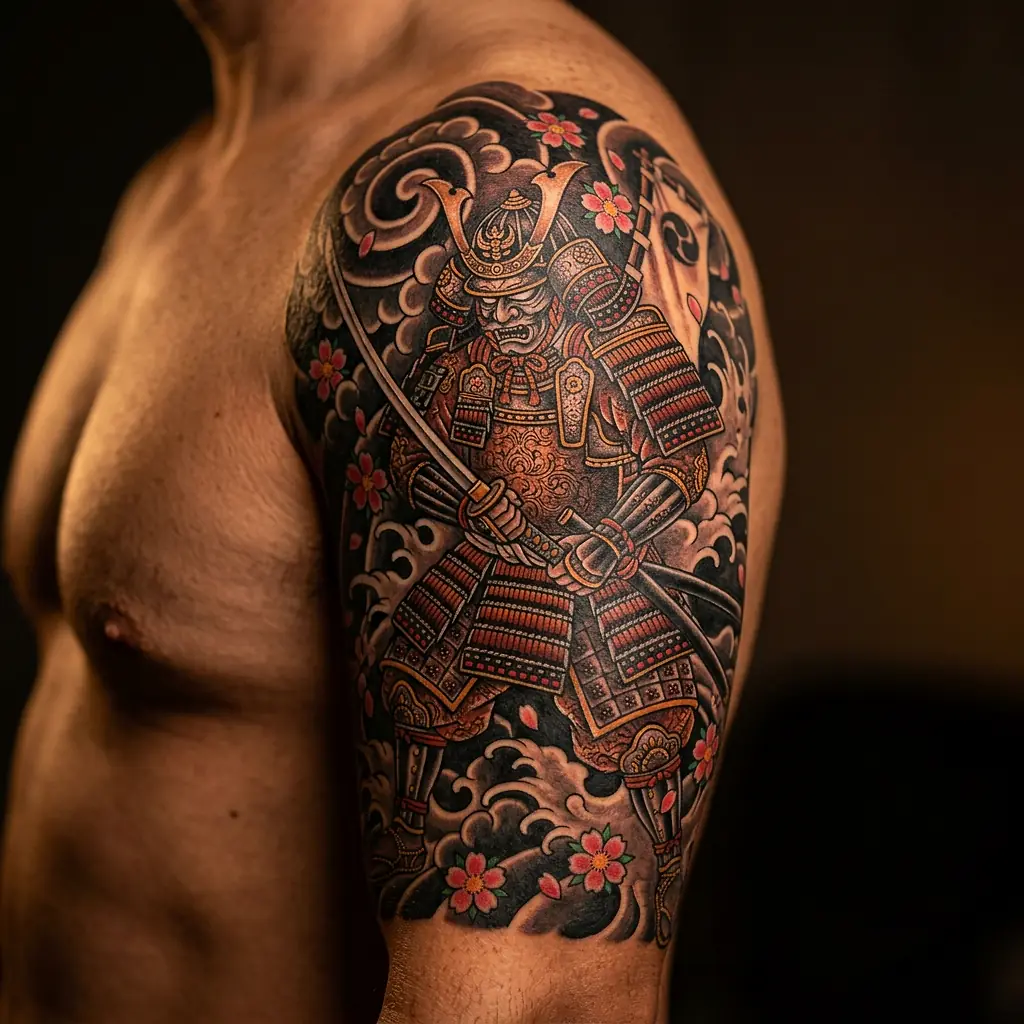
Meaning of the Samurai Tattoo
The samurai tattoo pays tribute to the most iconic warrior class of feudal Japan. A symbol of honor, discipline and self-mastery, the samurai embodies an ideal of life where courage and righteousness take precedence over everything, including the fear of death.
The samurai represents above all the values of bushido, the warrior code of conduct. This code rests on seven fundamental virtues: rectitude (gi), courage (yu), benevolence (jin), respect (rei), sincerity (makoto), honor (meiyo) and loyalty (chugi).
Getting a samurai tattoo means claiming these values as life principles. The armored warrior symbolizes protection and resilience. A samurai drawing his katana expresses determination against adversity. A meditating samurai embodies inner mastery and the pursuit of balance.
The samurai mask (menpo) is a particularly powerful motif. These war masks, designed to terrify enemies and protect the face, have become symbols of transformation: the warrior who dons his mask leaves his human weaknesses behind.
The kabuto (samurai helmet) with its elaborate ornaments represents rank, bravery and the warrior’s identity. Each clan had distinctive designs that told its own history and values.
Origins and History
Samurai emerged in Japan during the Heian period (794-1185) as a warrior class serving the nobility. They gradually seized political power, establishing the shogunate and dominating Japanese society for nearly seven centuries.
During the Kamakura period (1185-1333), bushido began to formalize as an ethical code. Samurai cultivated martial arts alongside calligraphy, poetry and the tea ceremony, embodying the ideal of the warrior-scholar.
The Sengoku era (1467-1615), a period of relentless civil wars, saw the samurai at the peak of battlefield prominence. Great warlords like Oda Nobunaga, Toyotomi Hideyoshi and Tokugawa Ieyasu became legendary figures.
The Meiji era (1868) officially abolished the samurai class, but their cultural legacy endures. Traditional Japanese tattooing (irezumi) draws extensively from warrior iconography, perpetuating their memory through body art.
Popular Styles
Traditional irezumi is the most authentic choice. It uses saturated colors (red, black, blue, gold), backgrounds of waves, clouds and wind, and compositions that cover large body areas. The samurai often appears in full action, sword raised.
Black and grey realism offers a striking cinematic rendering. Armor details, facial expressions and fabric textures gain photographic depth that honors the complexity of warrior equipment.
Neo-Japanese style modernizes traditional codes with sharper contrasts, dynamic compositions and greater creative freedom. It allows integration of contemporary elements while respecting the spirit of irezumi.
Trash polka creates a striking contrast by combining realistic samurai elements with abstract textures, ink splashes and typography.
Recommended Placements
The full back is the most prestigious placement for a full-body samurai, allowing the warrior to be depicted in full splendor with environment (temple, cherry trees, mountain).
The full sleeve allows a narrative composition that unfolds a story: the samurai, his armor, weapons and surrounding landscape. The half sleeve suits a detailed portrait or mask.
The thigh offers an ideal flat surface for realistic portraits. The chest accommodates symmetrical compositions with two warriors facing each other or a samurai framed by traditional motifs.
Combinations and Associations
Samurai combine naturally with cherry blossoms (sakura), reminding us that the warrior’s life is beautiful but fleeting. The dragon accompanies the samurai as a symbol of divine power and wisdom.
Waves and wind create dynamic backgrounds typical of irezumi. Temples and pagodas anchor the scene in feudal Japan. A lone katana with its characteristic curved blade works as a standalone motif carrying the same symbolism of discipline and cutting precision.
Kanji (Japanese characters) added to the composition can inscribe bushido values or quotes from famous warriors like Miyamoto Musashi.