Meaning of the Raven Tattoo
The raven tattoo is a powerful motif charged with mystery, intelligence, and transformation. A dark and fascinating bird, the raven is one of the most prominent creatures in mythologies around the world, simultaneously revered and feared across cultures.
The raven is one of the most intelligent animals on the planet. Capable of using tools, solving complex problems, and recognizing individual human faces, it symbolizes wisdom, cunning, and strategic thinking at its finest.
The raven represents transformation and change. Associated with darkness and death in many cultures, it is not a symbol of ending but of passage. The raven guides souls between worlds, accompanying the major transitions that shape a life.
Mystery surrounds the raven. Its absolute black plumage, piercing gaze, and unsettling intelligence make it a creature that exists between two worlds. It sees what others cannot see, hears what others cannot hear.
The resilience of the raven is remarkable. Present on every continent except Antarctica, it adapts to every environment, from the arctic tundra to the desert. It thrives where other creatures fail to survive.
Origins and History
In Norse mythology, Odin possessed two ravens: Huginn (thought) and Muninn (memory). Each morning, they flew across the nine worlds and returned to report everything they had seen and heard. The raven was thus the eye and ear of the supreme god himself.
Among the Native Americans of the Pacific Northwest coast, Raven is a central figure in mythology. Among the Haida and Tlingit peoples, Raven is a trickster creator deity who shaped the world and stole the light of the sun to give it to humanity.
In the Celtic tradition, the Morrigan, goddess of war and fate, took the form of a raven. Ravens on the battlefield were considered her emissaries. The Tower of London has housed ravens for centuries: legend holds that if the ravens ever leave the Tower, the kingdom will fall.
In Japan, the Yatagarasu is a three-legged raven that serves as a symbol of divine will and guide to the emperors. It remains the emblem of the Japanese Football Association today.
In Greek mythology, the raven was the sacred bird of Apollo. According to the myth, it was once white but was turned black by Apollo for delivering unwelcome news about the god’s beloved.
Popular Styles
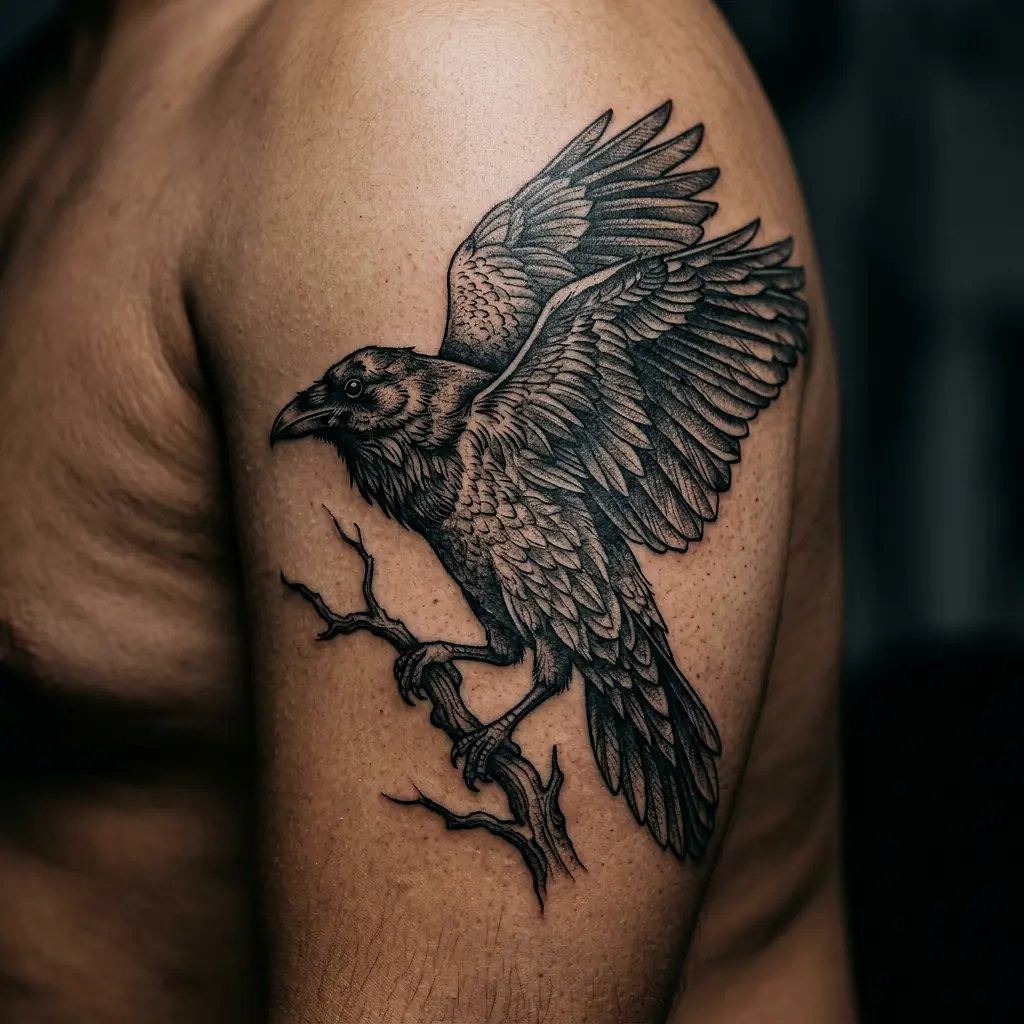
Blackwork is the natural style for a raven tattoo. Deep blacks, grey shades, and dramatic contrasts perfectly reproduce the dark plumage of the bird. The result is powerful and graphic.
Realism captures every feather, every reflection, and the intelligent gleam in the raven’s eye. Anatomical details make the tattoo strikingly lifelike and impressive.
Trash polka, a bold mix of realism and graphic collage in red and black, suits the raven’s dark aesthetic perfectly. Neo-traditional offers an expressive raven with ornamental details and rich colors.
Norse style integrates the raven into compositions with runes, Celtic knots, and Viking symbols for a mythologically rich design. Dotwork creates complex, hypnotic feather textures through meticulous stippling.
Recommended Placements
The forearm is the most popular placement for a raven, whether in flight or perched on a branch. The arm (bicep, full sleeve) accommodates compositions with a raven set against a dark landscape.
The shoulder blade and back allow for a raven with outstretched wings, creating an impressive statement piece. The chest accommodates a symmetrical raven design.
The calf and thigh offer space for complex scenes: a raven on a tree, in a graveyard, or beneath a full moon. The hand and neck are bold placements for a raven in flight.
Combinations and Associations
A raven paired with a skull is a classic, symbolizing mortality and the passage between worlds. A raven perched atop a skull evokes vanity and the memento mori tradition.
With the moon, the raven creates a nocturnal and mystical atmosphere. A raven in flight silhouetted against a full moon is a timeless composition.
Norse runes or Celtic symbols surrounding the raven anchor the motif in ancient mythology. A dead tree or misty forest adds a gothic atmosphere. An eye within the raven’s plumage symbolizes clairvoyance and hidden wisdom.