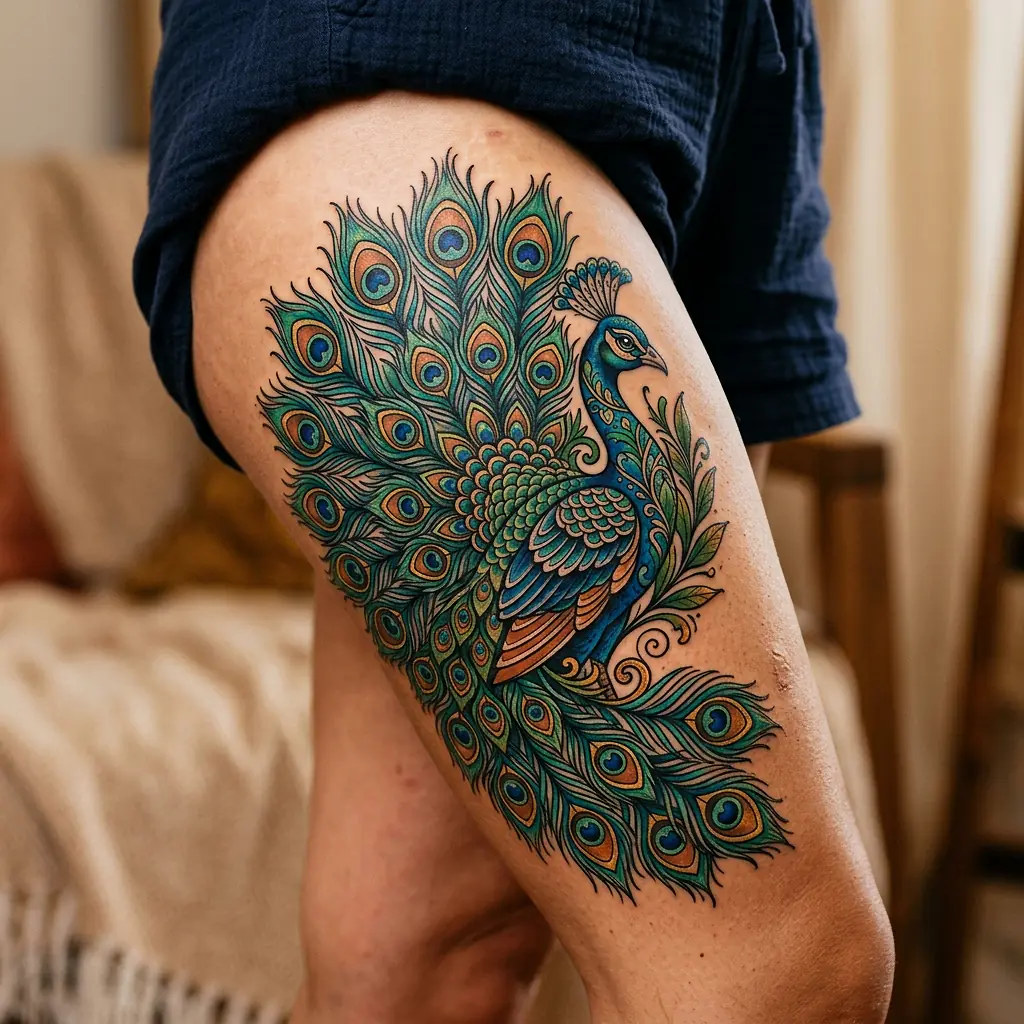
Meaning of the Peacock Tattoo
The peacock is among the most visually spectacular creatures on Earth, and its tattoo carries a resonant message of beauty, self-confidence, and perpetual renewal. When a peacock fans its tail, revealing hundreds of iridescent eye-spots, it performs one of nature’s most breathtaking displays.
A peacock tattoo celebrates the courage to be seen. It speaks to those who refuse to dim their brilliance to make others comfortable and who embrace their uniqueness without apology. The peacock does not hide its plumage; it displays it with unapologetic pride.
The peacock also represents renewal and immortality. Each year it sheds its magnificent tail feathers, only to regrow them even more vibrant than before. This annual cycle of loss and regrowth makes it a symbol of resilience and the understanding that beauty renews itself through transformation.
Origins and History
In India, the peacock is the national bird and holds sacred status in Hindu mythology. It serves as the mount (vahana) of Kartikeya, the god of war, and its feathers adorn the crown of Krishna. The peacock’s dance during the monsoon rains is considered a sacred act celebrating the fertility of the earth.
In ancient Greece, the peacock was consecrated to Hera, queen of the gods. According to myth, the hundred eyes of Argos, the giant guardian, were placed upon the peacock’s tail after his death, giving rise to the characteristic eye-spots. The bird thus became a symbol of watchfulness and divine vision.
Early Christian tradition associated the peacock with immortality and resurrection, as it was believed that its flesh did not decay. Peacocks adorned the mosaics of early churches and represented the eternal life promised to the faithful.
In Islamic art, the peacock is sometimes associated with paradise, its shimmering colors evoking celestial gardens. Persian and Mughal art abounds with peacock representations symbolizing divine beauty and royalty.
Popular Styles
Watercolor is particularly well-suited to the peacock. Splashes of blue, green, and gold capture the iridescent shimmer of the feathers and produce a painterly effect that seems to glow on the skin.
Realism reproduces every detail of the plumage, from delicate barbs to hypnotic eye-spots. This style demands an artist skilled in rendering metallic sheen and the shifting reflections of the tail.
Ornamental style transforms the peacock into a refined decorative motif, integrating arabesques, filigree, and jewelry-inspired elements drawn from Indian art. Neo-traditional offers clean outlines and saturated colors for a vibrant, expressive peacock.
Japanese style places the peacock within floral compositions alongside peonies and chrysanthemums, creating a tattoo of exceptional visual richness.
Recommended Placements
The thigh is the most popular placement for a full peacock with its tail fanned. The generous surface allows every feather to be rendered with precision. The back offers an ideal canvas for a monumental design, with the tail cascading along the spine.
A full sleeve accommodates a peacock whose feathers spiral around the arm, producing an organic, colorful composition. The ribcage suits a vertical arrangement where the bird stretches elegantly along the torso.
The shoulder works well for a peacock whose plumage cascades over the arm or back. For a subtler approach, a single peacock feather on the wrist or forearm captures the essence of the symbol with elegance. See also our guide to the feather tattoo for more inspiration.
Combinations and Associations
Peacocks pair harmoniously with flowers: peonies, lotus, and orchids enrich the composition and layer additional symbolism. Combined with a mandala, the peacock creates a spiritual tattoo where outer beauty mirrors inner harmony.
Jewelry and filigree elements inspired by Indian royal ornaments transform the peacock into a living adornment on the skin. Arabesques and paisley motifs naturally complement the Eastern theme.
A peacock paired with the moon or stars evokes nocturnal beauty and mystery. Peacock feathers integrated into geometric patterns build a bridge between tradition and modernity, between nature and abstraction.