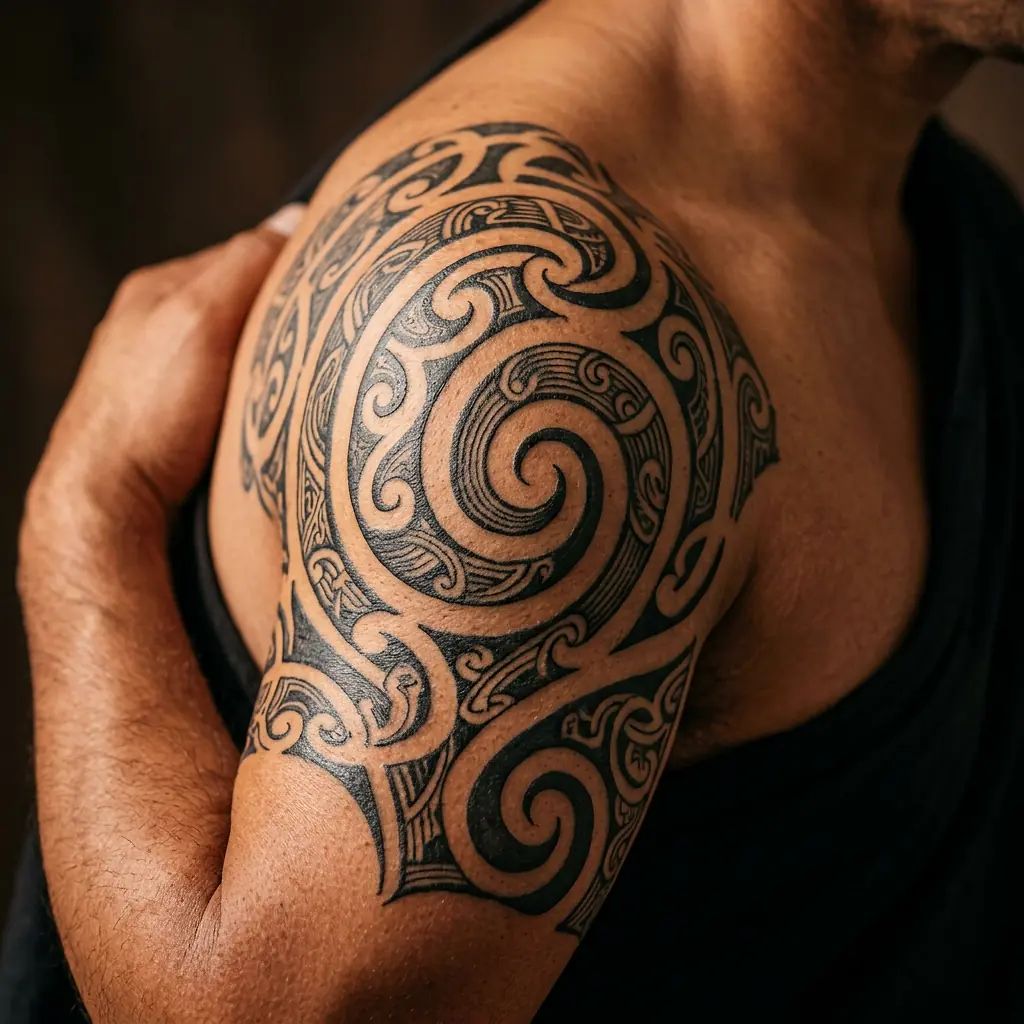
Meaning of the Maori Tattoo
The Maori tattoo, called ta moko, is far more than body ornamentation: it is a visual identity card etched into the skin, telling the lineage, rank and personal history of its wearer. Originating from the Maori people of New Zealand (Aotearoa), this sacred art is one of the oldest and most respected tattoo traditions in the world.
Ta moko is intrinsically linked to the concept of whakapapa (genealogy). Each motif inscribed on the skin tells a chapter of family and personal history. Maori tattooing is never purely decorative: it is an act of memory and identity affirmation.
The koru (unfurling fern spiral) is the most universal Maori motif. It symbolizes new life, growth, peace and renewal. The silver fern (ponga) is the emblem of New Zealand, and the koru captures the precise moment the frond unfurls, a metaphor for birth and hope.
The hei matau (fish hook) represents prosperity, strength and protection at sea. For a seafaring people, the hook also symbolizes the connection with Tangaroa, god of the ocean.
The manaia, a mythical creature part human, part bird, part fish, is a spiritual guardian protecting the boundary between the physical world and the spirit world. It is a powerful symbol of spiritual protection.
The tiki represents ancestors and fertility. The tiki’s eyes, often made of paua shell, symbolize knowledge and clear-sightedness.
Origins and History
The Maori people, of Polynesian origin, arrived in New Zealand around the 13th century. They brought with them the Polynesian tattoo tradition and transformed it into a unique art form, the ta moko.
Unlike other Polynesian traditions that use a comb (au) to prick the skin, traditional ta moko was performed with bone chisels (uhi) that literally carved the skin, creating raised grooves. This technique produced a distinctive texture, different from standard needle tattooing.
The facial moko was the most prestigious. For men, it covered the entire face, each zone telling an aspect of their identity: the forehead indicated rank, the temples paternal lineage, the cheeks social status, the chin maternal lineage. For women, the moko kauae adorned the chin and lips.
European colonization from the 19th century attempted to eradicate ta moko, deemed primitive. The decline was rapid, but the Maori cultural renaissance of the 1970s brought this practice back to the forefront as an act of identity pride and cultural resistance.
Popular Styles
Traditional ta moko is characterized by fluid curved lines, koru spirals and organic motifs that follow the body’s contours. The contrast between dense black areas and bare skin creates a powerful visual rhythm.
Kirituhi is Maori-inspired tattooing created by or for non-Maori people. It uses the aesthetic motifs of Maori art without claiming the identity dimension of authentic ta moko. This distinction is important for cultural respect.
Contemporary blackwork reinterprets Maori motifs with mechanical precision, perfectly regular lines and symmetrical compositions that contrast with the organic character of traditional ta moko.
Polynesian fusions combine Maori elements with Samoan, Tahitian or Marquesan patterns, creating pan-Polynesian compositions rich in symbolism.
Recommended Placements
The shoulder and arm are the most common placements for Maori-inspired tattoos. They symbolize strength, courage and personal achievements. A full sleeve allows a complex narrative composition to unfold.
The thigh and calf represent connection to the earth and the strength of journey. The chest symbolizes the link between sky (Ranginui) and earth (Papatuanuku).
The back offers a large surface for complex compositions integrating multiple narrative motifs. The forearm suits a koru or hei matau.
Combinations and Associations
Maori motifs combine naturally with other Polynesian elements. The koru pairs with turtle motifs (longevity, navigation) and oceanic symbols (waves, sharks, manta rays).
Natural elements of New Zealand, like the silver fern, sacred mountains and the ocean, enrich Maori compositions. Geometric tribal motifs form structural backgrounds for the organic spirals of the koru.
It is essential to approach Maori tattooing with cultural respect. Facial ta moko remains reserved for people of Maori heritage. For others, kirituhi allows paying tribute to this artistic tradition without appropriating its sacred identity dimension.