Meaning of the Jellyfish Tattoo
The jellyfish has emerged as one of the most captivating tattoo subjects of recent years, prized for its visual beauty and its profound symbolism of fluidity, hidden strength, and ethereal grace. Drifting through ocean currents without bones, brain, or heart, the jellyfish moves through life in a way that feels almost philosophical.
A jellyfish tattoo embodies the art of surrender without weakness. The creature does not fight the current; it flows with it, yet it carries venomous tentacles capable of disabling prey far larger than itself. This paradox of gentle movement and lethal power resonates with those who understand that true strength does not always need to be displayed.
The jellyfish also represents immortality in the most literal sense. The species Turritopsis dohrnii, dubbed “the immortal jellyfish,” can revert its cells back to their earliest form and restart its life cycle indefinitely. This biological miracle makes the jellyfish a singular symbol of perpetual renewal and the transcendence of mortal limits.
Origins and History
Greek mythology lends the jellyfish its name through the Gorgon Medusa, whose hair of serpents and petrifying gaze have fascinated humanity for millennia. While the marine creature and the mythological figure are distinct, they share an aura of dangerous beauty and hidden power.
In Asian cultures, particularly in Japan, the jellyfish (kurage) is admired for its minimalist aesthetic and hypnotic movement. It appears in Japanese art as a symbol of grace and simplicity, often linked to meditation and contemplation.
Coastal peoples of the Pacific revered the jellyfish as a messenger from the deep. Its bioluminescence, the ability to emit light in the darkest depths, gave it a magical quality, a living lantern in the oceanic darkness.
During the Art Nouveau movement of the late 19th century, the jellyfish became a recurring motif, celebrated for its organic forms and flowing lines that perfectly embodied the movement’s aesthetic principles.
Popular Styles
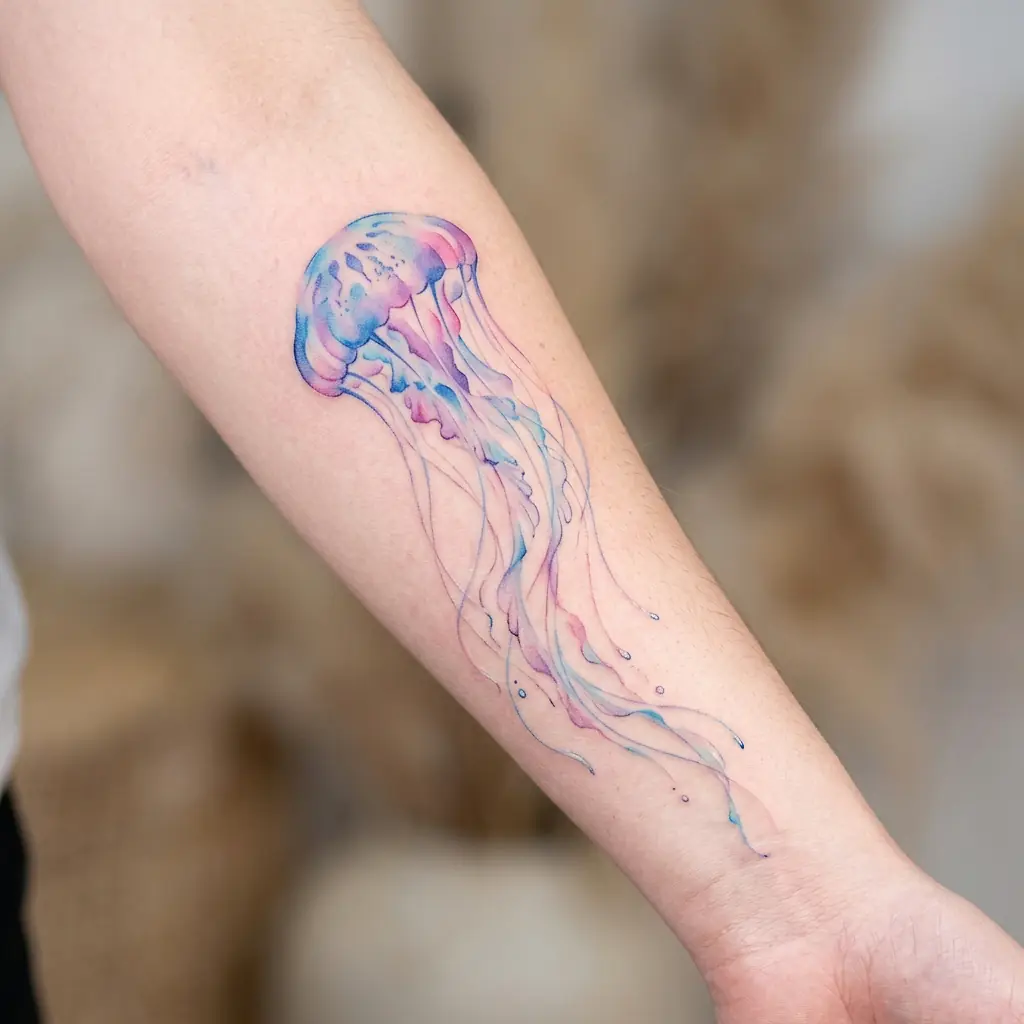
Watercolor is the definitive style for jellyfish tattoos. Transparent washes, gradients of blue, purple, and turquoise reproduce the translucent appearance of the creature and create a luminous effect on the skin.
Realism captures the delicate textures of the bell and the graceful filaments of the trailing tentacles. The play of light through the translucent body presents an exciting technical challenge for skilled artists.
Dotwork delivers an ethereal, delicate rendering where thousands of dots create an airy texture perfectly suited to the jellyfish’s immaterial nature. Neo-traditional offers saturated colors and expressive outlines for a more graphic interpretation.
A cosmic style, integrating stars and nebulae within the jellyfish’s body, transforms the creature into a celestial being floating through space, an original and poetic interpretation.
Recommended Placements
The forearm is an ideal placement. The bell of the jellyfish sits at the elbow while the tentacles descend gracefully toward the wrist, creating natural movement. The thigh offers generous space for a detailed jellyfish with long, flowing tentacles.
The ribcage beautifully accommodates a vertical jellyfish, with tentacles undulating along the torso. The calf allows a similar effect, with filaments descending toward the ankle.
The back is perfect for an ambitious composition: multiple jellyfish drifting in a current, or a single monumental specimen with its bell between the shoulder blades and tentacles cascading toward the lower back. The inner arm offers an intimate spot where the jellyfish appears to float in a personal ocean.
Combinations and Associations
Jellyfish combine naturally with other marine elements: corals, shells, seahorses, and small fish create a complete underwater ecosystem. Paired with a lotus, the jellyfish symbolizes beauty emerging from the depths.
A galaxy or nebula background transforms the jellyfish into a cosmic creature floating among the stars. This combination is particularly spectacular in watercolor or color realism.
Flowers intertwined with tentacles create an organic contrast between the marine and terrestrial worlds. Bubbles and luminous particles add a fairy-tale quality, evoking the bioluminescence of the deep abyss.