Meaning of the Hummingbird Tattoo
The hummingbird tattoo is a motif vibrant with color and symbolism. This tiny yet extraordinary bird embodies the joy of living, resilience, and the ability to find sweetness in every moment. As the only bird capable of flying backward, it reminds us that sometimes we need to look back in order to move forward.
The hummingbird symbolizes joy and optimism. Despite its small size, it overflows with energy and vitality. Its erratic flight, darting from flower to flower, evokes the ability to find happiness in life’s simple pleasures.
The resilience of the hummingbird is extraordinary. With a heart that can beat up to 1,200 times per minute and wings that beat 80 times per second, it defies the very laws of physics. Getting a hummingbird tattoo celebrates the strength hidden behind small size and apparent fragility.
The hummingbird is the only bird capable of flying backward, hovering in place, and changing direction instantaneously. This unique ability symbolizes adaptability, flexibility, and the capacity to revisit the past without becoming trapped in it.
Love is an important dimension of hummingbird symbolism. In Native American cultures, the hummingbird is a messenger of love. Its ceaseless quest for nectar represents the search for sweetness and affection in life.
Origins and History
Among the Aztecs, the war god Huitzilopochtli bore a name meaning “hummingbird of the left” or “hummingbird of the south.” Warriors who fell in battle were reborn as hummingbirds, returning to sip nectar from the flowers of the living world. The hummingbird thus served as a messenger between the living and the dead.
In Maya tradition, the hummingbird was created by the gods from leftover material used to make all the other birds. To compensate for its tiny size, they gave it the ability to fly like no other bird and feathers that shimmered with the colors of precious gemstones.
Among the Taino people of the Caribbean, the hummingbird was a symbol of rebirth and fertility. It was considered a warrior of peace: small in stature but boundless in courage.
In Native American traditions of North America, the hummingbird is a healer and a bearer of good fortune. The Navajo consider it a symbol of beauty and harmony. The Hopi tell the story of a hummingbird that brought rain during a devastating drought.
In Peru, the famous Nazca Lines include a 90-meter-long geoglyph of a hummingbird, visible only from the sky, testifying to the immense importance of this bird in pre-Columbian cultures.
Popular Styles
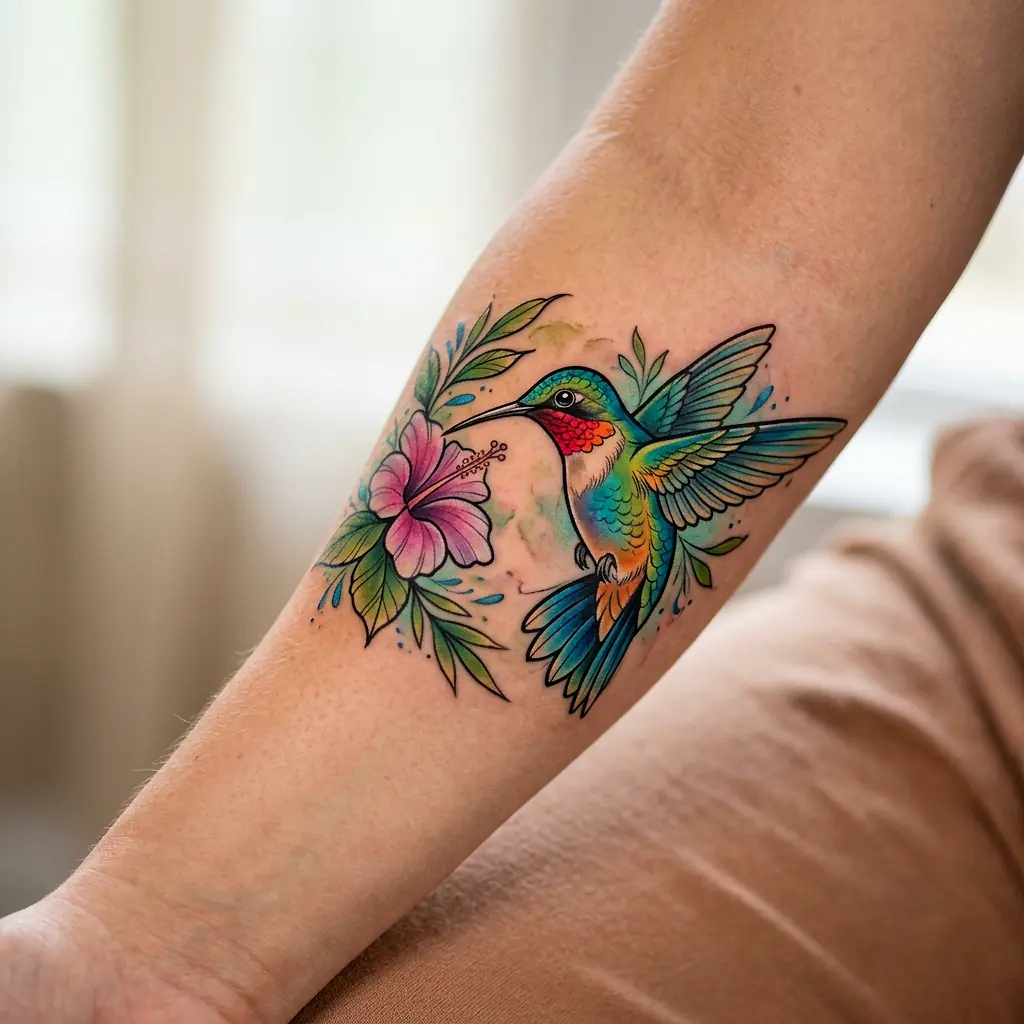
Watercolor is the ideal style for capturing the iridescence of hummingbird plumage. Vivid splashes of color (emerald green, sapphire blue, fuchsia pink) recreate the metallic shimmer of its feathers.
Realism reproduces the details of the plumage, the long beak, and wings in motion with precision. Rendering the iridescent reflections on the feathers is a technical challenge that yields spectacular results.
Neo-traditional offers an expressive hummingbird with vibrant colors and bold outlines. Minimalist fine-line work creates a delicate hummingbird in a few elegant strokes, often in black with a single touch of color.
Geometric deconstructs the hummingbird into abstract shapes, capturing the movement and energy of the bird. Dotwork adds texture and depth to the feathers through careful stippling.
Recommended Placements
The wrist and ankle are popular placements for a small hummingbird, creating a delicate and personal motif. Behind the ear, a tiny hummingbird is an elegant and discreet choice.
The forearm and shoulder suit a hummingbird in flight with flowers, offering enough space for a colorful composition. The side (ribs) allows for a vertical hummingbird in full flight.
The shoulder blade and back accommodate more elaborate scenes. The collarbone is an elegant placement for a hummingbird in horizontal flight.
Combinations and Associations
A hummingbird sipping from a rose or hibiscus is the most classic combination, symbolizing the quest for beauty and sweetness. Tropical flowers (plumeria, orchid) reinforce the exotic character of the design.
With a butterfly, the hummingbird creates a vibrant duo of color and movement, symbolizing transformation and joy. Cherry blossoms around the hummingbird add a touch of Japanese delicacy.
Music notes or stars accompanying the hummingbird evoke lightness and poetry. Multiple hummingbirds in flight create a dynamic pattern representing energy, community, and abundance.