Meaning of the Hamsa Tattoo
The hamsa is one of the most universally recognized protective symbols in human history. This open palm adorned with a central eye spans cultures, religions, and continents, carrying a message of divine protection, blessing, and defense against the evil eye that has endured for over three thousand years.
The hamsa (also known as the Hand of Fatima or Hand of Miriam) primarily symbolizes spiritual shielding. The eye at the center of the palm deflects the evil eye (ayin hara in Hebrew, nazar in Arabic), a malevolent force born from the jealousy and envy of others. Wearing a hamsa tattoo means carrying a permanent shield against negative energy.
The hamsa also represents blessing and abundance. The open hand is a universal gesture of generosity and giving. Facing upward, the hamsa attracts luck and prosperity; facing downward, it offers protection and fertility.
The symbol carries deep associations with feminine strength. Linked to Fatima (daughter of the Prophet Muhammad) in Islam and to Miriam (sister of Moses) in Judaism, the hamsa holds a protective maternal energy. The number five, represented by the hand’s five fingers, symbolizes the five senses and the connection between body and spirit.
Origins and History
The hamsa traces its origins to ancient Mesopotamia, where the Hand of Ishtar served as a protective symbol for over 3,000 years. Open-hand amulets have been recovered from Sumerian and Babylonian archaeological sites, making this one of humanity’s oldest continuous symbols.
In Jewish tradition, the hamsa is called the “Hand of Miriam” and symbolizes the five books of the Torah. It has been worn as a protective amulet and features prominently in Sephardic art, decorating ketubot (marriage contracts) and synagogues for centuries.
In Islam, the “Hand of Fatima” represents the five pillars of faith. According to legend, Fatima was cooking when she saw her husband Ali return with a new wife; she dropped her spoon and continued stirring the soup with her bare hand, numb to the pain. This act became a symbol of patience, fidelity, and inner strength.
In North Africa, the hamsa (khamsa) is ubiquitous: front doors, jewelry, textiles, and tattoos all bear its form. Berber women have been tattooing the hamsa for centuries as protection for their homes and families.
Popular Styles
Ornamental style is the most popular approach to the hamsa. Complex patterns fill the palm: arabesques, filigree, floral motifs, and geometric designs create a tattoo of extraordinary visual richness.
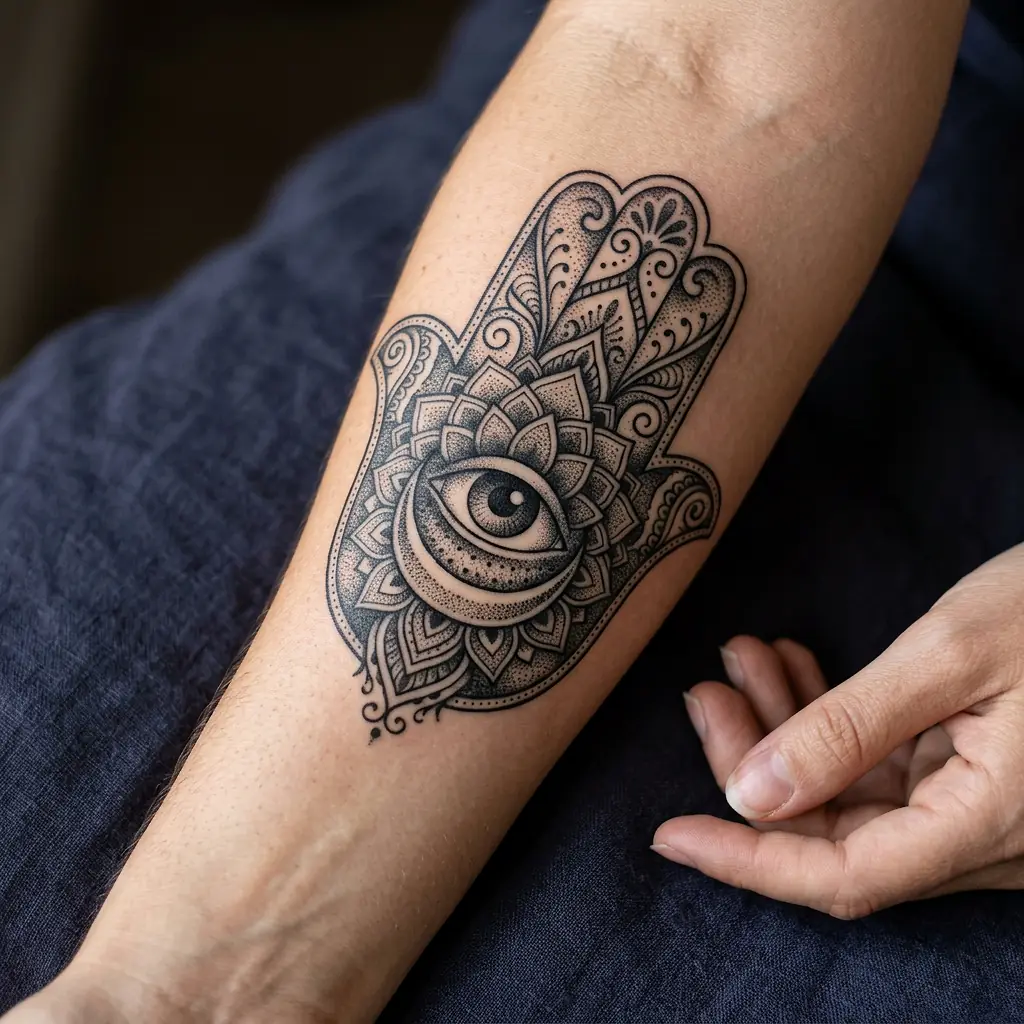
Dotwork is particularly suited to the hamsa. Thousands of dots build subtle gradients and a texture that evokes Eastern mosaics. This style reinforces the meditative and spiritual dimension of the symbol.
Blackwork delivers a high-contrast, graphic hamsa ideal for bold visual impact. Mandala style integrates concentric circles and symmetrical patterns within the hand, creating a hybrid between the hamsa and the mandala.
Minimalist fine-line offers a pared-down hamsa reduced to its essential lines, elegant and discreet. Watercolor brings splashes of color that soften the symbol and add an artistic dimension.
Recommended Placements
The forearm is the most popular placement for a hamsa. Centered on the inner face, it remains visible as a daily talisman. The back of the hand is a bold, symbolically coherent choice: the hamsa on the hand itself.
The sternum accommodates a hamsa centered between the collarbones, an intimate and protective placement. The upper back, between the shoulder blades, offers ideal space for an ornamental hamsa with full detail.
The nape is perfect for a hamsa that protects from behind, symbolically powerful. The wrist suits a small minimalist hamsa, discreet but ever-present.
For a larger piece, the arm or thigh allow a monumental hamsa surrounded by decorative motifs and symbolic elements like the protective eye.
Combinations and Associations
The hamsa combines naturally with the evil eye (nazar) to reinforce protection against malevolent gazes. A blue Turkish eye at the center of the palm is a classic and powerful pairing.
Combined with a lotus, the hamsa creates a spiritual tattoo blending Eastern traditions. Sacred geometry elements like the Flower of Life add a cosmic dimension to the symbol.
Arabesques, paisley motifs, and floral elements enrich the hamsa and root it in the decorative traditions of the Near East and North Africa. A hamsa surrounded by sunbeams or crescent moons evokes divine protection that watches over day and night.