Meaning of the Galaxy Tattoo
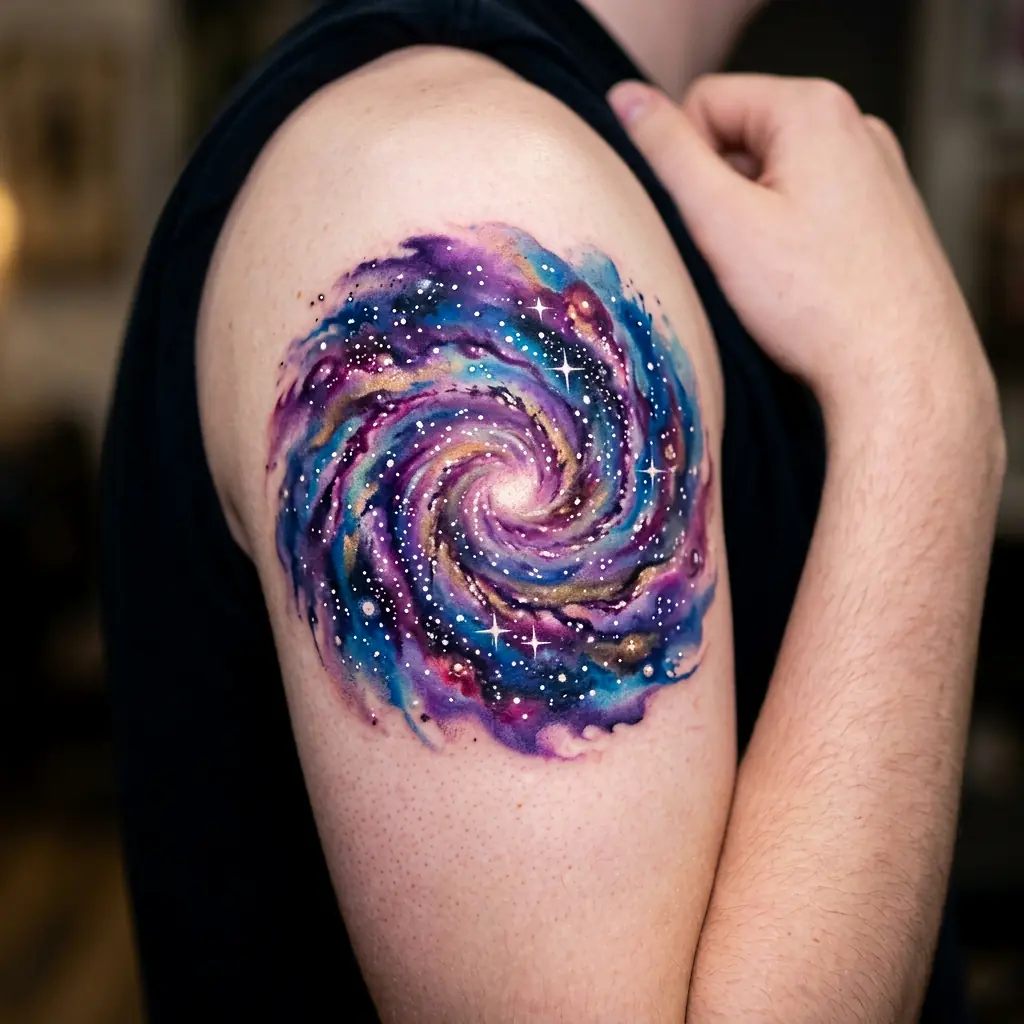
The galaxy tattoo captures the immensity of the universe on skin. It speaks to humanity’s oldest questions: where do we come from, where are we going, and what is our place in the vast cosmos? As a tattoo symbol, the galaxy represents infinity, mystery, cosmic connection, and the limitless potential that exists within and beyond us.
Our own Milky Way galaxy contains between 100 and 400 billion stars, and the observable universe holds an estimated two trillion galaxies. This dizzying scale is precisely what makes the galaxy tattoo so powerful: it is a permanent reminder of how simultaneously small and extraordinary our existence is.
The galaxy symbolizes the search for meaning. Faced with cosmic immensity, human beings seek purpose and belonging. This tattoo expresses the desire to understand, to explore, and to find significance in an apparently boundless universe.
It also represents infinite potential. Every star in a galaxy is a sun, potentially surrounded by worlds of its own. This idea of unlimited possibilities resonates deeply with those who refuse to accept narrow boundaries on what their life can become.
Finally, the galaxy evokes universal connection. The elements that compose our bodies were forged in the hearts of ancient stars. We are, quite literally, made of stardust, and the galaxy tattoo celebrates this cosmic belonging.
Origins and History
The word “galaxy” derives from the Greek galaxias, itself from gala (milk), referring to the Milky Way. Ancient Greeks told the story that the Milky Way was formed from the spilled milk of Hera when the infant Heracles was torn from her breast.
The Egyptians saw the Milky Way as the body of the goddess Nut, arched above the Earth to protect the living. The Maya considered the luminous band a sacred road leading to the underworld (Xibalba), and their cosmology placed the Milky Way at the center of creation.
In Aboriginal Australian traditions, the Milky Way tells creation stories. The dark patches between stars represent a cosmic emu, and the constellations trace the journeys of ancestral beings from the Dreamtime.
In Chinese mythology, the Milky Way is the Silver River (Yinhe) that separates the eternal lovers the Cowherd and the Weaver Girl. This myth inspired the Qixi Festival, celebrated as a day of romantic love.
Hindu cosmology describes the universe as cyclic, with galaxies forming and dissolving across unimaginable timescales. The concept of Brahma’s day, lasting 4.32 billion years, reflects a cosmic perspective that modern astronomy has only recently confirmed.
Popular Styles
Watercolor is the quintessential style for galaxy tattoos. Fluid washes of purple, blue, pink, and black recreate the nebulous appearance of deep space, echoing the imagery captured by the Hubble and James Webb telescopes.
Realistic galaxy tattoos aim to faithfully reproduce the photographic appearance of spiral galaxies, nebulae, and star fields. This style demands an experienced artist capable of creating depth, luminosity, and the illusion of infinite distance.
Dotwork builds galaxies from thousands of dots of varying density. This technique produces subtle gradients that mimic star clouds and nebulae with remarkable precision, giving the tattoo an almost pointillist quality.
Geometric style frames the galaxy within triangles, hexagons, or circles, creating a compelling contrast between cosmic chaos and mathematical order. Minimalist approaches reduce the galaxy to its essential forms: a simple spiral or a few carefully placed stars.
Surrealist galaxy tattoos blend cosmic imagery with unexpected elements, placing galaxies inside hourglasses, within tree canopies, or emerging from open books, creating thought-provoking compositions.
Recommended Placements
A full sleeve provides the ideal canvas for an immersive galactic scene complete with stars, nebulae, and planets. The cylindrical form of the arm wraps the viewer in space.
The back is the ultimate choice for ambitious cosmic compositions. A spiral galaxy centered between the shoulder blades creates a striking, symmetrical effect.
The forearm works well for a medium-sized galaxy, visible and easy to admire daily. The calf offers generous surface area for a detailed cosmic landscape.
The wrist or inner arm accommodates a small, intimate galaxy: a discreet reminder of the vastness that surrounds us at every moment.
Combinations and Associations
The galaxy combines naturally with stars and planets to create a complete cosmic system. Adding an astronaut or spaceship introduces a narrative dimension of exploration and discovery.
A cosmic eye at the center of a galaxy merges inner and outer mystery, suggesting that contemplating the universe is ultimately contemplating oneself. A wolf howling before a galaxy evokes wild instinct confronting infinity.
A human silhouette gazing at the galaxy is a popular motif that captures the feeling of smallness and wonder before the cosmos. Combining galaxies with flowers or butterflies bridges the macrocosm and microcosm.
Constellations woven into a galaxy add a personal layer of meaning, especially when they correspond to the wearer’s zodiac sign or a significant star pattern.