Meaning of the Dreamcatcher Tattoo
The dreamcatcher tattoo is one of the most poetic and widely requested motifs in tattoo art. A sacred object from Native American culture, the dreamcatcher embodies protection, energy filtration, and the connection between the waking world and the realm of dreams.
The dreamcatcher functions as a spiritual filter. According to tradition, good dreams know the path through the web and slide gently down the feathers to the sleeper. Bad dreams remain trapped in the woven net and are destroyed by the first rays of the morning sun.
Getting a dreamcatcher tattooed means carrying a permanent protective shield on your skin. The tattoo symbolizes the will to guard yourself against negative influences, dark thoughts, and toxic energies that may cross your path.
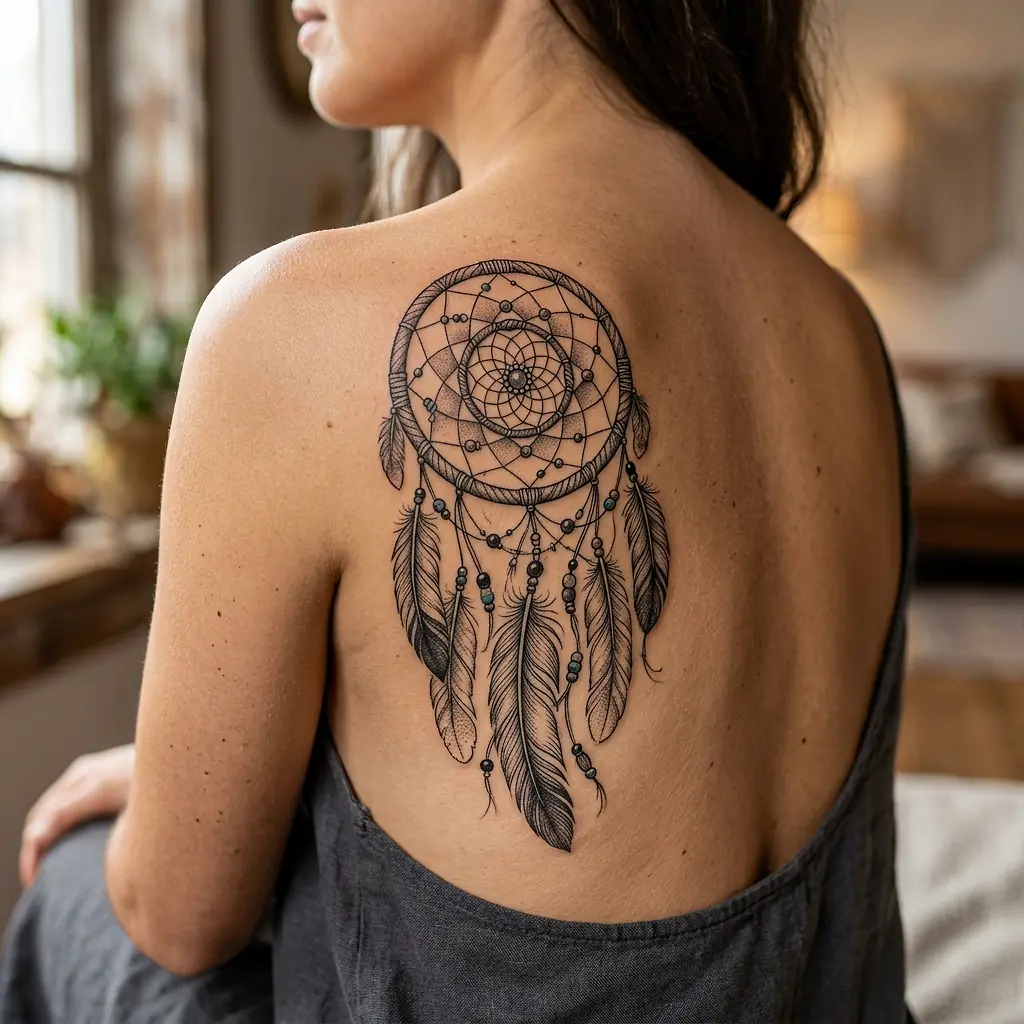
The circle of the dreamcatcher represents the cycle of life and the unity of the world. It symbolizes the sun and moon traveling across the sky, as well as the cyclical nature of existence itself.
The feathers hanging below represent breath, air, and lightness. They guide good dreams toward the sleeper with gentleness. The beads on the web represent either captured good dreams or the creator spider herself, depending on the tradition.
Origins and History
The dreamcatcher originates with the Ojibwe (Chippewa) people, one of the largest Native American nations in North America. In their tradition, Asibikaashi (Spider Woman) wove protective webs above the cradles of children to guard their sleep.
As the Ojibwe people dispersed across a vast territory, Asibikaashi could no longer protect every child. Mothers and grandmothers began weaving magical webs on willow hoops, reproducing Spider Woman’s protective work with their own hands.
The tradition later spread to the Lakota, who have their own version of the origin story. In their telling, Iktomi, the trickster spirit in spider form, taught an elder spiritual leader how to craft the dreamcatcher atop a sacred mountain.
During the 1960s and 1970s, the Pan-Indian movement adopted the dreamcatcher as a symbol of unity among Native American nations. It subsequently became a popular symbol worldwide, extending far beyond its original cultural roots.
Popular Styles
Realism reproduces the details of the woven web, the textures of beads, and the natural movement of feathers. The play of shadow and light on the net creates a captivating effect of depth and dimension.
Watercolor is particularly well-suited to the dreamcatcher, with dreamy splashes of color that evoke the world of dreams. Pastel or vivid tones spill beyond the edges of the motif like dreams escaping into the waking world.
Dotwork creates a delicate, hypnotic web built point by point. This style adds a meditative quality to the motif. Mandala transforms the center of the dreamcatcher into a sacred geometric pattern.
Blackwork offers a graphic, high-contrast dreamcatcher. Minimalist fine-line work distills the motif to its essentials: a circle, a few threads, and sketched feathers.
Recommended Placements
The shoulder blade is one of the most popular placements, offering enough space for the circle and hanging feathers. The arm (inner or outer) allows for an elegant vertical dreamcatcher.
The thigh and side (ribs) accommodate detailed compositions with long feathers. The back allows for a large-scale dreamcatcher with complex ornamental elements.
The wrist suits a miniature fine-line dreamcatcher. The nape of the neck is a discreet and symbolic placement, with the dreamcatcher watching over dreams from behind the head.
Combinations and Associations
The dreamcatcher combines naturally with ornamental feathers, beads, and elements from nature. Flowers woven into the web add a touch of beauty and femininity.
A moon integrated into the dreamcatcher’s circle strengthens the connection with night and dreams. Stars and constellations surrounding the design complete the nocturnal atmosphere.
A wolf or owl at the center of the dreamcatcher evokes spirit animals (totems) from Native American tradition. A tree of life woven into the web symbolizes rootedness and spiritual growth.
Butterflies or birds emerging from the dreamcatcher represent dreams taking flight and becoming reality, adding movement and hope to the composition.