Meaning of the Dotwork Tattoo
The dotwork tattoo builds its images exclusively from dots, creating works of remarkable fineness and depth. This technique, which demands extraordinary patience and precision, produces subtle gradients, unique textures and an almost hypnotic aesthetic. Dot by dot, dotwork transforms skin into a canvas of light and shadow.
Beyond the subject depicted, dotwork carries symbolism tied to its creation process. Building an image dot by dot is an act of patience and meditation that recalls Eastern contemplative traditions. Each dot is a conscious gesture, each gradient an accumulation of thousands of minute decisions.
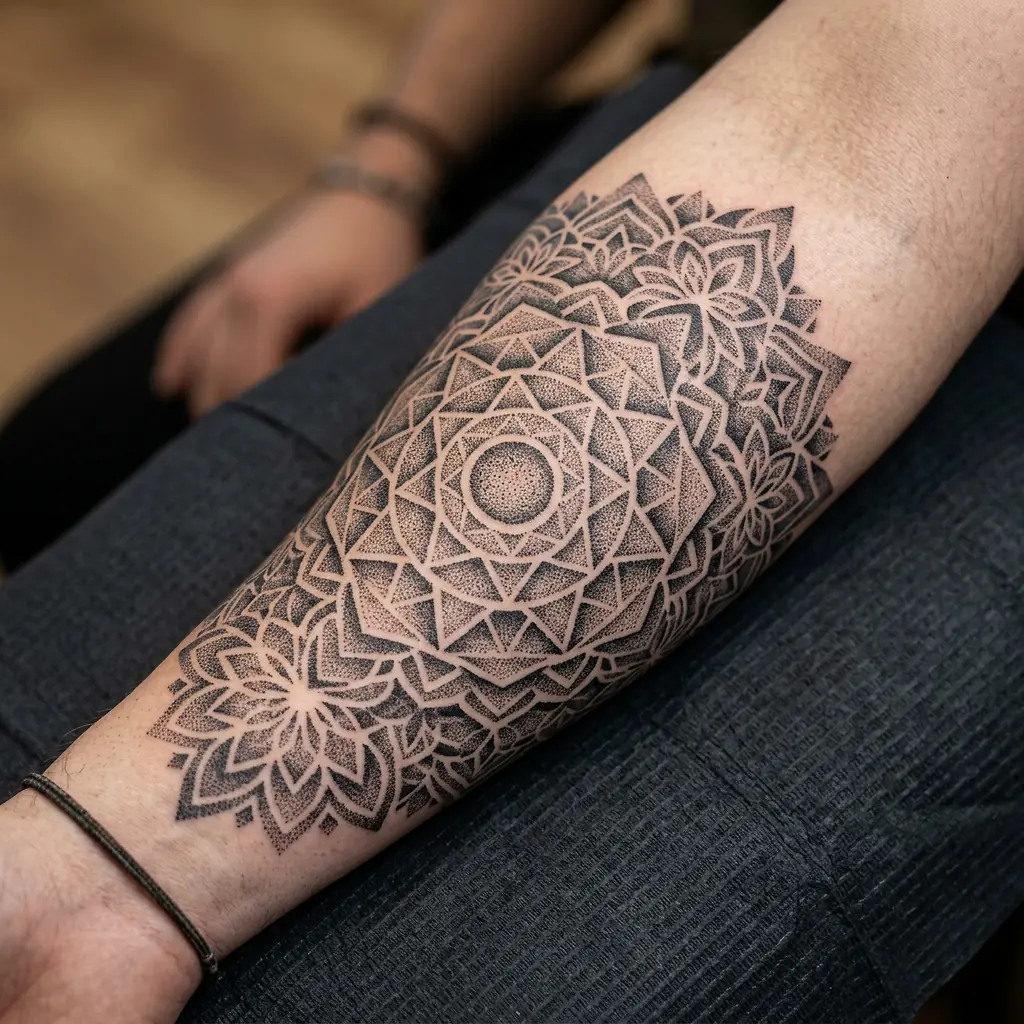
Dotwork is intrinsically linked to sacred motifs. Mandalas, ritual circles representing the universe in Hindu and Buddhist traditions, find their most faithful expression in dotwork. The concentric construction of the mandala, from center to periphery, mirrors the pointillist process itself.
Sacred geometric patterns (flower of life, seed of life, Metatron’s cube, Sri Yantra) are preferred dotwork subjects. Their perfect geometry, believed to reflect the fundamental structure of the universe, gains depth and mystery through dot gradients.
Dotwork also evokes the connection between whole and detail. From afar, the image appears as a harmonious composition; up close, it reveals itself as thousands of individual dots. This duality reminds us that the beauty of the whole is born from the perfection of each element.
Origins and History
Dot tattooing is one of humanity’s oldest techniques. The Aboriginal peoples of Australia have practiced dot tattooing for millennia, as have tribal traditions in Africa and Southeast Asia.
Japanese tebori, the traditional hand-tattooing technique, uses groups of needles that naturally create pointillist patterns. Shadows in classic irezumi are achieved through accumulations of ink dots.
In the West, modern dotwork emerged in the 1990s, pioneered by artists like Xed LeHead and Cory Ferguson who explored pointillism’s potential in tattooing. They drew inspiration from both pointillist painting (Seurat, Signac) and tribal tattoo traditions.
The European scene, particularly in England, Germany and Scandinavia, played a central role in developing contemporary dotwork. Artists there fused sacred geometry, ornamental motifs and pointillist technique to create a distinctive style.
Variations Within the Style
Pure dotwork uses exclusively dots, without any lines. The entire image, including outlines, is built through dot density and spacing. This is the most technically demanding and visually impressive form.
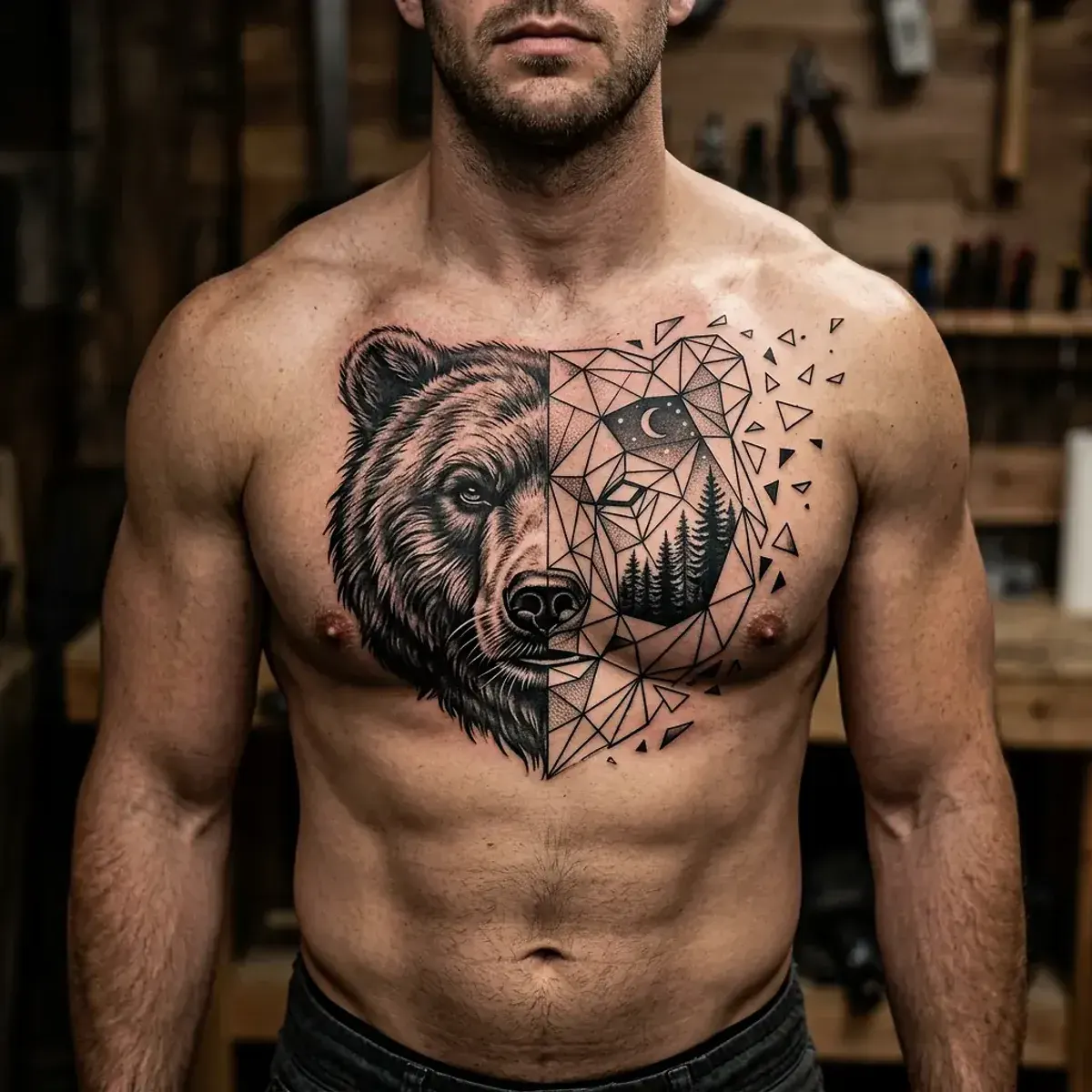
Geometric dotwork combines pointillist technique with precise geometric shapes: circles, triangles, hexagons, polyhedra. Dot gradients fill the shapes and create plays of shadow and light.
Ornamental dotwork integrates decorative elements inspired by Indian, Persian and Art Nouveau art: floral motifs, arabesques, scrolls and ornate borders. The result evokes luxurious textiles and ancient illuminations.
Realistic dotwork uses dots to reproduce photorealistic images. Portraits, animals and landscapes take on a unique texture, like a photograph seen through a veil of mist.
Recommended Placements
The full sleeve and forearm are the most popular placements, allowing geometric compositions that wrap around the limb. The back offers the ideal surface for large mandalas and complex ornamental compositions.
The sternum and ribs suit symmetrical compositions that follow the body’s midline. The calf perfectly accommodates circular motifs and ornamental bands.
The shoulder and shoulder blade offer flat surfaces ideal for mandalas and rosettes. The knee and elbow, often avoided by other styles, are prized dotwork placements for their radiant compositions.
Combinations and Associations
Dotwork excels as a shading technique for other styles. A blackwork motif with dotwork gradients gains dimension and subtlety. Tribal or Norse symbols enriched with pointillism take on new depth.
Mandalas and sacred geometry patterns are dotwork’s natural partners. The flower of life, Metatron’s cube and the Sri Yantra find their most accomplished expression in this technique.
Natural motifs (flowers, butterflies, feathers) rendered in dotwork gain an ethereal delicacy. Lunar and celestial symbols (moon phases, constellations) naturally lend themselves to dot rendering, evoking the starry sky.