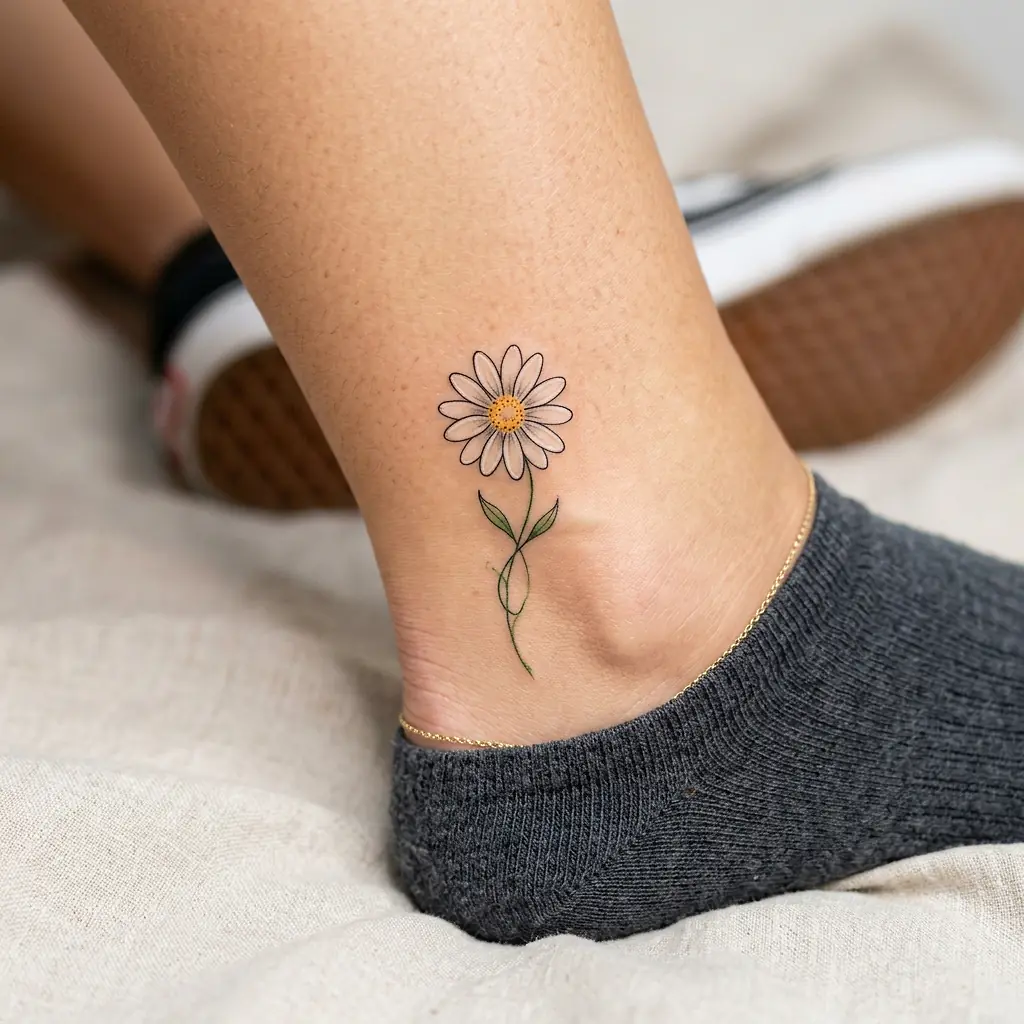
Meaning of the Daisy Tattoo
The daisy is a flower of disarming simplicity, and that simplicity is precisely its power. A daisy tattoo symbolizes innocence, purity, joy, and the beauty of uncomplicated things. Its white petals radiating from a golden center represent a kind of beauty that needs no embellishment.
The daisy is the quintessential symbol of innocence and purity. It evokes childhood, summer fields, and a time before complexity. Choosing a daisy tattoo is often a celebration of authenticity, a commitment to finding joy in simplicity rather than sophistication.
The daisy also represents new beginnings and hope. It is one of the first flowers to appear in spring, pushing through cold ground as a signal that winter is over. This makes it a meaningful tattoo for anyone marking a personal renaissance, a fresh chapter, or recovery from a difficult period.
In the language of flowers, the daisy symbolizes loyal, sincere love. The classic petal-picking game transforms the daisy into an oracle of romantic destiny. As a tattoo, it expresses love that is pure and unpretentious, given freely without expectation.
The daisy also embodies quiet resilience. It grows everywhere: in meadows, along roadsides, through cracks in pavement. Its ability to bloom in the most ordinary conditions makes it a symbol of gentle strength and adaptability.
Origins and History
The name “daisy” comes from the Old English day’s eye, because the flower opens with the sunrise and closes at nightfall. This solar behavior links the daisy to light, truth, and transparency, qualities that have shaped its symbolism across Western culture.
In Norse mythology, the daisy was the sacred flower of Freya, goddess of love, fertility, and spring. Offering daisies celebrated motherhood and new births, and daisy chains were woven as offerings during spring festivals.
In the Christian tradition, the daisy is associated with the Virgin Mary and symbolizes innocence and virtue. Renaissance painters frequently included daisies in scenes of the Annunciation, placed at the feet of the Virgin.
During the Middle Ages, knights wore daisies as tokens of courtly love. If a lady offered her suitor a daisy, it signaled acceptance of his affections. Young women wove daisy crowns as a rite of passage, and the flowers featured prominently in May Day celebrations throughout Europe.
In Celtic tradition, daisies were believed to soothe the spirits of children who had died, and the gods would scatter daisies across the earth to comfort grieving parents.
Popular Styles
Minimalist is the most requested style for daisy tattoos. A few fine lines capture the flower’s essence, creating a discreet, elegant, timeless design that works beautifully at any size.
Fine line adds precision to the petals and center, offering a delicate rendering that respects the flower’s simplicity. Color realism captures the luminous white of the petals and the vivid yellow of the center for a fresh, lifelike motif.
Illustrative style, inspired by botanical drawings, offers a rendering between realism and artistic interpretation. Old school provides a more graphic version with thick outlines and bold colors, giving the daisy a pop-art dimension.
Watercolor adds vaporous color touches around the flower, creating a light, springlike effect. Micro-tattoo reduces the daisy to a tiny size, perfect for discreet placements.
Recommended Placements
The wrist is the star placement for a daisy tattoo, offering a visible yet intimate motif. The ankle hosts a daisy or small bouquet with charm and grace.
The forearm allows a composition with multiple daisies or a wildflower arrangement. The shoulder and collarbone offer elegant, feminine placements.
Behind the ear and on the fingers, a miniature daisy provides a discreet, personal touch. The sternum accommodates a symmetrical composition with intertwining stems.
The foot is a classic choice for a daisy garland, while the nape of the neck offers a surprising, delicate placement.
Combinations and Associations
Daisies combine naturally with other wildflowers like poppies, cornflowers, and buttercups, creating a joyful, colorful meadow bouquet. This is a popular choice for pastoral botanical compositions.
Paired with a bee or a ladybug, the daisy creates a lively pastoral scene. A butterfly resting on a daisy symbolizes transformation and lightness.
Stars or a moon add a dreamy quality to the composition. Letters or a name calligraphed around a daisy personalize the design with sentimental value.
A daisy chain is a particularly poetic motif that evokes childhood, summer days, and the innocent pleasure of creating something beautiful from simple things.