Meaning of the Dahlia Tattoo
The dahlia is a flower of extraordinary visual complexity, and as a tattoo it carries a symbolism to match. A dahlia tattoo represents elegance, inner strength, creativity, and the ability to remain graceful under pressure. Its perfectly arranged concentric petals suggest mathematical beauty, natural harmony, and a personality that thrives on showing the world something remarkable.
The dahlia symbolizes dignity and composure. This is not a wildflower scattered carelessly across a field. The dahlia grows with intention and produces blooms of stunning complexity even in adverse conditions, making it a symbol of resilience and determination. It is a flower that refuses to go unnoticed.
The dahlia also embodies creativity and uniqueness. With over 42,000 registered varieties displaying an almost infinite range of forms and colors, every dahlia is distinctive. This extraordinary diversity makes it a perfect symbol for celebrating individuality and personal expression.
Color carries specific meaning: red dahlias express passion and inner power, purple evokes royalty and wisdom, white represents purity and new beginnings, and pink incarnates grace and kindness. A black dahlia carries darker connotations of mystery, betrayal, and the shadow side of beauty.
Origins and History
The dahlia is native to Mexico, where the Aztecs cultivated it long before European contact. Known as acocotli by indigenous peoples, it served simultaneously as a medicinal plant, a food source (its tubers are edible), and a decorative element in religious rituals.
For the Aztecs, the dahlia was associated with Quetzalcoatl, the feathered serpent deity, and symbolized the connection between the terrestrial and spiritual worlds. Warriors wore dahlias as markers of bravery and nobility.
The dahlia reached Europe at the end of the 18th century, brought back by Spanish botanists. It was named after Swedish botanist Anders Dahl. The flower rapidly conquered European gardens and became a symbol of good taste and refinement during the Victorian era.
In Victorian flower language, giving a dahlia communicated a message of lasting commitment and recognition of someone exceptional. The dahlia is now the national flower of Mexico, celebrated annually during dedicated festivals that honor its Aztec heritage.
Popular Styles
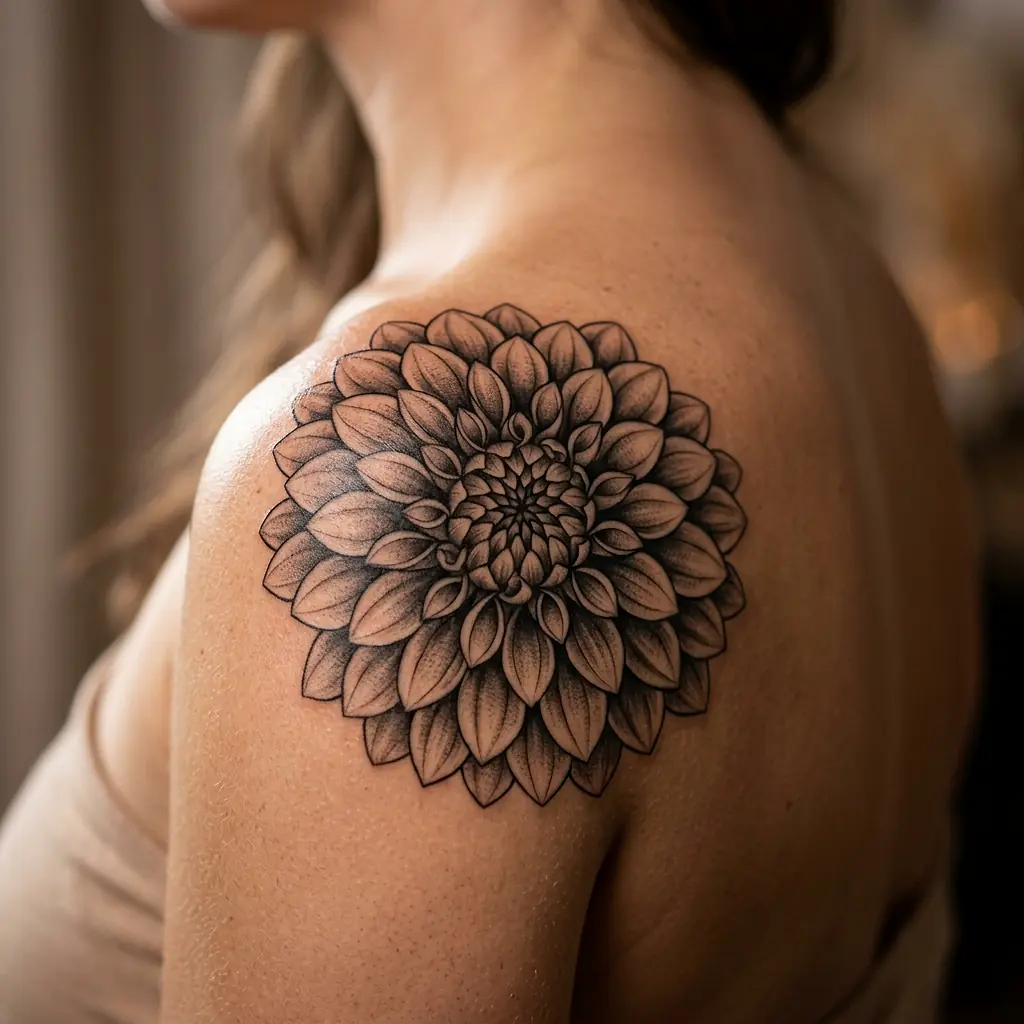
Realism captures the dahlia’s fascinating petal complexity, with successive layers creating depth and dimension. In color, the effect is spectacular. In black and grey, texture and shadow become the dominant features, producing dramatic compositions.
Dotwork is particularly well-suited to the dahlia thanks to its naturally geometric structure. The stippled texture reinforces the hypnotic quality of the flower, evoking mandala patterns through organic rather than designed geometry.
Neo-traditional offers a strong balance between detail and readability, with vivid colors and confident outlines. Ornamental style enriches the dahlia with filigree, jewels, and decorative patterns inspired by fine jewelry.
Minimalist and fine line versions capture the dahlia’s characteristic concentric silhouette with just a few essential strokes. Geometric style deconstructs the flower into pure forms, playing with its natural symmetry.
Recommended Placements
The thigh is a prime placement for a large, detailed dahlia, offering generous space to display the full complexity of the petals. The upper arm and shoulder allow for a visible, impactful design.
The shoulder blade suits a medium-sized dahlia perfectly, centered and symmetrical. The ribs offer an elongated, discreet placement ideal for a vertical composition with stem and leaves.
The sternum is a popular choice for a symmetrical dahlia placed between the breasts, often enhanced with ornamental details. The wrist and behind the ear suit small minimalist dahlias.
The forearm and calf provide good surfaces for medium compositions that balance detail with everyday wearability.
Combinations and Associations
The dahlia combines beautifully with other flowers for elaborate botanical bouquets. Paired with a rose, it creates a dialogue between passion and elegance, classic beauty and modern sophistication.
Butterflies or hummingbirds resting on a dahlia add movement and a transformation narrative to the composition. Geometric patterns framing the flower reinforce its natural mandala-like quality.
The dahlia also associates well with ornamental elements like jewels, fine chains, and pearls, creating a baroque, precious aesthetic. Foliage and buds complete the composition for a botanically rich and realistic rendering.