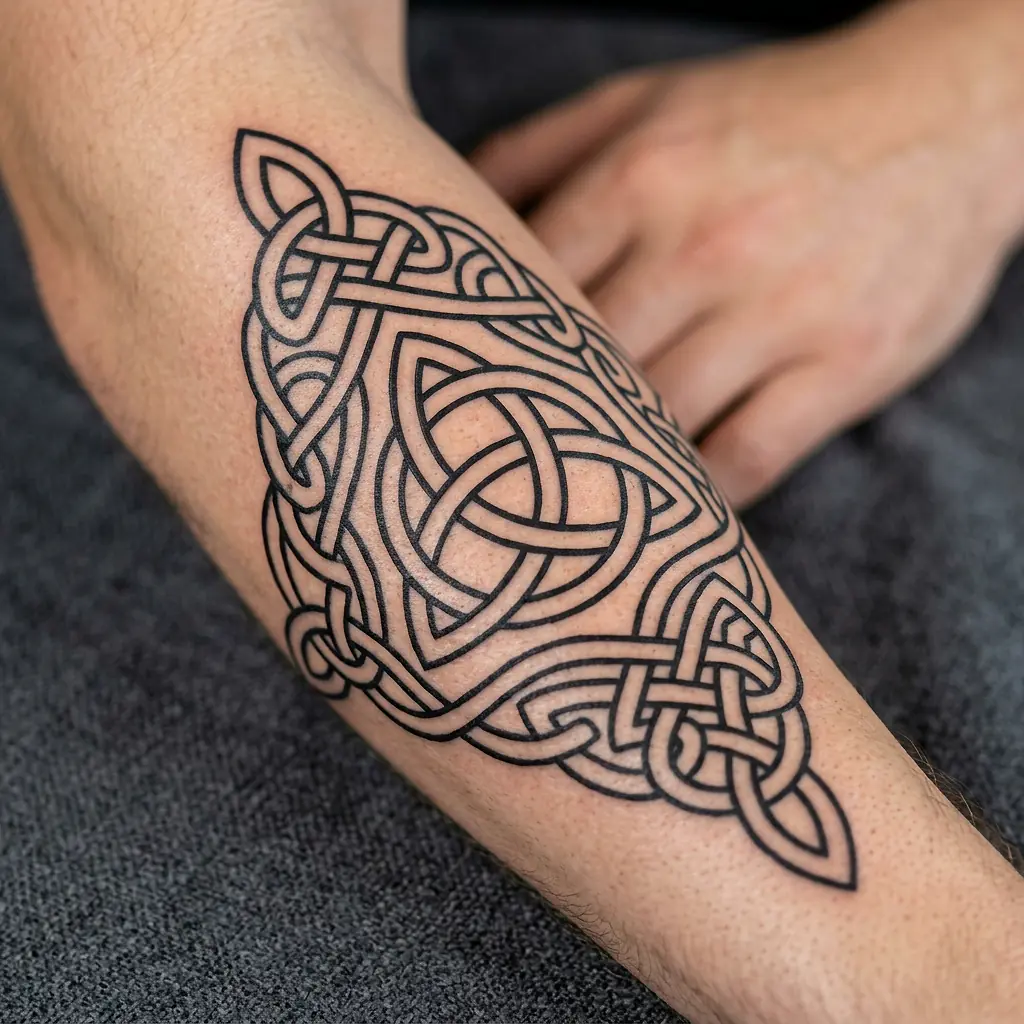
Meaning of the Celtic Knot Tattoo
The Celtic knot tattoo is one of the oldest and most recognizable motifs in tattoo art. Its interlaced lines, with no beginning or end, carry a profound symbolism of eternity, interconnection and infinite cycles. Inherited from the Celtic peoples of Europe, this motif has crossed centuries without losing its visual power or richness of meaning.
The fundamental principle of the Celtic knot lies in its continuous lines: a single line that interlaces without ever breaking, symbolizing that all things are connected and that life has no true beginning or end.
The triquetra (Trinity knot) is the most famous Celtic knot. Its three interlocking loops represent the triple nature of existence: birth, life and death; past, present and future; body, mind and soul. With the Christianization of Celtic peoples, it was adopted as a symbol of the Holy Trinity.
The Dara knot draws inspiration from the root system of the oak tree, sacred to the druids. It symbolizes inner strength, resilience and deep wisdom. Its complex interlace recalls the roots that firmly anchor the tree in the earth.
The Celtic love knot, with its two intertwined lines forming a heart, represents eternal union between two people. It is a symbol of devotion and unbreakable bond.
The shield knot, square in shape, is a symbol of protection. Celts placed it on their shields and at the entrance of their homes to ward off evil spirits and illness.
Origins and History
Celtic interlace art appeared around the 3rd century in Celtic territories across Europe (Ireland, Scotland, Wales, Brittany). The earliest examples are found on carved stones, metalwork jewelry and ritual objects.
The pinnacle of this art falls between the 6th and 9th centuries, during the golden age of Insular art. The Book of Kells, an illuminated manuscript created around 800 by Irish monks, represents the summit of Celtic interlace mastery, with entire pages of staggeringly complex patterns.
Celtic high crosses carved in stone, found throughout Ireland and Scotland, combine the Christian cross symbol with traditional interlace, testifying to the fusion of Celtic culture and Christianity.
The tradition continued through goldsmithing, stone carving and, later, tattooing. Today, Celtic knots have become an identity symbol for people of Celtic heritage and a universal motif representing infinity and continuity.
Popular Styles
Blackwork is the preferred style for Celtic knots. Precise black lines and solid fills faithfully reproduce interlace complexity while ensuring excellent readability over time.
Dotwork brings a contemplative dimension to Celtic knots. Point gradients create shadow and light effects that give volume to flat interlace patterns.
Modern geometric style reinterprets Celtic knots through the lens of mathematical precision, adding symmetry elements and contemporary geometric shapes.
Neo-traditional injects color into the interlace, often greens, blues and golds that evoke medieval illuminations and the landscapes of Ireland.
Recommended Placements
The forearm is ideal for a triquetra or medium-sized knot. Celtic armbands encircling the arm or calf are a timeless classic that perfectly exploits the continuous nature of interlace.
The back suits complex compositions integrating a Celtic tree of life or an ornate Celtic cross. The chest accommodates symmetrical knots centered on the sternum.
The wrist and ankle are perfect for small, discreet knots. The shoulder and shoulder blade offer a flat space ideal for detailed circular knots.
Combinations and Associations
Celtic knots make excellent borders and backgrounds for other motifs. A tree of life framed by interlace, a Celtic cross adorned with knots, a wolf or deer integrated into an interlaced pattern: the possibilities are vast.
Celtic animals (deer, raven, serpent, horse) stylized in the interlace tradition create zoomorphic designs where the animal’s body melds into the knot lines.
Celtic knots share an aesthetic kinship with Norse interlace and Viking motifs, allowing compositions that unite Celtic and Scandinavian traditions in a single visual narrative.