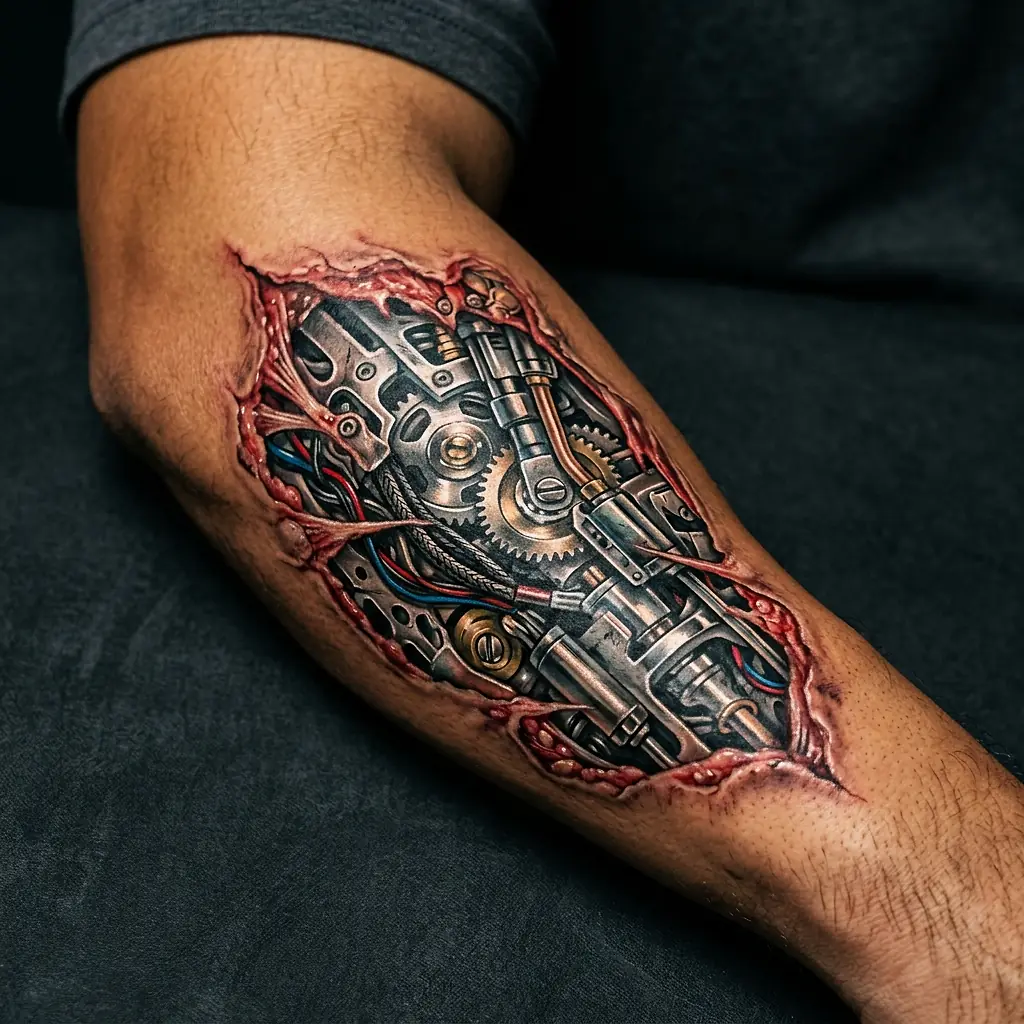
Meaning of the Biomechanical Tattoo
The biomechanical tattoo creates the fascinating illusion that beneath human skin lies a complex machinery of gears, pistons, cables and circuits. This spectacular style, born at the intersection of art and science fiction, explores the boundary between the organic and the mechanical, between human and machine.
Biomechanical tattooing carries a profound reflection on human nature and its relationship with technology. By revealing hidden machinery beneath the skin, it asks the question: are we purely organic beings, or already hybrids of flesh and machine?
This symbolism of human-machine fusion resonates particularly in our era where technology extends and transforms the human body: prosthetics, implants, augmented reality. Biomechanical tattooing visually anticipates what transhumanism theorizes.
Biomechanical also symbolizes hidden inner strength. Beneath an ordinary human surface lies extraordinary mechanical power. It is a metaphor for resilience: even when the outside appears fragile, the interior holds unsuspected strength.
The notion of transformation is central. Biomechanical shows a body in full metamorphosis, neither entirely human nor entirely machine. This permanent transition between two states evokes change, evolution and the capacity to reinvent oneself.
For some, biomechanical is a celebration of mechanics itself: the beauty of perfectly interlocking gears, the precision of pistons, the elegance of a complex system where every part has its function. It is a tribute to engineering and human ingenuity.
Origins and History
Biomechanical tattooing traces its origins to the work of H.R. Giger, a Swiss artist whose surrealist paintings fuse human bodies with mechanical structures. His work on the film Alien (1979), where he created the xenomorph creature design, established a biomechanical aesthetic that permanently marked global visual culture.
Giger’s paintings, with their organic tubes, mechanized bone structures and surfaces that are simultaneously alive and industrial, provided the founding visual vocabulary of the style. His concept of the “biomechanoid,” a being fusing flesh and machine, became the genre’s archetype.
In the 1980s, American tattoo artists Guy Aitchison and Aaron Cain were among the first to adapt the Giger aesthetic to tattooing. They developed techniques for creating the illusion of depth and torn skin that became the style’s hallmarks.
The cyberpunk movement of the 1980s-1990s (William Gibson, Blade Runner, Ghost in the Shell) reinforced cultural interest in human-machine fusion, feeding the biomechanical imagination with a constant flow of visual references.
Variations Within the Style
Classic biomechanical, directly inspired by Giger, presents metallic structures, pipes, gears and pistons visible beneath torn or transparent skin. Tones are generally dark: blacks, greys, metallics, with steel reflections.
Bio-organic replaces mechanical elements with strange organic forms: tentacles, membranes, alien bone structures, fantastic biological tissues. It is a style closer to biological science fiction than to mechanics.
Cyber-biomechanical integrates digital elements: circuit boards, code lines, holographic interfaces, LEDs. It reflects the current digital era where technology is less mechanical than computational.
The biomechanical skull, where a human skull reveals internal mechanics, has become a sub-genre in its own right, combining the symbolism of mortality with that of the machine.
Recommended Placements
The arm and forearm are the most common placements. The arm’s muscles, tendons and veins provide a natural anatomical substrate that the biomechanical tattoo “reveals” in mechanical form. A full sleeve allows an immersive composition.
The calf and thigh offer large flat surfaces ideal for detailed compositions. Leg muscles lend themselves particularly well to pistons and hydraulic actuators.
The shoulder is a classic placement where mechanics seem to emerge from the joint, creating a particularly realistic “mechanical joint” effect. The chest and ribs allow playing with the rib cage as a mechanical structure.
The back offers the largest surface for ambitious compositions: a mechanical spine, a system of cables and pistons spanning the entire back.
Combinations and Associations
Biomechanical combines naturally with anatomical elements: bones, muscles, tendons and organs visible beneath torn skin. This hybrid approach reinforces the realism of the illusion.
Mechanized animals (mechanical dragon, cybernetic wolf, robotic eagle) fuse animal symbolism with biomechanical aesthetics. The result creates fantastic creatures of considerable visual power.
The association with science fiction elements (ships, futuristic armor, holographic interfaces) anchors biomechanical in a complete narrative universe. Cybernetic eyes and mechanical hands are particularly popular combinations.