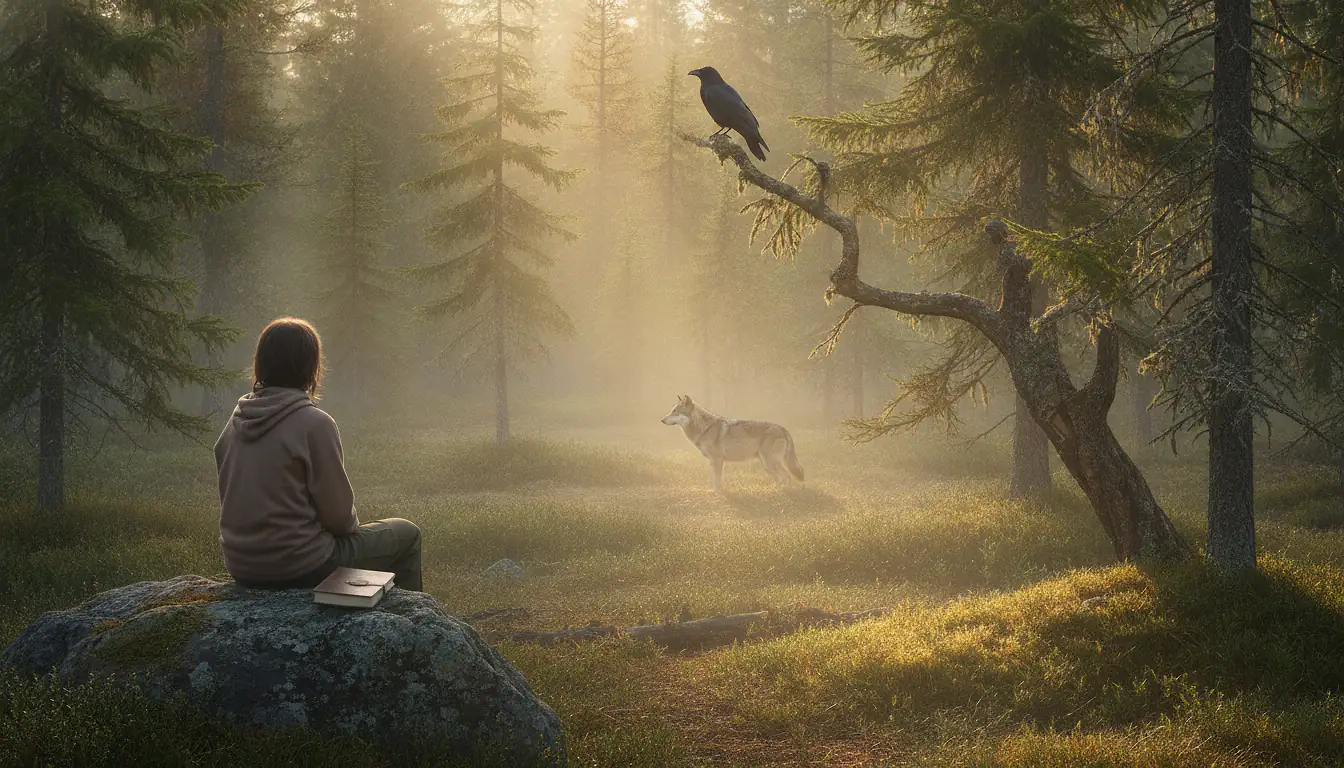
How do you find your totem animal without falling for an online quiz that assigns you a wolf in three clicks? The honest answer starts with a distinction: among the peoples who gave us the word, the totem is not sought, it is received at birth along with one's clan. The "personal" animal that people discover through observation or meditation comes from a different history, that of shamanism and its Western reinterpretation. Both approaches are valid as tools for reflection, as long as you know which one you are practicing.
Where the Idea of the Totem Animal Comes From
The word "totem" is a borrowing from a northern Algonquian dialect: the forms totam, then totem, came in through American English. The CNRTL (the French national dictionary of language resources) records a first attestation in French as early as 1609, and American English attestations in 1791 and 1809. Linguists generally connect the term to Ojibwe doodem, often cited as ototeman, which the CNRTL glosses as "his clan": the word really does mean a clan.
Among the Ojibwe, the doodem is an extended family name far more than a spiritual guide. It is traditionally passed down through the father, sets marriage rules (two members of the same clan do not marry), and assigns roles within the community. The Crane, Loon, Bear, Fish, and Marten clans are not chosen by their members: they inherit them.
The individual guide animal follows a different logic, found in many shamanic cultures (Siberia, the Americas, the Arctic): an animal spirit accompanies a specific person, often revealed during a dream, an illness, or a ritual ordeal. In the 1980s, the American anthropologist Michael Harner popularized the notion of a "power animal" in the West through his so-called "core" shamanism, detached from any particular culture. Most mainstream methods descend from this modern synthesis, not from Ojibwe traditions.
The same caution applies to the "medicine wheel" that assigns an animal based on birth month: this animal astrology was spread in the late 20th century by New Age authors, notably Sun Bear. Genuine medicine wheels are sacred stone structures, such as the Bighorn Medicine Wheel in Wyoming, whose 28 spokes connect the central cairn to the outer circle. Nothing about it points to a system of totems based on date of birth.
4 Methods for Finding Your Totem Animal
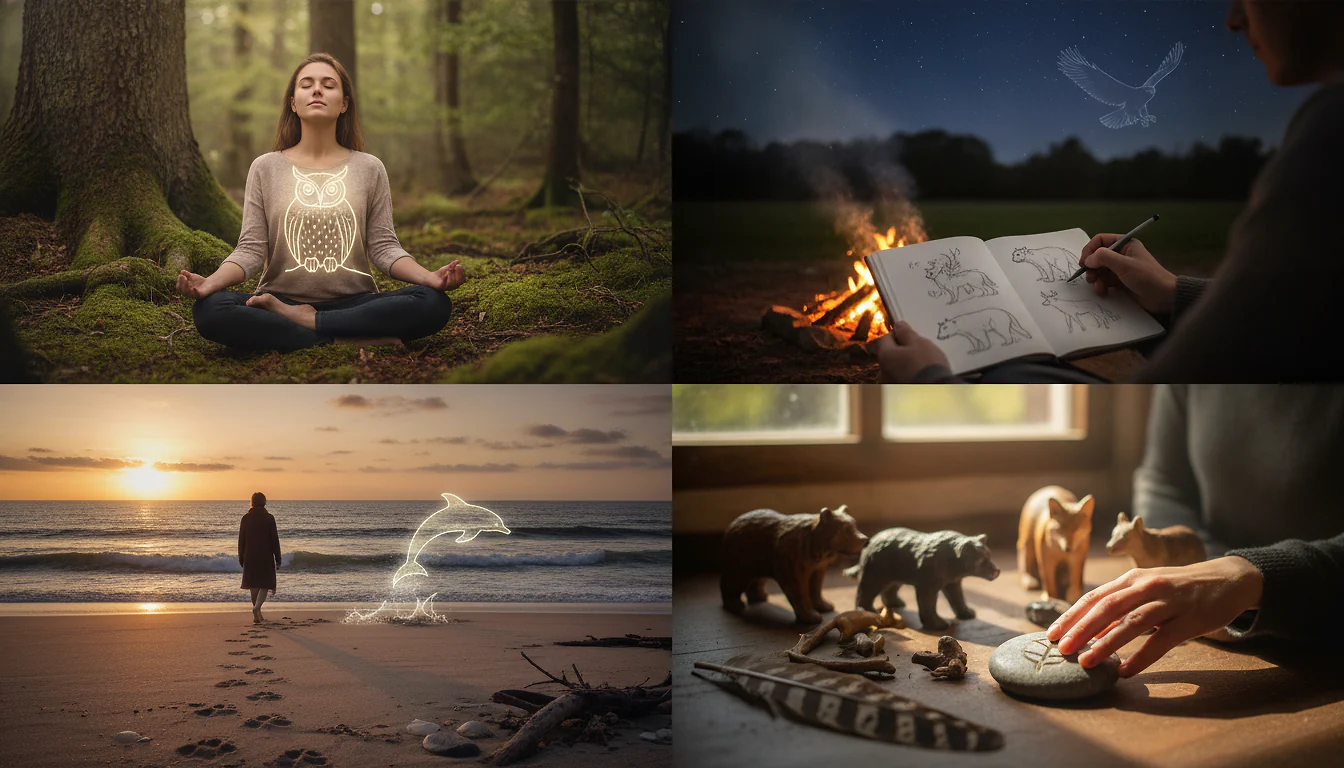
No method has been scientifically validated for determining a totem animal: the process is a matter of belief or introspection, not measurement. The four approaches below are the ones that come up most often in modern shamanic practice and in personal development. They can be combined.
1. Note the Animals That Keep Showing Up in Your Life
Keep a journal for a few weeks: animals you meet on walks, see in dreams, or notice on a poster or in a conversation. The principle, drawn from traditions where the animal spirit appears through repeated encounters, is to look for recurrence rather than a one-off event. A deer glimpsed at the edge of the woods just once doesn't say much; the same animal returning in your dreams, your reading, and your outings deserves your attention.
Stay clear-eyed about selection bias: the more you think about an animal, the more you notice it. The journal is there precisely to tell a real pattern from directed attention.
2. Examine Your Attractions and Your Fears
List the animals that have fascinated you since childhood, then those that inspire a marked aversion. In modern shamanic readings, the feared animal counts as much as the admired one: it is said to represent a quality you keep at a distance. A fear of spiders, for example, leads some practitioners to explore the symbolism of the spider as weaver of destiny, associated with patience and creation in several mythologies.
3. Try Meditation or a Drum Journey
The "shamanic journey" popularized by Harner is practiced lying down, eyes closed, to the sound of a steady drum: the person visualizes a descent into a "lower world" and notes which animal appears repeatedly. A simpler version is a guided meditation in which you imagine a natural landscape and let an animal come without choosing it.
The traditional vision quest of the Plains nations is something else entirely: a rite overseen by an elder, whose course varies from one nation to another and cannot be improvised. To learn the actual protocol, turn to the cultural centers of the nations concerned rather than to a commercial workshop.
4. Compare Your Traits With Symbolic Profiles
Once you have identified two or three candidates, compare their symbolism with your temperament and the period you are going through. An independent, observant, nocturnal person may recognize themselves in the cat and its love of autonomy. Someone seeking perspective before an important decision will rather explore the eagle's wide vision. Keep the animal that genuinely enlightens you, not the one that flatters your self-image.
Totem Animals and Their Meanings
Each tradition gives the same animal different meanings: the raven is a cunning creator of the world among the peoples of the Northwest Coast, but a bird of ill omen in part of European folklore. The meanings that follow sum up the most widespread symbolic reading today, which should be attributed to these traditions and not taken as truths.
Among birds and large mammals, the eagle embodies the big picture and the link with the sacred: many Native American nations regard it as the messenger of the Creator. The bison, central to the culture of the Plains peoples, stands for abundance, gratitude, and sharing. The whale is associated with memory, emotional depth, song, and transmission.
Other animals speak more to temperament. The deer evokes gentleness, sensitivity, and the ability to move forward without violence. The spider points to patience, creation, and the weaving of destiny. The cat, finally, symbolizes independence, intuition, and a certain ease with the unseen.
The number of "recognized" totem animals has no single answer: it depends on each nation, its clans, and its stories, and only the cultural institutions of those peoples can account for it accurately.
Pitfalls to Avoid When Looking for Your Totem
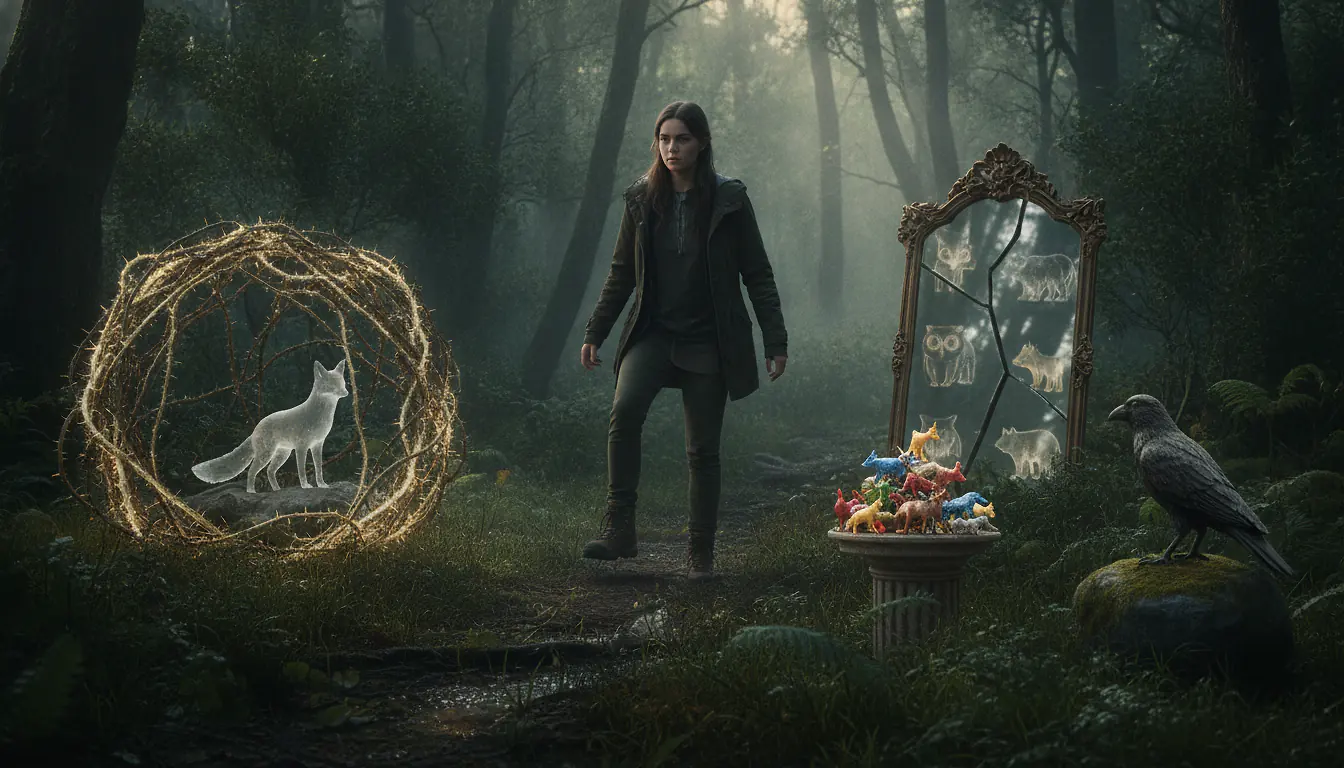
First pitfall: the express quiz. Five questions about your favorite color reproduce no tradition and mostly produce wolves, eagles, and lions, the most flattering animals. Second pitfall: declaring yourself a member of an Ojibwe or Lakota clan because an animal speaks to you. The doodem is a family and community affiliation, and many First Nations members find this appropriation hurtful. It's better to speak of a "guide animal" or "power animal" for a personal journey.
Third pitfall: fixing the animal forever. In modern shamanic practice, several animals can accompany the same person, and a guide can change with the stages of life. Some people even choose to mark this encounter on their skin: an eagle tattoo or a wolf tattoo is a commitment for decades, whereas symbolism is often lived in seasons. Give yourself a few months of distance before a decision like that.