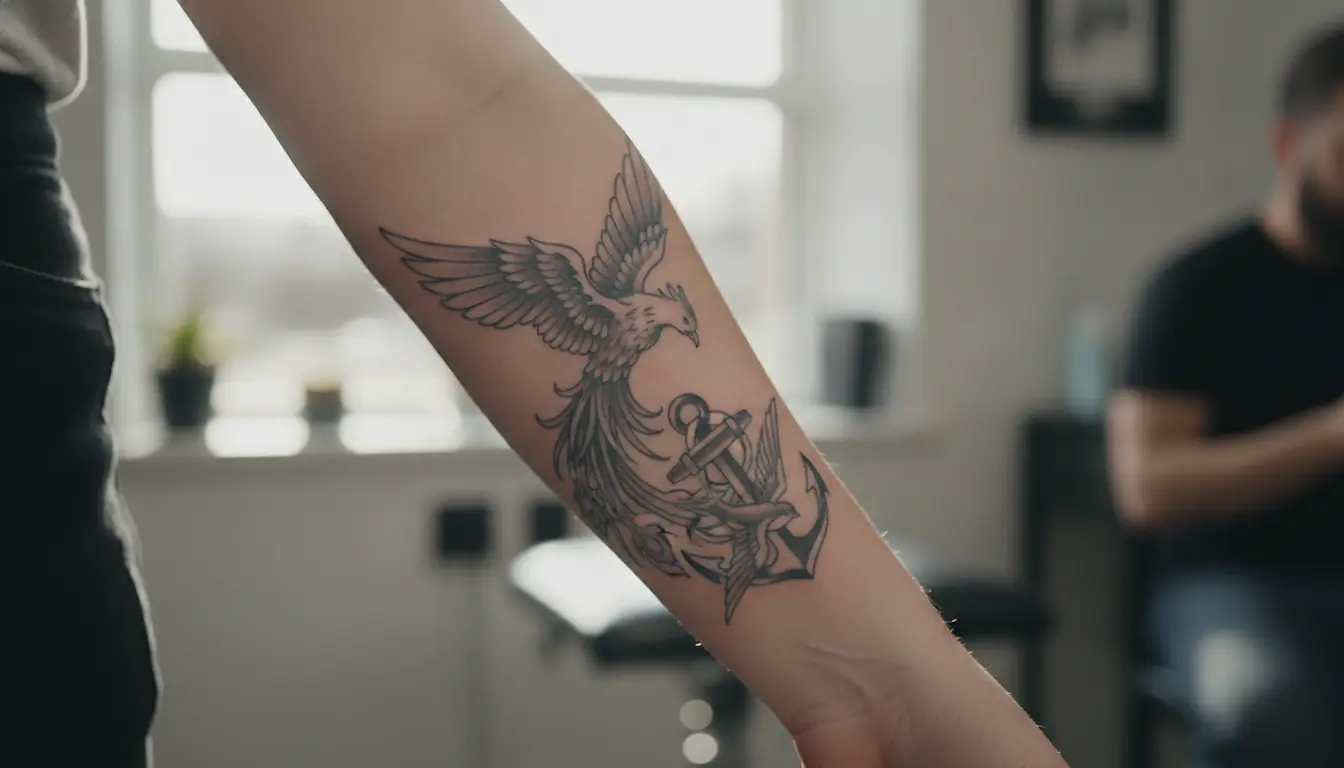
What tattoo means what? The question deserves an answer before your first appointment, because a design stays on your skin far longer than the emotion that inspired it. Tattoo meanings appear in no official dictionary: each symbol draws its sense from a specific tradition (ancient Egypt, Christianity, sailor culture, Buddhism), and that sense varies from one culture to another. The symbols below are sorted by message, around the 5 most common intentions: protection, strength, love, grief and renewal.
Start from the message, never from the design
The soundest choice starts with one sentence: what you want to say, to whom, and for how long. A design picked for its look, then justified after the fact, often ends up feeling false. A clear message, on the other hand, narrows the list of possible symbols down to three or four candidates.
No scientific study attributes an effect to a tattooed symbol. The meaning of a tattoo rests on two layers: the tradition that shaped the design, and the personal story of the person who wears it. The first can be checked, the second belongs to you.
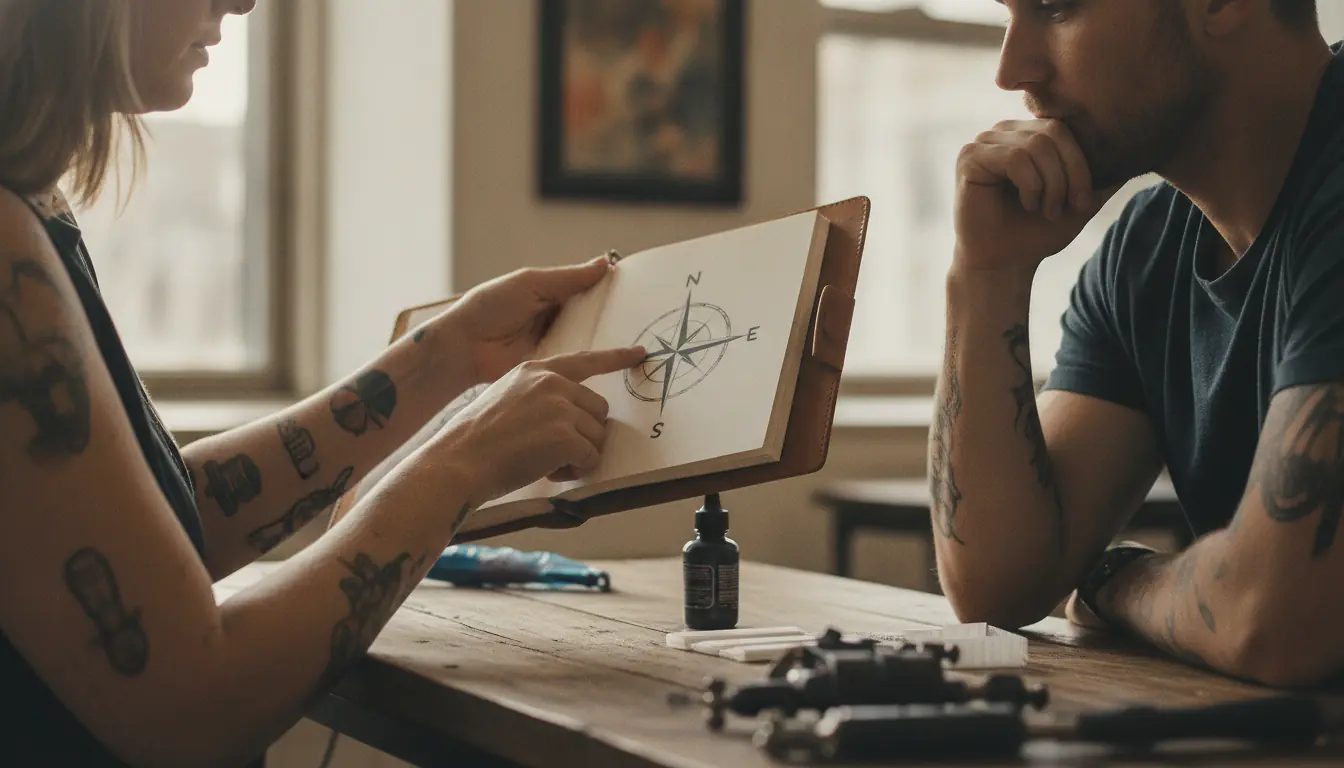
List of tattoo symbols with explanations, by message
Use this table as a starting point: for each message, the most common symbols, their tradition of origin and the point to check before you decide.
| Message | Symbols | Tradition of origin | Point to watch |
|---|---|---|---|
| Protection | Eye of Horus, hamsa, guardian angel, dreamcatcher | Ancient Egypt, North Africa and the Middle East, Christianity, Ojibwe | The dreamcatcher remains a sacred object for some Indigenous nations |
| Strength | Lion, eagle, tiger, anchor | European heraldry, ancient Rome, China, sailors | The imperial eagle has also served as an emblem for authoritarian regimes |
| Love | Heart, swallow, rose, infinity | Traditional Western tattooing, Greco-Roman mythology | A name commits you far more than a symbol does |
| Grief | Wings, feather, forget-me-not, the deceased's handwriting | Christianity, the language of flowers, contemporary practice | A date alone loses its meaning for other people |
| Renewal | Phoenix, butterfly, lotus, semicolon | Greek mythology, Buddhism and Hinduism, advocacy movement | The semicolon is read as a message tied to mental health |
Protection: the eye, the hand and the angel
The Eye of Horus, or udjat, was an amulet in ancient Egypt, placed alongside the living and the dead to ward off evil. The hamsa, an open hand with five fingers, plays the same role against the evil eye in the folk traditions of North Africa and the Middle East, shared by Jewish and Muslim communities.
In Christian culture, the figure of the guardian angel tattoo expresses the protection received from a benevolent being, often a loved one. The dreamcatcher comes from the Ojibwe, who hung it above children's cradles to protect their sleep. Our advice: if this last symbol appeals to you, learn about its original use, because its decorative adoption is criticized by some of the peoples concerned.
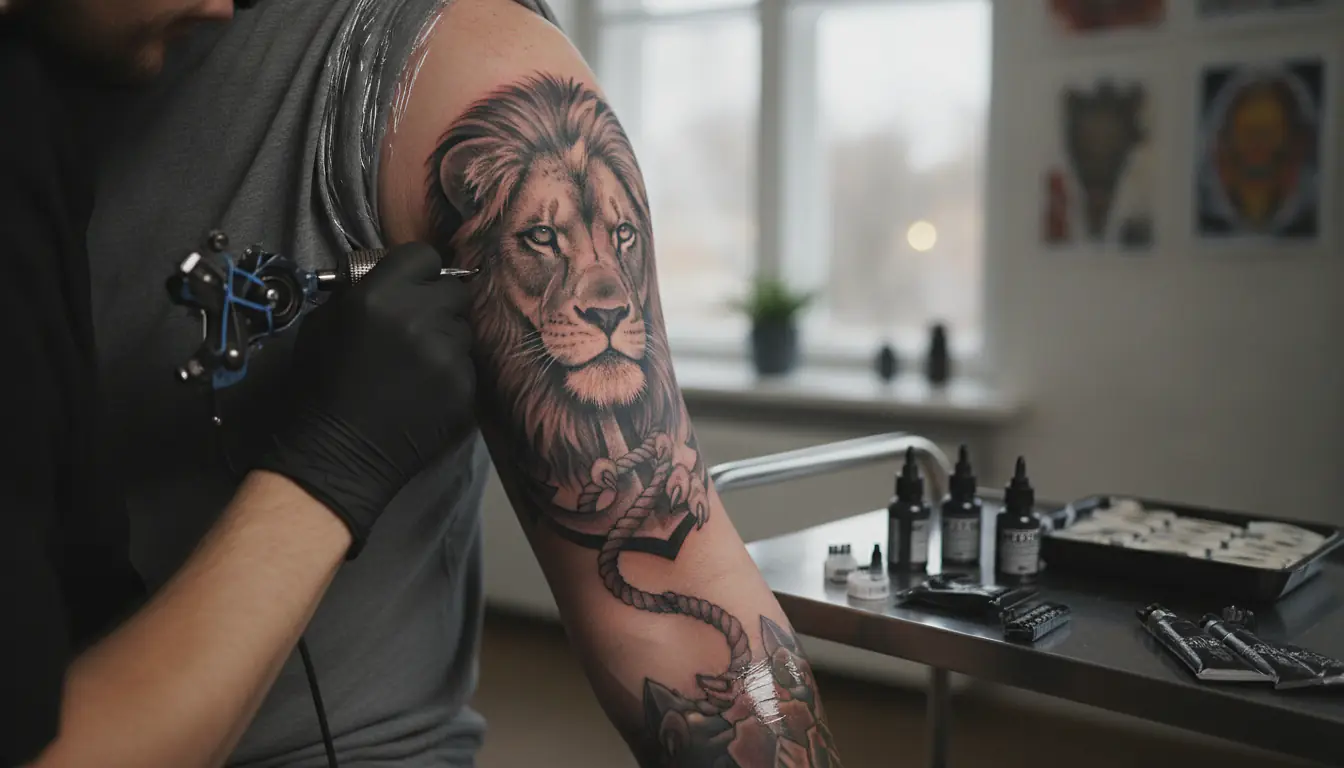
Strength: from the lion to the anchor
The lion dominates European heraldry as an emblem of courage and sovereignty. The eagle carries a similar symbolism: the standard of the Roman legions, it stands for power and a broad vantage point, and the symbolism of the eagle in tattoos differs sharply between an imperial reading and a Native American one, where the eagle feather is sacred.
The tiger, in Chinese tradition, is one of the four guardian animals of the cardinal points: the White Tiger watches over the west. The anchor, finally, speaks of quiet strength. Sailors wore it, and the first Christians made it a sign of hope: the meaning of the anchor therefore lies in stability more than in power.
Love: heart, swallow, rose and infinity
The heart crossed by a banner is a classic of traditional Western tattooing. The swallow comes from sailor culture: a bird that returns to the same nest every year, it symbolizes fidelity and the return to one's loved ones. The rose, associated with Aphrodite and then Venus, unites beauty and pain through its thorns.
The infinity sign, borrowed from mathematics, has become established as a symbol of endless love. A firm opinion: choose a symbol whose meaning will still hold if the relationship changes. A name commits you more than a swallow shared by two people.
Grief: keeping a trace without saying everything
Wings, often paired with a name or a date, depict a lost loved one taking flight. The feather offers a more discreet version. The forget-me-not, whose name in many languages means "do not forget me," comes from the language of flowers.
A contemporary practice consists of reproducing the handwriting of the deceased, copied from a card or a letter. It is the most personal choice on this list: no one else will read it the same way, and that is precisely its strength.
Renewal: phoenix, butterfly, lotus and semicolon
The phoenix of Greek mythology is reborn from its ashes: the most direct symbol of rebuilding after an ordeal. The butterfly speaks of metamorphosis, and the Greek word psyche meant both the soul and the butterfly. The lotus, in Buddhism and Hinduism, rises from the mud without being soiled by it.
The semicolon was popularized by the American movement Project Semicolon: the sentence could have ended, but it continues. This tattoo signals a journey tied to mental health, and many people will read it that way.
Tattoo symbols and meanings: double readings to know about
Some designs change meaning from one country to another. The teardrop under the eye, the spiderweb on the elbow or the five dots arranged in a quincunx on the hand are associated with prison culture in several countries. Stars on the shoulders or knees refer to the codes of Russian prisons. The swastika, a favorable sign in Hinduism and Buddhism, remains inseparable from Nazism in Europe.
Placement matters mainly in these prison codes and in Polynesian traditions, where the position of a design on the body indicates lineage or status. Outside these frameworks, neither color nor body area changes the meaning of a symbol: only your intention does.
Before the appointment: checking the message and the tattoo artist
Once you have settled on a symbol, this five-step check avoids the two costliest mistakes: a meaning you had not intended, and a tattoo artist who is not in compliance.
- Write the message in one sentence, without naming a design.
- Identify the tradition of origin of the chosen symbol and check that it speaks to you.
- Look up the design in other cultures to spot any possible double reading.
- Ask the tattoo artist whether they have declared their activity to the ARS (the French regional health agency) and completed the mandatory hygiene and sanitation training: 21 hours over 3 days, including 7 hours of practice.
- For anyone under 18, plan for written parental consent, which the tattoo artist must keep for 3 years.
At a convention or a guest spot, a visiting tattoo artist may not work more than 5 business days per year in the same venue without declaring a permanent premises. The price, for its part, depends on the size of the design, the level of detail and the session length: a written quote remains the only reliable basis for comparison.