
The meaning of dreams has intrigued people since antiquity, but the question changed in nature in the 20th century: we no longer ask only what a dream foretells, but what it says about the person who had it. Freud, Jung and now neuroscience offer three very different readings, and none of them works like a dictionary where each symbol has a single meaning. Interpreting your dreams seriously means knowing where each framework comes from, what it can do and what it cannot.
Our position is clear: a dream is not a prediction, it is personal material. Symbolic traditions offer leads, psychoanalysis offers a method, and sleep research offers a framework.
What Science Knows About Dreaming
REM Sleep, the Prime Time for Dreams
An adult's night is organized into cycles of about 90 minutes, and we go through 4 to 6 of them. Each cycle ends with a phase of REM sleep: the brain shows activity close to wakefulness, the eyes move rapidly under the eyelids and the body's muscles are almost paralyzed, which keeps us from physically "acting out" our dreams.
This phase accounts for 20 to 25% of total sleep. It lengthens as the night goes on: the last cycles, in the early morning, contain more of it, which explains the long, narrative dreams we remember on waking. With an average of 6 hours 50 minutes of sleep per weeknight among the French, an earlier wake-up cuts into these dream-rich final hours first.
Everyone Dreams, Few People Remember
People who claim they never dream do dream too: the difference lies in memory, not in production. When woken in the middle of REM sleep in laboratory experiments, 80% of sleepers report a dream. When woken during another phase, 50 to 75% still report some mental content, often shorter and less visual.
For anyone looking for the meaning of last night's dream, the consequence is practical: the memory fades quickly, especially if you move around or immediately start thinking about your day.
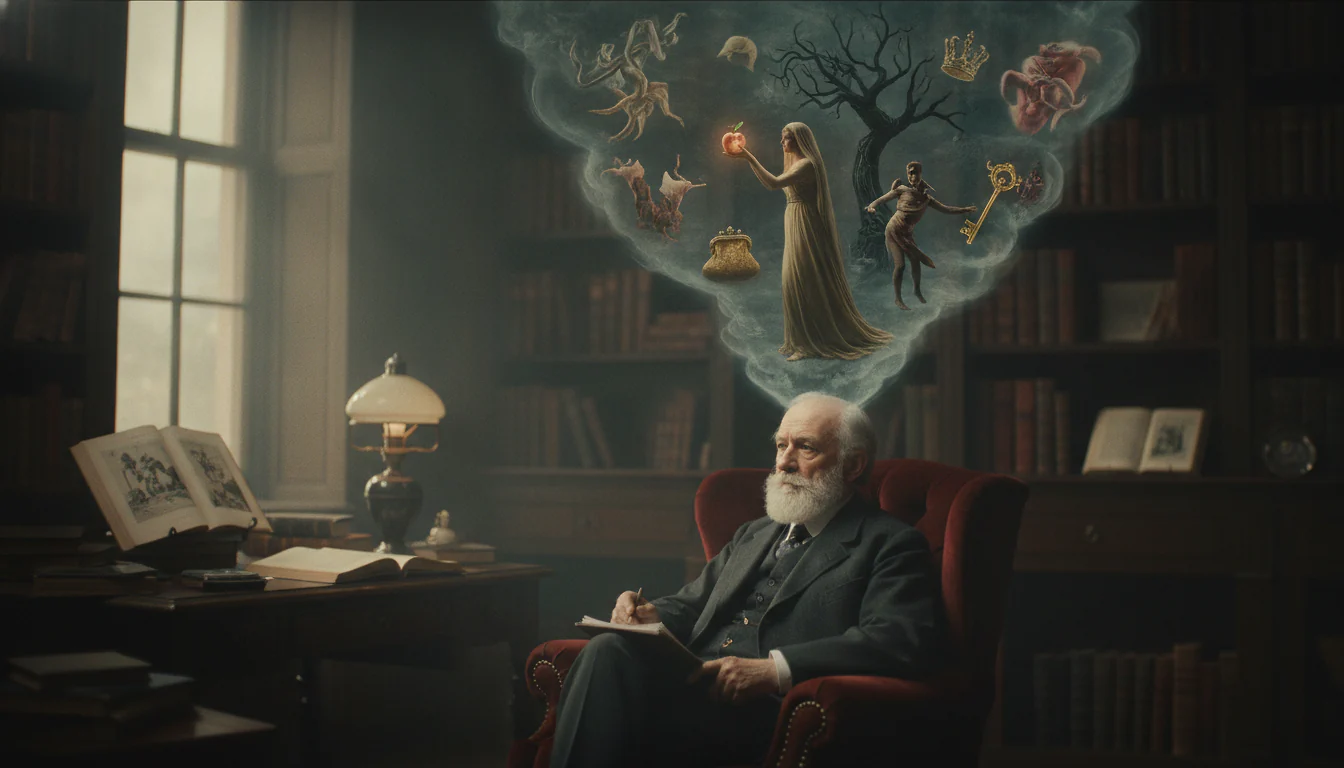
Freud: The Dream as a Disguised Wish
With The Interpretation of Dreams, published in Vienna at the end of 1899 and dated 1900 by its publisher, Sigmund Freud made the dream "the royal road" to knowledge of the unconscious. His thesis: every dream is the disguised fulfillment of a wish, often a repressed one, that psychic censorship does not let through as it is.
Manifest Content and Latent Content
Freud distinguishes manifest content, meaning the story we remember, from latent content, the thoughts that produced it. The "dream work" turns the latter into the former through several operations: condensation (several people or ideas merge into a single image), displacement (emotion shifts onto a trivial detail), representation (an abstract idea becomes a scene) and secondary revision, which gives the whole an appearance of coherence.
To these are added "day residues": an ordinary event from the day before serves as the setting, and interpretation often starts there.
The Primacy of Associations
Freud's lasting contribution lies in his method. He rejects the "decoding method" of dream books, where each element has a fixed translation. He breaks the dream into fragments and asks the dreamer what each one evokes, without filtering: it is these free associations, not a universal code, that give the meaning.
Its main limitation is well known: reducing almost every dream to a wish, often a sexual one, rests on a postulate that experiments have never confirmed.
Jung: Symbols, Archetypes and Compensation
Carl Gustav Jung, at first close to Freud, broke with him in the early 1910s. For Jung, the dream disguises nothing: it expresses the state of the psyche in the language of symbol, a language to be learned rather than decoded.
The Compensatory Function
Jung's central idea is compensation: the dream rebalances the conscious attitude. A person who always appears self-assured will readily dream of falling or failing an exam; another who puts themselves down may dream of being cheered. The dream flags what consciousness neglects.
Jung also reads dreams in series, over weeks or months, rather than one at a time. A motif that recurs and transforms tells you more than an isolated image.
Universal Symbolism, to Be Handled With Care
Jung adds a second level: the collective unconscious, populated by archetypes shared by humanity (the Shadow, the Anima and Animus, the Wise Old Man, the Great Mother). To explore them, he uses amplification: linking the dream image to the myths, tales and religions that use it. He himself interpreted one of his famous dreams, a house with several floors that he explores down to a prehistoric cellar, as an image of the successive layers of the psyche.
This universal symbolism feeds most of today's interpretations: water and the sea as a figure of the unconscious, descent as a return to oneself. Yet Jung insisted on a point that is often forgotten: personal context comes first, and a symbol only has meaning once it is tied to the dreamer's life. The very existence of a collective unconscious remains a hypothesis, not a demonstrated fact.

Dream Neuroscience: Four Hypotheses
Sleep research does not look for the hidden meaning of a dream, it looks for what dreaming is for. No theory has won consensus, but four hypotheses dominate the debate.
Activation-Synthesis and Memory Consolidation
Activation-synthesis. Proposed by the American psychiatrists Allan Hobson and Robert McCarley in 1977, it sees the dream as the cortex's attempt to build a story out of signals sent by the brainstem during REM sleep. Hobson later acknowledged that this story also reflects the dreamer's concerns.
Memory consolidation. Sleep contributes to sorting and fixing memories, and dream content often mixes recent fragments with old memories. The dream would be the conscious trace of this filing work.
Emotional Regulation and Threat Simulation
Emotional regulation. Dreaming would let us relive strong emotions in a state where the chemical messengers of stress are at their lowest, and soften their charge.
Threat simulation. The Finnish researcher Antti Revonsuo proposes that the dream serves as training: chases, falls and attacks by a monster or threatening creature would rehearse flight and defense responses in a danger-free environment.
These models are not mutually exclusive, and none of them invalidates the idea that a dream speaks about its author. They do rule out two beliefs, though: that of a message coming from outside and that of a symbolic code valid for everyone.
Freud, Jung, Neuroscience or Dictionary: Which Reading to Choose
| Approach | What a dream is | Method | Strength | Limitation | Verdict |
|---|---|---|---|---|---|
| Freud | A repressed, disguised wish | Free associations on each fragment | Personal method, role of day residues | Wish postulate not demonstrated | Keep the method, leave the dogma |
| Jung | A compensatory message from the psyche | Context, dream series, amplification | Constructive reading, oriented toward growth | Archetypes cannot be verified | The best framework for personal work |
| Neuroscience | A product of the sleeping brain (memory, emotions) | Laboratory experiments, induced awakenings | Facts about sleep and recall | Silent on the meaning of a specific dream | The reference framework, not a key for reading |
| Dream dictionaries | A set of symbols with fixed meanings | Looking up the symbol in a list | Quick leads drawn from traditions | Ignores the dreamer's context | Useful to get started, misleading as a final answer |
Interpreting Your Dreams: The 5-Step Method
Keep a Dream Journal
Keep a notebook and pen within reach, or a voice recorder, and write things down on waking before you get up: staying still with your eyes closed for a few moments helps you find the thread. Write in the present tense, even just a fragment, and date each entry.
Add three lines under the account: the emotion on waking, the notable events of the day before and what is on your mind right now. After a few weeks, recurrences appear on their own: a place, a person, a scenario that keeps coming back.
The Five Steps of Interpretation
- Write down the raw account, without correcting it and including the absurd details: they are often the ones that matter.
- Identify the dominant emotion (fear, joy, shame, relief). The emotion you felt is a better guide than the images.
- Look for day residues: which event, which conversation shows up in the dream?
- Associate freely on each element: what does this place, this person, this object bring to mind? Write down the first answer, even if it seems unrelated.
- Only then compare with the symbols of traditions, last of all, and keep only what resonates with your situation.
Worked Example: Picking an Apple
Take an example: a person dreams that they pick a red apple in their grandparents' orchard, then does not dare bite into it. A dream dictionary would see temptation there, referring to the forbidden fruit of Genesis. The raw account, for its part, highlights hesitation. The day before, this person received a job offer they have not yet accepted, and their associations with the orchard evoke the security of childhood.
The personal interpretation then becomes more precise than any symbol: a tempting opportunity within reach, and the fear of leaving a reassuring setting. The Freudian reading (a held-back wish), the Jungian reading (a compensation for excessive caution) and the neuroscientific reading (a concern of the day reprocessed at night) converge, though none of them says what the person should decide.
The Limits of Dream Interpretation
An interpretation remains a hypothesis that the dreamer either validates or not. The best indicator is the feeling of recognition, the impression that the reading "rings true" and sheds light on something.
No serious method can predict the future through dreams. Dreaming of the death of a loved one does not foretell it: this type of dream most often speaks of a change in the relationship or a life transition. Premonitory readings belong to popular and religious traditions, not to facts.
Not every dream calls for interpretation, either. Nightmares that repeat after a traumatic event, or that degrade your sleep night after night, are first a matter of sleep health, not of symbolic reading.
Dreams and Meaning: The Major Themes
Signifika's dream entries follow the same logic as this method: for each theme, they distinguish what psychoanalysis, traditions and dream books say, then suggest questions to ask yourself. Among the most searched themes are the house, often read as an image of the self and its inner rooms, the wedding, associated with commitment or the union of two parts of oneself, the mirror, which questions self-image, and the mountain rising in a dream, between an obstacle to overcome and a summit to reach.
Before opening an entry, write down your dream and your associations: the entry then serves to broaden your leads, not to dictate a meaning to you.