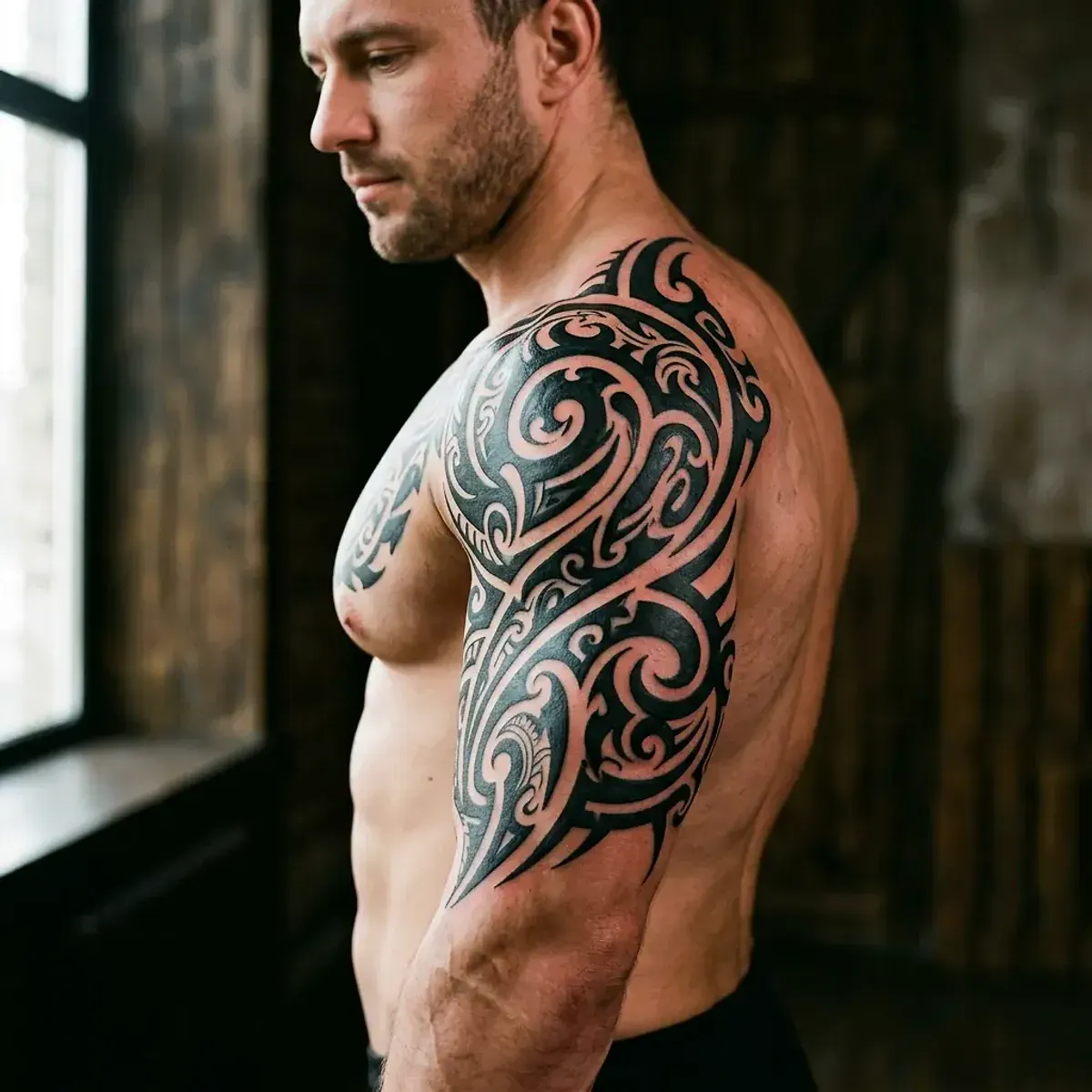
Tribal Tattoo Meaning
The word “tribal” in tattooing refers to the broadest and oldest category of human body marking — the traditions that existed for thousands of years before modern tattooing, in cultures around the world, where permanent body modification was a fundamental technology of identity, spirituality, and social communication.
In these original contexts, a tribal tattoo was not a decorative choice but a necessity of cultural existence. A Maori warrior without his tā moko was incomplete — without identity, without standing, without the visible declaration of his genealogy and spiritual status. A Dayak woman without her traditional tattooing might be barred from the afterlife. A Polynesian navigator without his patterns was unrecognized in the spirit world.
Contemporary tribal tattoos in the Western tradition are inspired by these ancient forms and adapted for a different cultural context. They carry the energy of ancient tradition, primal pattern-making, and the aesthetic power of bold black geometry without necessarily encoding the specific meanings of their source cultures. This distinction between inspired-by and authentic-to is important — someone who grows up outside the Maori, Polynesian, or other specific tribal cultures does not carry the full weight of meaning that those traditions hold for people born within them.
Strength and connection to ancestral power are the most common contemporary meanings. The bold, dynamic patterns of tribal tattooing communicate something visceral and immediate — they speak directly to an aesthetic response that seems to operate below cultural conditioning. The solid black, the organic flow, the interplay of filled and open space — these qualities create a visual impact that is recognized across cultures as powerful and significant.
Identity and belonging are fundamental to tribal tattooing in all its forms. In original tribal traditions, the tattoo was the body’s declaration of community membership — who your people are, who your ancestors were, where you stand in the social and spiritual world. Contemporary tribal tattoos can honor this dimension by representing a chosen identity, a found community, or a lineage — biological or chosen — that the wearer wants to embody permanently.
Protection and spiritual armor are dimensions of tribal tattooing across all its traditions. Tattoos were believed to transmit spiritual power to the wearer, to create a visual barrier against malevolent forces, and to identify the wearer as protected by specific ancestral or divine powers. The bold, boundary-marking quality of tribal patterns — the way they define and claim the skin’s territory — is visually coherent with this protective function.
Origins and History of Tribal Tattooing
Human tattooing is at least 5,000 years old, based on the evidence of Ötzi the Iceman — a Neolithic man found preserved in an Alpine glacier in 1991, whose 61 tattoos consist of simple lines and crosses placed on joints and the spine, possibly for therapeutic purposes. But the tradition almost certainly goes back much further.
Ancient Polynesian tattooing is the most extensively documented and culturally developed tribal tattoo tradition. Polynesian societies — Samoan, Tongan, Hawaiian, Marquesan, Maori, Tahitian — each developed distinctive tattoo languages that encoded genealogy, spiritual status, and identity in precise geometric and biomorphic patterns. Captain Cook’s voyages in the 1770s introduced Western audiences to Polynesian tattooing and brought the word “tattoo” (from Tahitian tatau) into the English language.
Maori tā moko is perhaps the most famous tribal tattoo tradition in the world. The moko — covering the face in complex curvilinear patterns — contains the wearer’s complete genealogy and tribal identity in a form that serves as both personal ID and spiritual weapon.
African tribal tattooing encompasses enormous diversity across the continent — from the keloid scarification of central Africa to the fine geometric patterns of North African Berber tradition to the elaborate body decoration of southern African cultures.
The Tribal Tradition in Different Cultures
In Polynesia, the tattooist (tufuga ta tatau in Samoa, tohunga ta moko in Maori tradition) held sacred status as a mediator between the human and spirit worlds. The tattooing process itself was a ritual of transformation.
In Japan, the Ainu people of Hokkaido practiced mouth tattoos on women (sinuye) as marks of social maturity and spiritual protection. These tattoos were performed gradually over years beginning in girlhood.
In Celtic Europe, while the evidence for actual tattooing among ancient Celts is limited, the tradition of bold, interlocking geometric patterns in metalwork, manuscripts, and stone carving represents the same aesthetic tradition — the Celtic knot as a visual language with encoded spiritual meaning.
In Native American traditions, tattooing varied enormously between nations but was practiced widely as a form of spiritual protection, identity marking, and achievement recognition.
Tribal Tattoo Styles
Bold blackwork with solid fills and sharp edges is the defining aesthetic — no grey wash, no fine lines, just the dynamic interplay of solid black and bare skin.
Biomorphic organic shapes that flow naturally with the body’s contours are characteristic of most tribal traditions.
Geometric grid-based patterns (more common in Polynesian traditions) use systematic repetition of specific units to build complex compositions.
Contemporary tribal fusion may add grey wash, fine lines, or incorporate other styles while maintaining the bold black foundation.
Popular Placements
The upper arm is the most common placement for tribal tattoos in Western contemporary tattooing.
The shoulder, chest, and back suit larger tribal compositions.
The calf works for tribal designs that follow the leg’s musculature.
A tribal sleeve covering the entire arm is a comprehensive composition.
Combinations and Associations
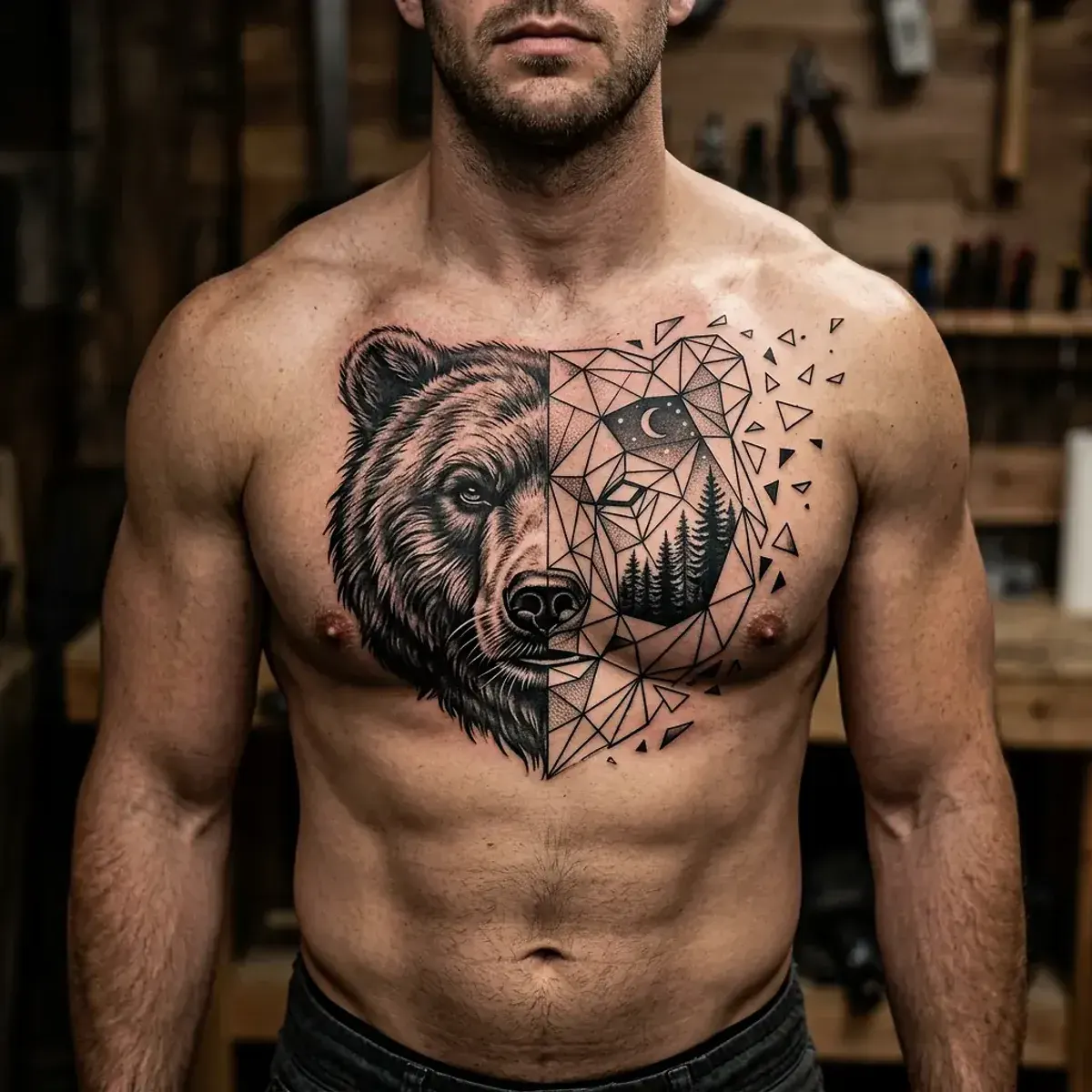
Tribal patterns as a framework for realistic animal portraits creates powerful half-and-half compositions.
Polynesian patterns within a tribal composition creates culturally specific and historically grounded work.
A geometric overlay on tribal patterns creates contemporary sacred geometry compositions.
Tribal extensions from a realistic face — wolf, lion, or bear — create striking compositions where the wild and the geometric meet.