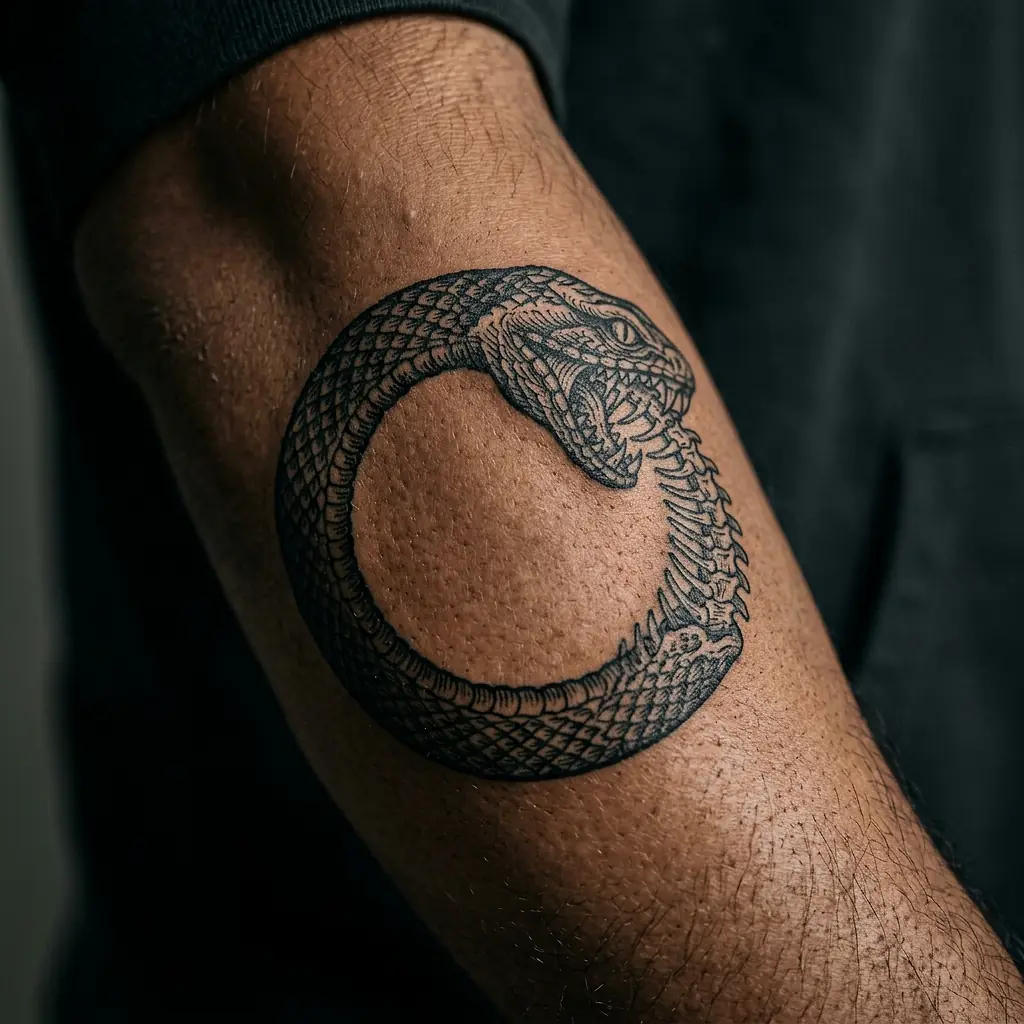
Meaning of the Ouroboros Tattoo
The ouroboros is one of humanity’s oldest and most philosophically dense symbols, and as a tattoo it carries a weight of meaning that few other motifs can match. This serpent devouring its own tail represents the eternal cycle of life, death, and rebirth, infinity, and the fundamental unity of all existence.
The ouroboros embodies the concept of eternity and perpetual renewal. By consuming itself, the serpent continuously recreates itself, symbolizing the endless cycle of destruction and creation. It is a powerful metaphor for the cyclical nature of existence: seasons turning, cells regenerating, civilizations rising and falling.
The symbol also represents the unity of opposites. Beginning and end merge, life and death fuse, creator and creation become one. The ouroboros reminds us that the boundaries between opposites are illusory, that everything is connected in one continuous process.
Getting an ouroboros tattoo declares a deep understanding of transformation. Like the serpent that sheds its skin and emerges renewed, the ouroboros symbolizes the capacity to reinvent oneself, to be reborn after each trial, to find renewal in apparent destruction.
The ouroboros also embodies self-sufficiency and completeness. The serpent feeds on itself, forming a perfect, autonomous circle. It is a symbol of inner wholeness and independence, of needing nothing outside itself to be complete.
Origins and History
The oldest known representation of the ouroboros dates from ancient Egypt, approximately 3,400 years ago. It appears in the Amduat, a funerary text of the New Kingdom describing the sun’s journey through the underworld. The serpent encircling the solar disk symbolized the daily cycle of the sun’s death and rebirth.
In ancient Greece, the ouroboros was adopted by pre-Socratic philosophers as a symbol of cosmic eternity. The term itself comes from the Greek oura (tail) and boros (devouring). Plato described the first living being as a circular creature that was entirely self-sufficient.
The ouroboros is a central symbol in European and Arabic alchemy. It represents the philosopher’s stone, transmutation, and the unity of matter. Alchemists used it to illustrate the concept of hen to pan (“the all is one”) and the process of purification through successive cycles.
In Norse mythology, Jormungandr, the Midgard Serpent, encircles the entire Earth while biting its own tail. Its release will trigger Ragnarok, the end of the world, followed by a new beginning. In Hindu mythology, the cosmic serpent Shesha carries the universe on its coils, symbolizing infinity.
Popular Styles
Blackwork is the most powerful style for the ouroboros, with a densely inked serpent and visible scale details. The contrast between black ink and skin creates immediate visual impact.
Engraving style, inspired by alchemical illustrations and medieval woodcuts, offers a vintage, mysterious rendering. Hatching and fine lines evoke ancient manuscripts and esoteric treatises.
Realism brings the serpent to life with detailed scales, skin reflections, and a striking open mouth. Neo-traditional adds colors and shadows that reinforce the mythical dimension.
Geometric reinterprets the ouroboros through clean lines and mathematical forms. Minimalist reduces the motif to a simple circle formed by a stylized snake, discreet but loaded with meaning.
Recommended Placements
The arm and forearm are natural placements for the ouroboros, with the circle following the cylindrical shape of the limb. The serpent can wrap completely around the arm like a permanent bracelet.
The wrist and ankle host a small ouroboros that encircles the limb, creating a symbolic permanent ring. This is a discreet but visually effective placement.
The back offers an ideal surface for a large ouroboros containing other symbols at its center. The sternum and chest allow a centered, symmetrical placement.
The shoulder and calf are also strong choices, offering a rounded surface that harmonizes with the motif’s circular form.
Combinations and Associations
The ouroboros forms a natural frame for other symbols. An eye at the center evokes wisdom and cosmic consciousness. A tree of life inside the circle unites the cycle of existence with perpetual growth.
Combined with an infinity symbol or shaped into a figure eight, the ouroboros creates a double symbol of eternity. Alchemical symbols (triangles, circles, squares) enrich the composition with esoteric references.
A dragon replacing the serpent brings a more mythical and powerful dimension. Flowers or foliage growing inside or around the circle symbolize life emerging from the eternal cycle.
Moon phases or stars add a cosmic dimension, while runes or ancient inscriptions reinforce the esoteric, mystical quality of the tattoo.