Meaning of the Mermaid Tattoo
The mermaid is one of humanity’s oldest and most enduring mythical figures. Half woman, half fish, she has captivated the human imagination for millennia, and as a tattoo she carries potent symbolism of allure, duality, and the freedom of the untamed ocean.
A mermaid tattoo speaks to living between worlds. Neither fully human nor fully marine, the mermaid exists on the boundary of two realities. She represents those who feel the pull of different identities, who refuse to be defined by a single role, and who embrace the complexity of being many things at once.
The mermaid is also a powerful symbol of feminine strength and self-sovereignty. She attracts through her voice, her beauty, and her mystery, but she answers to no one and belongs to no land. She represents natural magnetism, confidence in one’s own allure, and the rejection of constraints imposed by conventional society.
Origins and History
The earliest mermaids appear in Assyrian mythology, with the goddess Atargatis who transformed into a sea creature out of love and grief. This origin ties the mermaid to themes of passion, sacrifice, and transformation through love.
In Homer’s Odyssey, sirens sang with an irresistible voice that lured sailors to their destruction. Odysseus had to be lashed to the mast of his ship to resist their call. This foundational narrative links the mermaid to temptation and the peril of beauty.
Norse legends tell of the little mermaid who sacrificed her fish tail to walk on land for love of a prince. This myth, later popularized by Hans Christian Andersen, adds dimensions of sacrifice and transformation to the mermaid’s symbolism.
In West African tradition, Mami Wata is an aquatic deity, part woman and part serpent or fish, associated with wealth, healing, and fertility. European sailors of the 17th century tattooed mermaids as protection against the dangers of the sea, a tradition that endures in maritime tattoo culture today.
Popular Styles
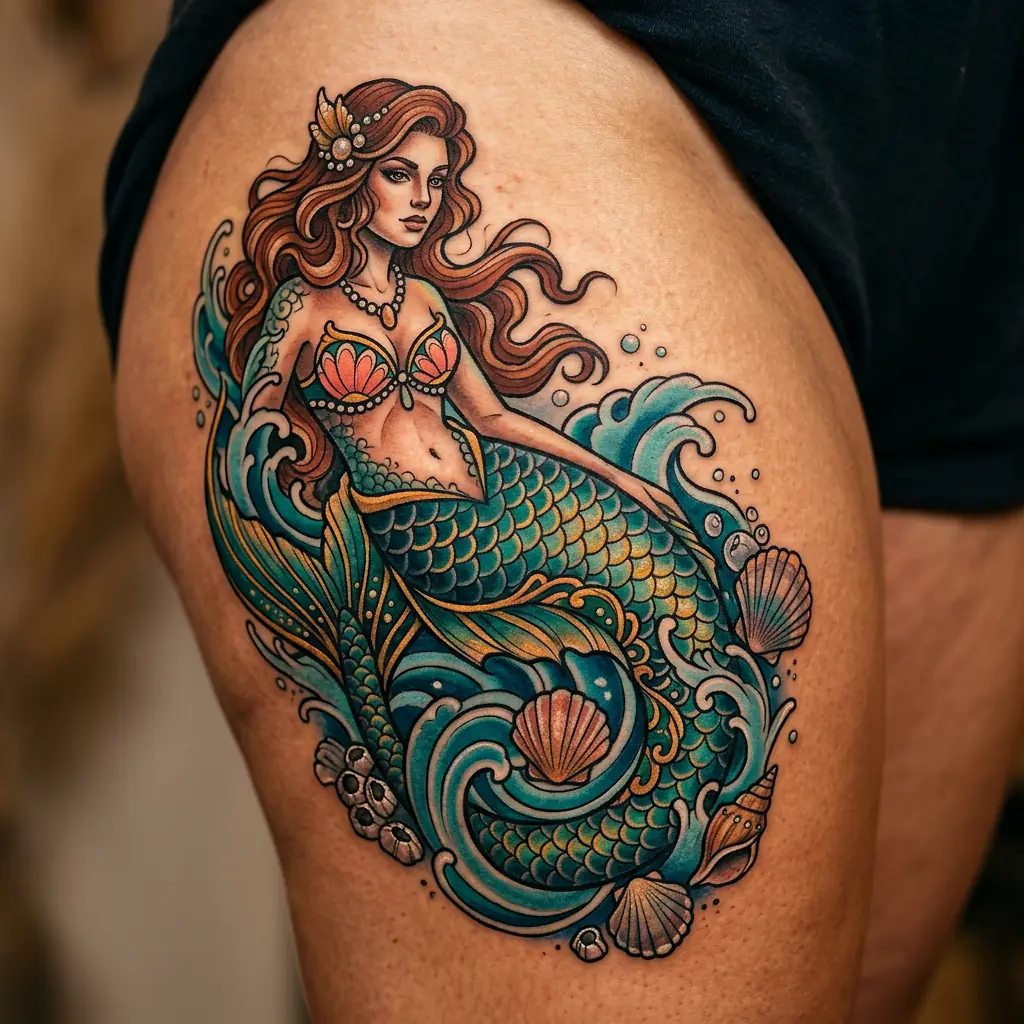
Old school presents the classic sailor’s mermaid: a pin-up with flowing hair and a scaled tail, seated on a rock or an anchor. Bold outlines and saturated colors pay homage to the maritime heritage of tattooing.
Realism creates a detailed, enchanting portrait with underwater light effects, hair floating in the current, and iridescent scales. Neo-traditional modernizes the classic with sophisticated gradients and decorative elements.
Art Nouveau style, inspired by Alphonse Mucha, frames the mermaid within botanical arabesques and elegant curves. Watercolor brings aquatic tones and transparency effects that evoke the underwater realm.
Japanese style incorporates the mermaid (ningyo) into marine compositions with stylized waves and koi fish, anchoring the design in Japanese mythology.
Recommended Placements
The thigh is the most popular placement for a full mermaid. The generous surface allows the figure to be rendered from flowing hair to tail fin. The ribcage accommodates a vertical mermaid whose tail curves toward the hip.
The back provides a canvas for an ambitious composition: a mermaid surrounded by waves, fish, and coral. A full sleeve allows the mermaid to be woven into a maritime scene with shipwrecks, treasure, and sea creatures.
The forearm suits a mermaid portrait or a more compact composition. The calf accommodates a mermaid diving toward the ankle, creating a natural vertical movement.
Combinations and Associations
The mermaid pairs harmoniously with marine elements: crashing waves, coral, seashells, seahorses, and starfish create a complete underwater world. A ship on the horizon adds a narrative dimension evoking maritime legend.
Combined with the moon, the mermaid evokes the nocturnal magic of the ocean and the tides. A mirror or comb are classic mermaid attributes that reinforce the symbolism of beauty and vanity.
Sunken treasure, pearls, and jewels add an element of wealth and mystery. A mermaid seated on a skull or shipwreck evokes the danger hidden beneath beauty, a central theme of ocean myth.