Meaning of the Labyrinth Tattoo
The labyrinth tattoo is a profound symbol of the inner journey, self-discovery, and perseverance. This ancient motif transforms life’s winding path into a permanent design that reminds us every detour carries meaning.
The labyrinth represents the journey of life in all its complexity. Its winding corridors, dead ends, and branching paths reflect the choices, mistakes, and discoveries that mark our existence. Unlike a straight path, the labyrinth teaches that the richest journey is rarely the most direct.
Self-discovery lies at the heart of labyrinth symbolism. To enter a labyrinth is to commit to an inward exploration. The center of the labyrinth represents the core of our being, the deep truth we seek to reach through life’s many detours.
The labyrinth symbolizes perseverance. Faced with dead ends and reversals, the one who continues always finds the way through. This message of hope and tenacity makes the labyrinth a meaningful tattoo for those who have navigated periods of confusion or hardship.
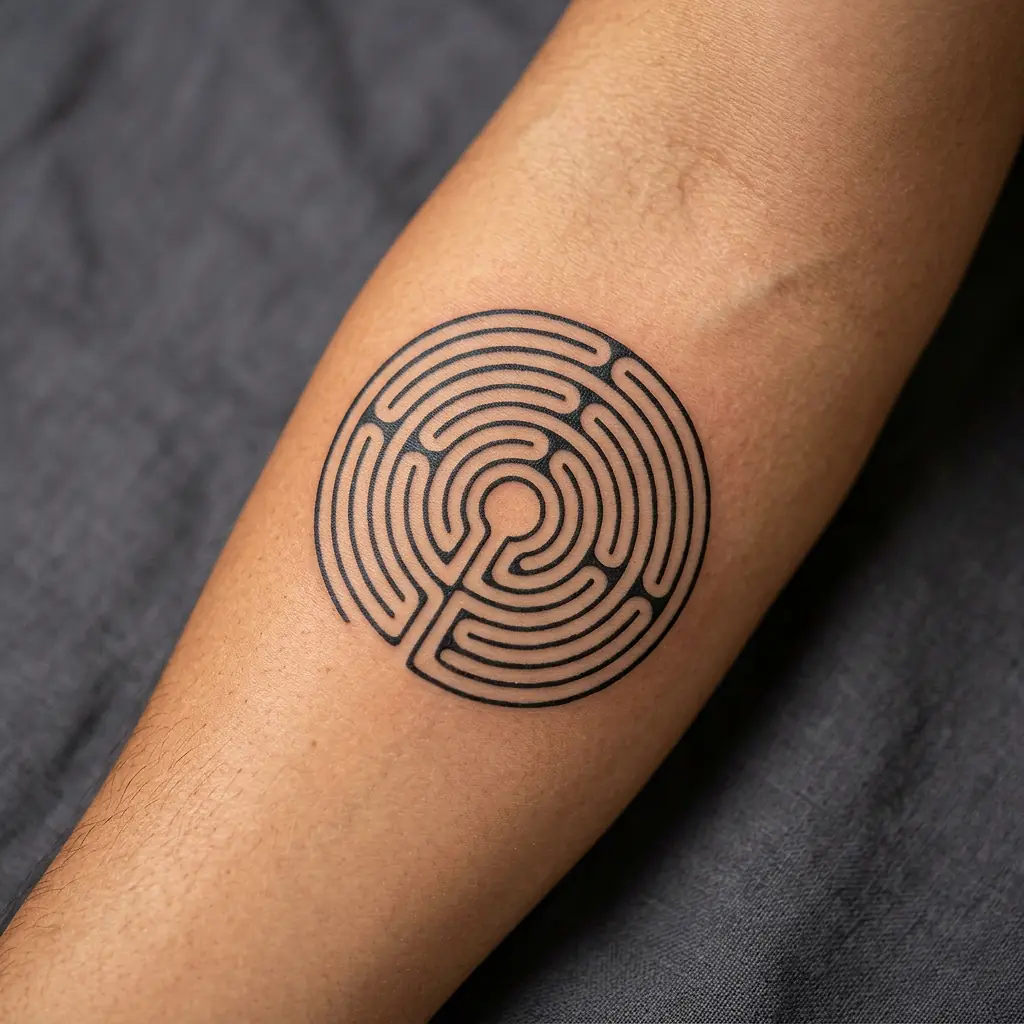
There is an important distinction between a labyrinth (a single path that leads to the center) and a maze (multiple paths with dead ends). The classical labyrinth guarantees that by following the path, you always reach the center. The maze demands choices and accepts error.
Origins and History
The most famous labyrinth belongs to Knossos, in Greek mythology. Built by Daedalus for King Minos, it imprisoned the Minotaur, a creature half man and half bull. Theseus entered the labyrinth and escaped thanks to Ariadne’s thread, becoming the hero who slew the beast.
The oldest carved labyrinths date back approximately 4,000 years, found on rocks in Galicia, Sardinia, and Scandinavia. The seven-circuit labyrinth pattern is remarkably similar across cultures that had no contact with one another, suggesting the symbol speaks to something universal in human experience.
Medieval European cathedrals incorporated labyrinths into their floors. The labyrinth of Chartres Cathedral, dating from the 13th century, served as a symbolic pilgrimage: the faithful walked it on their knees in prayer, simulating a journey to Jerusalem.
The Hopi people of North America used the labyrinth motif (Tapu’at) to represent Mother Earth and the soul’s journey. Scandinavian stone labyrinths called “Trojaborg” were associated with fishing rituals and maritime protection.
In India, labyrinth patterns appear in kolam floor designs and temple architecture, representing the complex path to spiritual enlightenment.
Popular Styles
Geometric is the labyrinth’s natural style. Precise lines and sharp angles reproduce the architectural structure of the pattern with rigor, creating a design that is visually satisfying through its symmetry.
Dotwork builds the labyrinth from thousands of dots, adding texture and depth to the pathway walls. This style gives an organic quality to a typically highly structured motif.
Blackwork offers powerful contrast between pathways (negative space) and walls (solid black). This style transforms the labyrinth into a striking graphic pattern.
Minimalist reduces the labyrinth to its essential lines, creating a clean pattern that is immediately recognizable. Geometric style allows integration of the labyrinth into larger compositions with other sacred forms.
Ornamental enriches the labyrinth walls with decorative patterns, scrollwork, and details that transform the pathway into a complex work of art.
Recommended Placements
The forearm is the ideal placement for a circular or square labyrinth of medium size. The flat, visible surface allows full appreciation of the pathway’s details.
The back offers the space needed for a large, detailed labyrinth, potentially accompanied by narrative elements like the Minotaur at the center or Theseus at the entrance.
The shoulder and upper arm accommodate a circular labyrinth that inscribes naturally within the deltoid’s curve. The calf provides generous surface for a detailed design.
The sternum or wrist suits a compact, circular, minimalist labyrinth.
Combinations and Associations
The labyrinth combined with a Minotaur at its center recreates the Greek myth in all its power. The beast at the heart of the labyrinth represents the inner demons one must confront to find freedom.
A compass integrated into the labyrinth adds the dimension of guidance and direction. It suggests that even in the most confusing moments, there is an inner north to follow.
An eye at the labyrinth’s center symbolizes the inner truth discovered at the journey’s end. Flowers growing along the labyrinth walls evoke the personal growth that emerges from every trial.
Integration within a mandala creates a meditative design where the labyrinth path becomes a visual contemplative practice.