Meaning of the Hourglass Tattoo
The hourglass tattoo is a visual meditation on time. Unlike a digital clock or a watch face, the hourglass makes time visible and tangible: you can see the sand falling, grain by grain, in an irreversible flow. This concrete visualization of time’s passage makes the hourglass one of the most emotionally resonant symbols in tattooing.
The hourglass embodies the memento mori tradition, the philosophical practice of remembering one’s mortality. Far from being morbid, this awareness is an invitation to live fully, to stop postponing what truly matters. Every grain of sand that falls is a moment that will never return.
Duality is built into the hourglass’s very form. Two bulbs separated by a narrow passage: past and future, birth and death, fullness and emptiness. The central point where sand passes from one world to the other is the present, that fleeting moment where everything happens.
The hourglass also symbolizes second chances. Unlike a clock, an hourglass can be turned over. Time restarts, the cycle begins again. This quality makes it a symbol of hope and renewal for those who believe in the possibility of starting fresh.
Patience is yet another layer of meaning. The hourglass cannot be rushed. The sand falls at its own pace, indifferent to our desires. This teaches acceptance of natural rhythms and trust in the timing of things.
Origins and History
The first hourglasses appeared in Europe around the 8th century, though some historians place their invention earlier, perhaps in Alexandria. They became essential measuring instruments for maritime navigation, religious sermons, and daily life.
In medieval art, the hourglass is the attribute of Death (the Grim Reaper) and Father Time. Vanitas paintings, those still lifes meditating on the fleeting nature of existence, systematically placed an hourglass alongside skulls, wilting flowers, and extinguished candles.
Sailors used four-hour hourglasses (called “watches”) to organize shifts aboard ships. The hourglass thus became a maritime symbol, associated with voyage, adventure, and the patient endurance required at sea.
In Freemasonry, the hourglass reminds initiates that time is finite and that every moment should be devoted to self-improvement and service to others.
Alchemists depicted the hourglass as a symbol of slow, methodical transformation, paralleling the Great Work that transmutes lead into gold through time, patience, and precise process.
In Victorian culture, the winged hourglass became a common tombstone motif, representing the Latin phrase “tempus fugit” (time flies). This image carried over into tattoo culture, particularly in Western traditional tattooing.
Popular Styles
Neo-traditional is one of the most requested styles for hourglass tattoos. Thick outlines, saturated colors, and generous shading give the hourglass a classic yet modern appearance that stands the test of time.
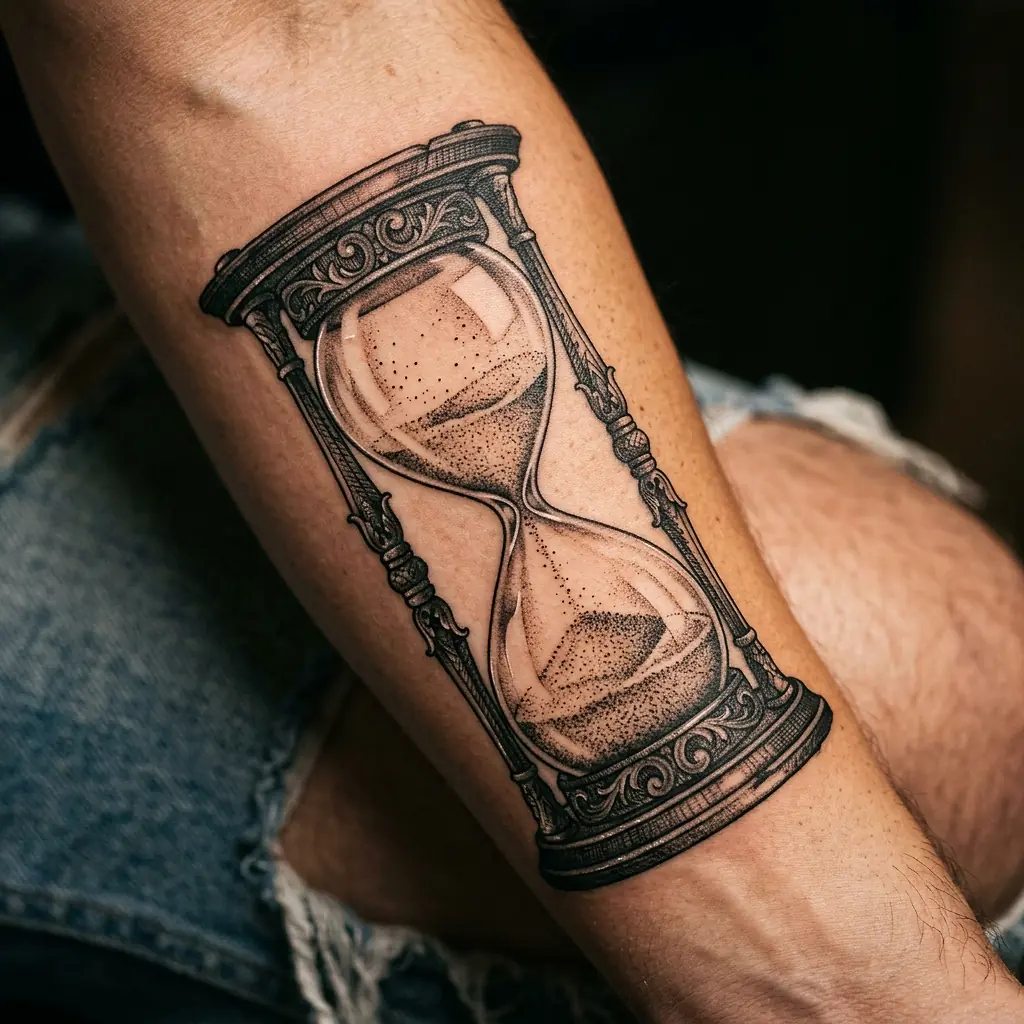
Realistic style showcases the transparency of glass, light reflections, and the texture of flowing sand. This approach creates the illusion of an actual hourglass resting on the skin.
Blackwork offers a graphic, high-contrast hourglass in pure black. Dense black areas and negative space create a striking composition that commands attention.
Dotwork builds the hourglass from thousands of dots, producing subtle gradients that simulate glass transparency and sand granularity. Surrealist approaches transform the hourglass into a narrative device, placing landscapes, life scenes, or impossible elements inside each bulb.
Recommended Placements
The forearm is the classic hourglass placement. The vertical, elongated shape fits naturally along the arm’s line, creating a balanced, visible design that can be admired easily.
The calf provides ample space for a detailed hourglass with decorative elements. The ribs accommodate a vertical hourglass that follows the body’s natural curve.
The back, centered between the shoulder blades, allows for a symmetrical, imposing hourglass. The chest works for wider compositions that integrate the hourglass into a larger design.
The wrist hosts a minimalist hourglass that is discreet but meaningful. The inner bicep offers an intimate placement for this personal reminder of time’s passage.
Combinations and Associations
The hourglass combined with a skull forms one of tattooing’s most classic memento mori compositions. This pairing forcefully reminds the viewer of mortality and the urgency of living fully.
Roses surrounding the hourglass symbolize fleeting beauty. Falling petals reinforce the message that time fades even the most beautiful things.
Wings added to the hourglass evoke the expression “time flies” (tempus fugit). This classic Victorian combination remains tremendously popular in modern tattooing.
Placing different scenes inside each bulb tells a story: youth and old age, day and night, earthly life and the cosmos. A skull in one bulb and flowers in the other illustrates the life-death cycle with visual eloquence.