Meaning of the Cherry Blossom Tattoo
The cherry blossom tattoo is a motif of breathtaking beauty that carries one of the most profound messages in Japanese culture: the fleeting beauty of existence. Cherry blossoms (sakura) remind us that every moment is precious precisely because it does not last forever.
The cherry blossom symbolizes impermanence (mono no aware in Japanese), a bittersweet awareness that all things are transient. Cherry blossoms burst into spectacular bloom but last only a few days before falling. This very fragility is what makes them so deeply treasured.
Getting a cherry blossom tattoo means embracing the beauty of the ephemeral and choosing to live fully in each moment. It serves as a reminder that difficulties are temporary, just as moments of happiness are, and that every instant deserves to be savored.
The cherry blossom also represents renewal and new beginnings. Its annual spring bloom marks the end of winter and the return of life. This tattoo speaks to those who have weathered hardship and are embracing a fresh chapter.
Resilience is another dimension of the cherry blossom. The tree endures the harshness of winter, stripped bare and dormant, only to be reborn each year in a burst of extraordinary beauty. It symbolizes the capacity to weather difficult times and bloom again.
Origins and History
In Japan, sakura culture stretches back over a thousand years. The tradition of hanami (flower viewing) dates to the Nara period (710-794). Japanese people gather beneath blooming cherry trees to celebrate the ephemeral beauty of nature with festive picnics and quiet contemplation.
In the samurai tradition, the cherry blossom embodied their philosophy of life. Just as the sakura falls at the peak of its beauty, the samurai was expected to be ready to die at the height of his glory, without fear or regret. The bushido (way of the warrior) taught that life should be lived with the same intensity as the cherry blossom’s bloom.
In China, the cherry blossom is a symbol of femininity, beauty, and feminine power. It also represents love and female sensuality in classical Chinese poetry and artistic tradition.
In Buddhist culture, cherry blossoms perfectly illustrate the concept of impermanence (anicca), one of the three pillars of Buddhist philosophy. They serve as a living reminder that attachment to worldly things is a source of suffering.
Popular Styles
Traditional Japanese style (irezumi) is the most authentic approach. Branches flow with natural grace, petals appear to be carried by the wind, and the design integrates harmoniously into larger compositions with waves, clouds, or mythical creatures.
Watercolor captures the delicacy of cherry blossoms with soft pink, white, and fuchsia tones that seem to dissolve on the skin. This style beautifully evokes the fragility and fleeting beauty of the motif.
Realism reproduces every petal, every stamen, and every nuance of color with botanical precision. Minimalist fine-line work offers a clean branch in black ink, often with just a few touches of pink for the blossoms.
Blackwork transforms the cherry blossom into a graphic silhouette, playing on contrasts between dark branches and delicate flowers to create a striking modern interpretation.
Recommended Placements
The full arm (Japanese sleeve) is the premier placement for a flowering cherry branch, with petals spiraling from wrist to shoulder. The side and ribs accommodate an elegant vertical branch.
The shoulder and shoulder blade allow a branch that cascades onto the arm. The back provides space for an entire cherry tree in full bloom.
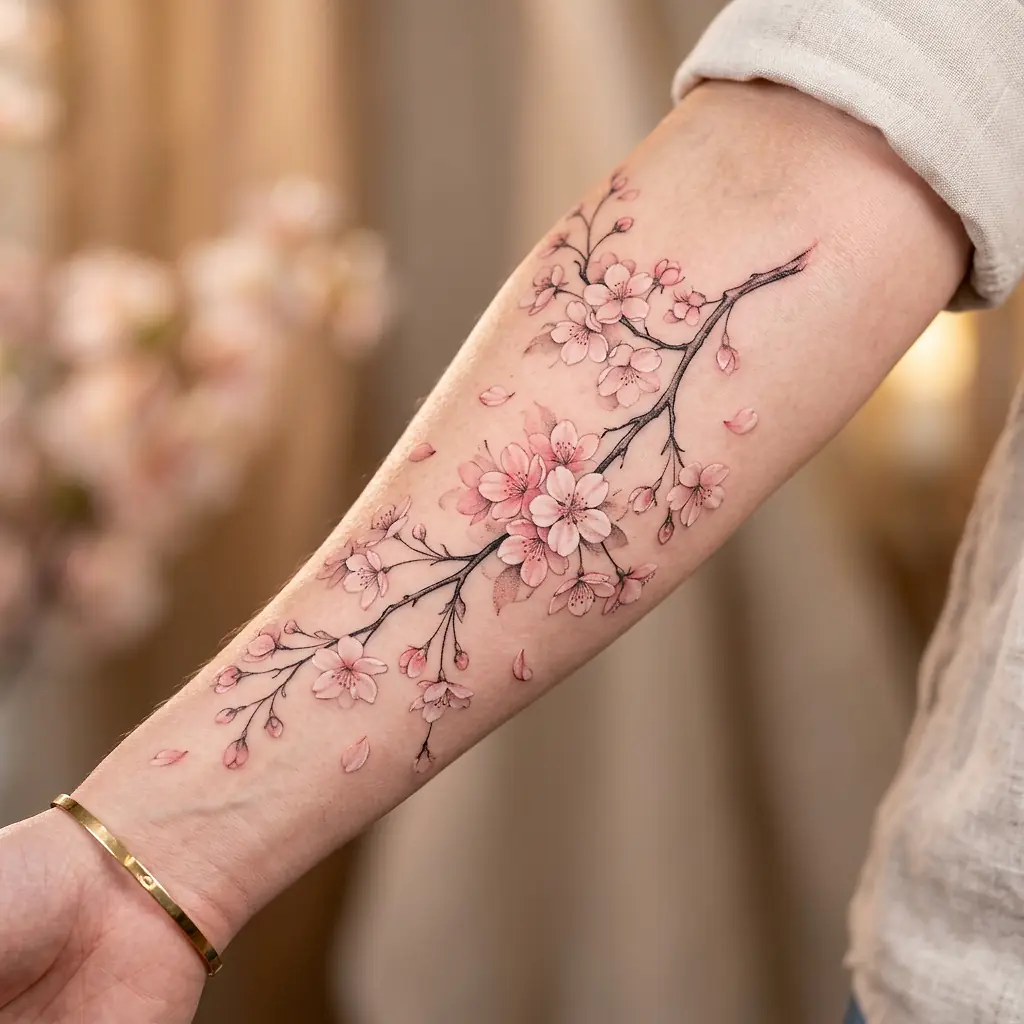
The wrist and ankle suit a small minimalist branch with a few delicate flowers. The forearm is ideal for a horizontal branch with petals drifting in the wind.
Combinations and Associations
Cherry blossoms combine magnificently with motifs from Japanese tattooing: koi fish, dragons, waves, or temple architecture. The contrast between delicate flowers and a powerful dragon is a classic of irezumi art.
A butterfly fluttering among cherry blossoms adds movement and a double symbolism of transformation and impermanence. A bird perched on a flowering branch evokes spring and the joy of living.
Petals carried by the wind around the branch create a poetic sense of movement and reinforce the theme of impermanence. A pagoda or torii gate in the background anchors the motif firmly in Japanese culture.