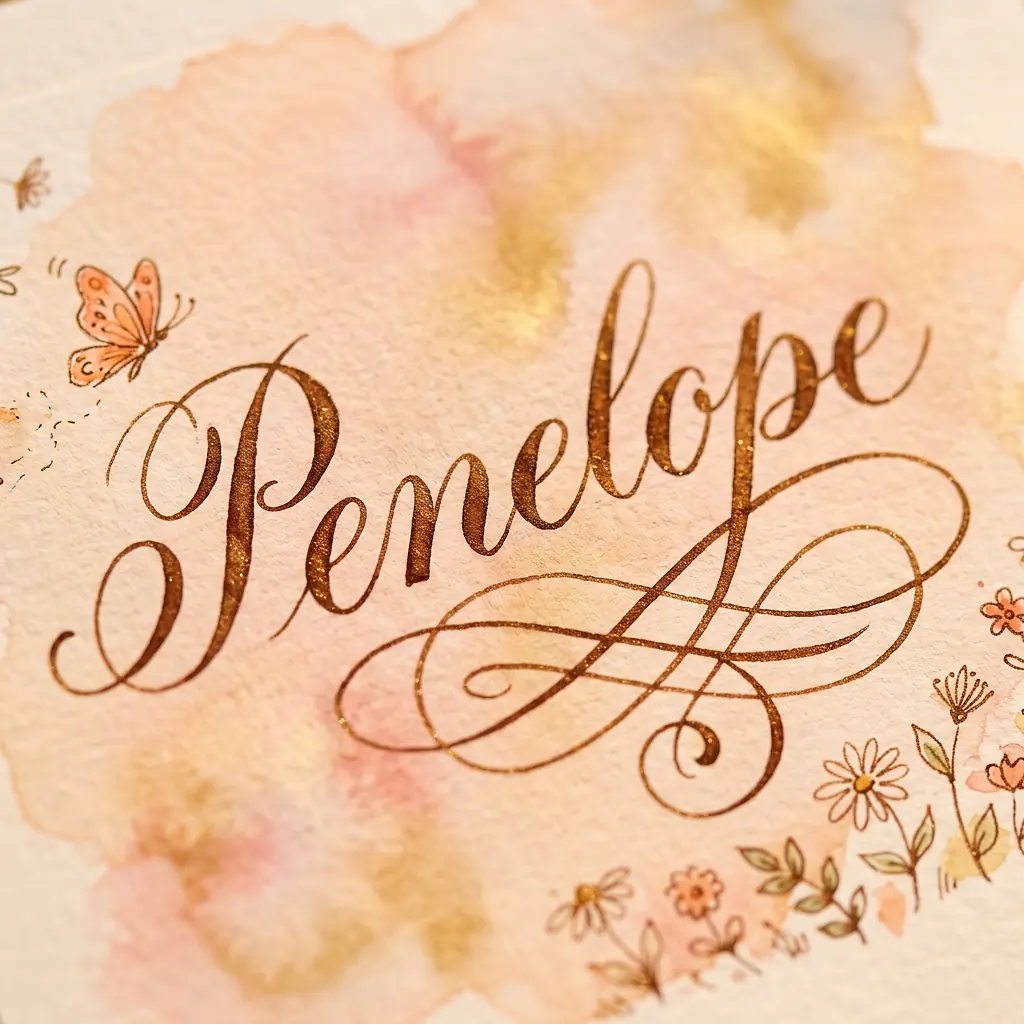
Meaning of the Name Penelope
The name Penelope weaves together meaning and mythology in a way that few other names can match. The most widely accepted interpretation derives from the Greek word ‘pene,’ meaning ‘thread,’ ‘weft,’ or ‘bobbin,’ connecting the name to the act of weaving. This textile association is inseparable from the mythological Penelope, who used her loom as a tool of cunning strategy. An alternative etymology links the name to ‘penelops,’ a type of duck, though this interpretation is less commonly cited. The weaving meaning carries rich metaphorical significance: it speaks to patience, creativity, and the ability to craft complex solutions from simple materials. Weaving is also an act of creation, of bringing order from threads of chaos, suggesting that Penelope represents the power of intelligence applied with patience. The name’s four syllables create a melodic, almost musical quality that has enchanted parents and listeners for millennia.
Origin and History
Penelope’s origins are rooted in ancient Greek civilization, and the name owes its immortality to Homer’s epic poem ‘The Odyssey.’ In this foundational work of Western literature, Penelope is the wife of Odysseus (Ulysses), king of Ithaca. When Odysseus departed for the Trojan War, Penelope waited faithfully for twenty years, ten of war and ten of his wandering journey home. During his absence, suitors pressured her to remarry. Penelope’s famous stratagem was to promise she would choose a suitor once she finished weaving a burial shroud for her father-in-law, Laertes, but each night she secretly unraveled the day’s work, buying time until Odysseus could return. This story made Penelope the archetype of faithful devotion and clever resourcefulness in Western culture. The name was used throughout the classical and medieval periods but remained relatively uncommon in modern English-speaking countries until the late 20th century. Its current surge began in the 2000s, driven by the charm of its sound, the appeal of its mythological pedigree, and celebrity influence.
Personality and Character
Individuals named Penelope often display the intelligence, patience, and quiet determination that their mythological namesake exemplified. They tend to be strategic thinkers who approach challenges not with brute force but with creativity and careful planning. This does not make them passive; rather, Penelopes typically possess a profound inner strength that allows them to maintain their course even when circumstances are difficult. They are frequently described as loyal and devoted in their relationships, investing deeply in the people they love and standing by their commitments with unwavering constancy. Creatively, Penelopes are often gifted, drawn to crafts, writing, design, or other pursuits that involve bringing together disparate elements into a cohesive whole. Their emotional intelligence is typically high, and they are skilled at reading situations and people with accuracy. In social settings, Penelopes tend to be warm and engaging, though they may reserve their deepest thoughts and feelings for those they trust most completely. Like those named Sophia, they combine beauty with formidable wisdom.
Popularity
Penelope’s rise in the 21st century has been remarkable. In the United States, the name was used sparingly throughout most of the 20th century, rarely breaking into the top 500. The climb began in the early 2000s and accelerated dramatically. By 2013, Penelope had entered the top 100. By 2019, it had reached the top 25, a position it continues to hold. This trajectory represents one of the most significant revivals of a classical name in recent naming history. Several factors contributed to this surge: actress Penelope Cruz brought international glamour to the name; celebrity parents (including Kourtney Kardashian and Tina Fey) chose it for their daughters; and the broader cultural appetite for names that are both elegant and substantial fueled its rise. In the United Kingdom, Penelope has also gained ground, re-entering the top 200. Latin American countries show strong affinity for the name as well. The charming nickname Penny (or Nell, Nellie, Poppy) adds practical appeal, giving the name versatility across formal and informal contexts.
Famous Bearers
The mythological Penelope of Ithaca remains the name’s most powerful association, representing an ideal of faithfulness, intelligence, and quiet strength that has resonated across nearly three thousand years of Western culture. In the real world, Penelope Cruz (born 1974) is a Spanish actress of international renown, the first Spanish actress to win an Academy Award, for her role in Woody Allen’s ‘Vicky Cristina Barcelona.’ Her combination of beauty, talent, and depth has given the name modern glamour. Penelope Fitzgerald (1916-2000) was a British novelist who won the Booker Prize for her novel ‘Offshore’ and is increasingly recognized as one of the finest English novelists of the 20th century. Penelope Lively is another distinguished British writer, also a Booker Prize winner, known for novels that explore memory and time with extraordinary sensitivity. Lady Penelope Creighton-Ward from the ‘Thunderbirds’ television series added a touch of glamorous adventure to the name. In contemporary culture, the animated character Penelope from numerous children’s films has introduced the name to younger audiences. These bearers collectively illustrate the name’s long association with intelligence, elegance, and creative achievement.