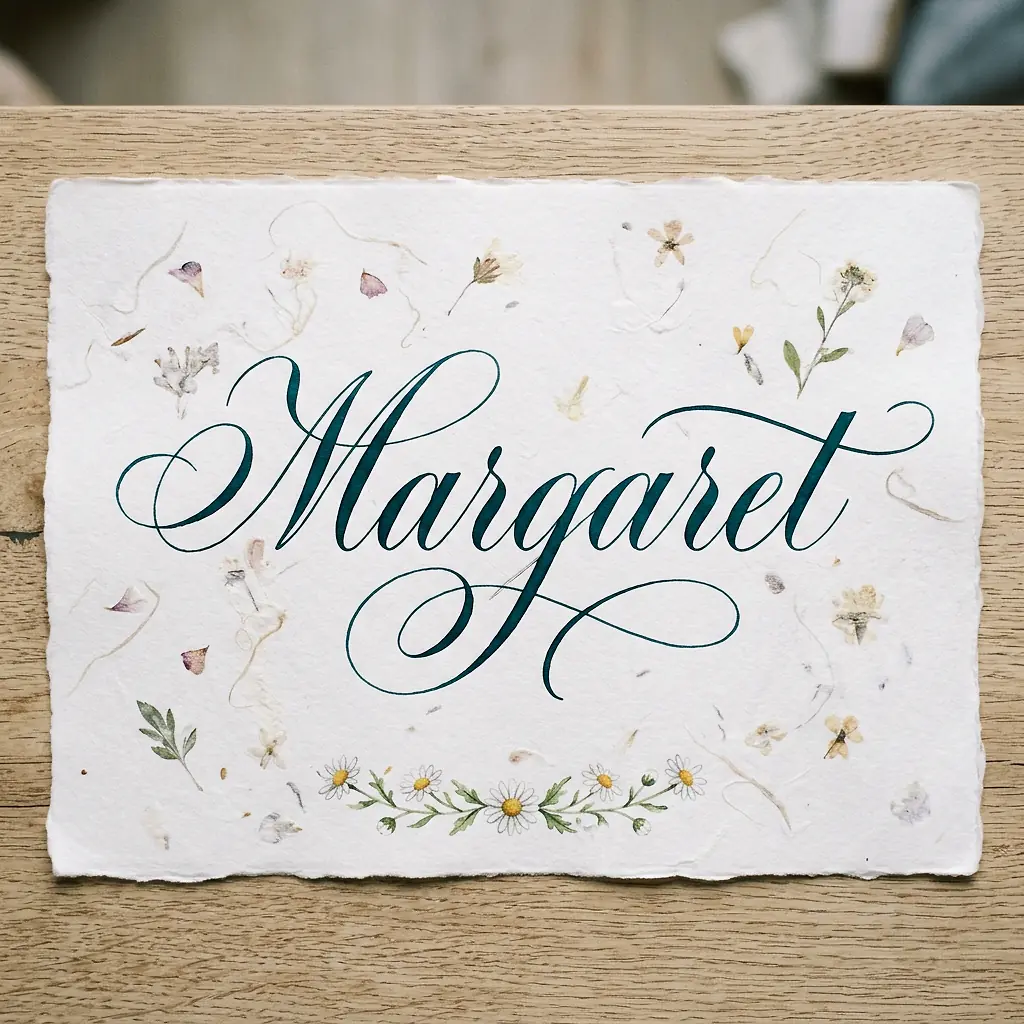
Meaning of the Name Margaret
The name Margaret carries the luminous meaning of ‘pearl,’ derived from the Greek word ‘margarites,’ which itself traces back to the Persian ‘marvarid.’ This etymology connects the name to one of nature’s most remarkable creations. A pearl forms through a long, hidden process of transformation: an irritant enters an oyster, and over time, through layers of nacre, it becomes something of extraordinary beauty and value. This process makes the pearl a powerful symbol of wisdom gained through experience, beauty refined through patience, and value that increases with time. As a name, Margaret suggests a person whose worth is not superficial or immediately apparent but develops through layers of character, knowledge, and lived experience. The name also carries historical weight: for centuries, Margaret was one of the most common and respected names across Europe, borne by queens, saints, and women of formidable achievement.
Origin and History
Margaret’s journey from a Persian word for pearl to one of the most widely used names in Western history is a story of cultural transmission spanning millennia. The Persian ‘marvarid’ became the Greek ‘margarites,’ which entered Latin and spread throughout Christendom. The name’s Christian popularity owes much to Saint Margaret of Antioch, a legendary early martyr who was one of the Fourteen Holy Helpers and among the most venerated saints of the medieval period. Her cult was extraordinarily popular across Europe, and the name became a royal favourite. Queen Margaret of Scotland (c. 1045-1093) was canonized for her piety and charitable works, giving the name saintly prestige in the British Isles. Margaret was a top 5 name in England for centuries. In the United States, it was a top 10 name from the 1890s through the 1940s, reaching as high as number 3. The name declined through the latter half of the 20th century as parents shifted toward newer choices, but it has never disappeared. Its current modest revival reflects the broader trend of rediscovering substantial, historically rich names. The name has spawned an extraordinary number of diminutives across languages, from Maggie and Peggy to Greta, Margot, and Maisie.
Personality and Character
Individuals named Margaret typically embody a quiet authority and intellectual substance that reflects the name’s long association with accomplished women. They tend to be thoughtful, principled people whose opinions carry weight because they are clearly the product of careful reflection. Margarets are frequently described as both intelligent and practical, equally capable of engaging in abstract discussion and managing concrete responsibilities. Their moral compass tends to be strong; they know what they believe and are willing to stand by their convictions, sometimes at personal cost. In social settings, Margarets often serve as stabilizing influences, bringing a combination of warmth and structure to group dynamics. They are typically reliable and thorough in their work, earning respect through consistent quality rather than self-promotion. Many Margarets possess a dry wit and a sharp sense of humor that emerges most fully in the company of those they trust. Their emotional life tends to be deep but controlled; they feel strongly but do not typically wear their hearts on their sleeves. Like those named Eleanor, Margarets carry themselves with a dignity that reflects their name’s royal and saintly heritage.
Popularity
Margaret’s popularity chart tells the story of one of the English language’s most enduring names. In the United States, Margaret was a top 10 name from the 1890s through the 1940s, ranking as high as number 3 in several years. It remained in the top 50 through the 1960s before beginning a gradual decline that continued through the turn of the century. The name reached its modern low point around 2010, hovering near position 170. Since then, it has experienced a modest but steady revival, climbing back to around position 120. This recovery is part of the broader vintage name renaissance, but Margaret’s return is also driven by parents who value its substance, history, and remarkable versatility through nicknames. In the United Kingdom, Margaret followed a similar arc of dominance followed by decline and early revival. Scotland, where Saint Margaret holds special significance, has maintained particularly strong usage. The name’s many diminutive forms, including Maggie, Meg, Peggy, Maisie, Greta, Margot, and Daisy (via the French Marguerite, which means both pearl and daisy), give it unmatched versatility, allowing a single formal name to serve multiple personalities and life stages.
Famous Bearers
The name Margaret has been carried by some of the most formidable women in history. Margaret Thatcher (1925-2013), Britain’s first female Prime Minister, served for eleven years and transformed the country’s political and economic landscape, earning the nickname ‘The Iron Lady’ for her unyielding determination. Margaret Atwood is one of the most important living writers, whose novel ‘The Handmaid’s Tale’ has become a defining text of contemporary literature and cultural discourse. Margaret Mead (1901-1978) was a pioneering anthropologist whose work on culture and gender shaped public understanding of human societies. Queen Margaret of Scotland was canonized for her devotion to education, charity, and religious reform. Margaret Hamilton delivered one of cinema’s most iconic performances as the Wicked Witch of the West in ‘The Wizard of Oz.’ Margaret Sanger was a revolutionary activist for birth control and women’s reproductive rights. Margaret Bourke-White was one of the first female war correspondents and a pioneering photojournalist. This extraordinary gallery of bearers, spanning politics, literature, science, religion, and the arts, reflects the name’s deep association with intelligence, strength, and enduring influence.