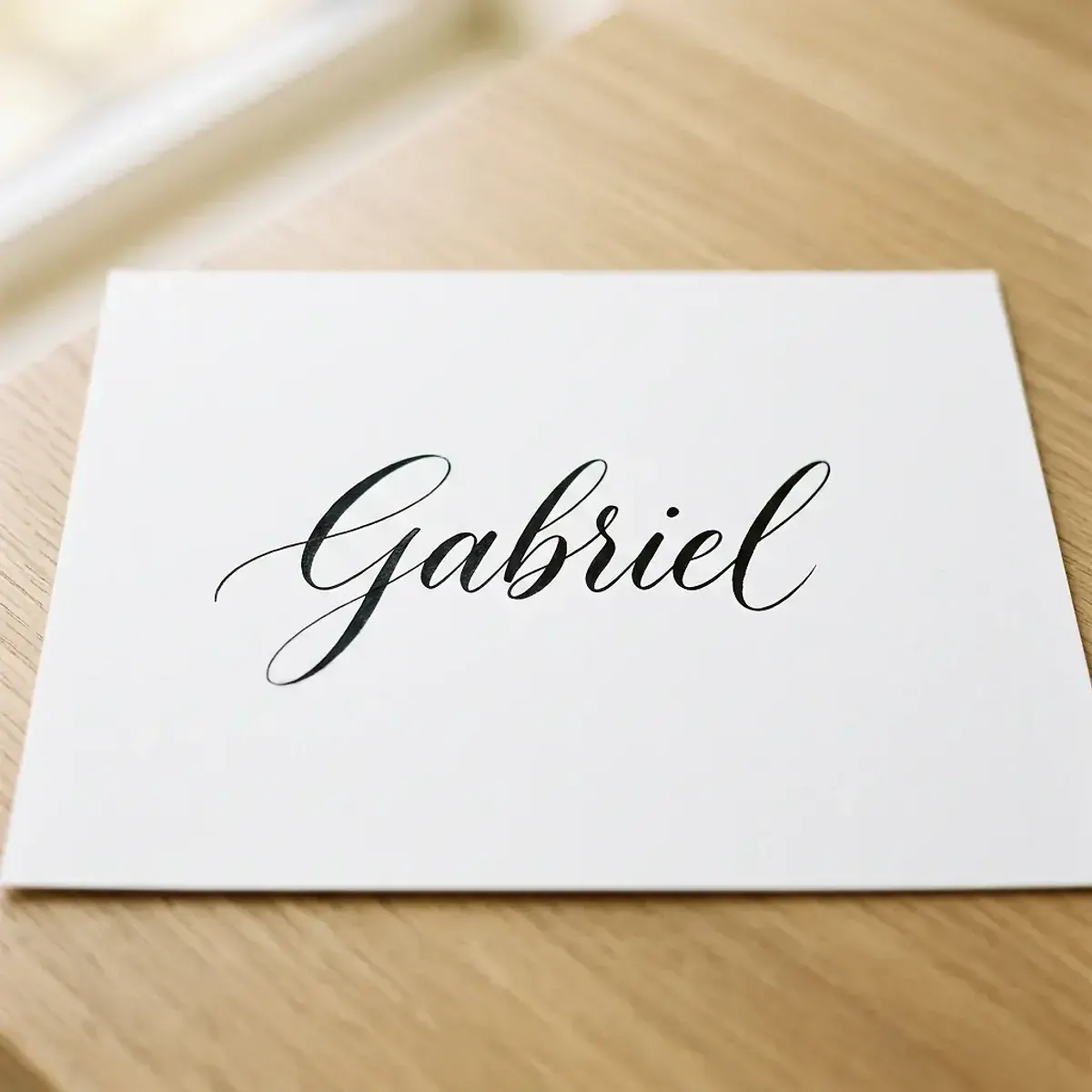
Meaning of the Name Gabriel
The name Gabriel resonates with a meaning of extraordinary spiritual power. It combines two Hebrew elements: ‘gever’ (strong man, hero, warrior) and ‘El’ (God), yielding the meaning ‘God is my strength’ or ‘strong man of God.’ This is not passive strength but active, purposeful power directed by divine will. In the religious traditions where Gabriel holds significance, the archangel serves as God’s primary messenger, the one entrusted with delivering the most important announcements in sacred history. This communication function adds a layer of meaning beyond raw strength: Gabriel suggests a person who not only possesses power but uses it to convey truth, deliver hope, and bridge the gap between the divine and the human. The name’s three syllables create a rising rhythm that mirrors its aspirational meaning, moving from the grounded ‘Ga’ through the open ‘bri’ to the elevated ‘el.‘
Origin and History
Gabriel’s origins are embedded in the foundational texts of Western and Middle Eastern civilization. In the Hebrew Bible, Gabriel appears in the Book of Daniel as the angel who interprets Daniel’s visions. In the New Testament, Gabriel performs two of the most significant announcements in Christian scripture: he tells Zechariah that his wife Elizabeth will bear John the Baptist, and he delivers the Annunciation to the Virgin Mary, informing her that she will be the mother of Jesus. In Islamic tradition, Jibril (Gabriel) is the angel who revealed the Quran to the Prophet Muhammad over a period of 23 years, making Gabriel central to the world’s three largest monotheistic faiths. As a given name, Gabriel has been used continuously since biblical times. It was popular in medieval Europe and particularly strong in French, Spanish, and Portuguese cultures. In the English-speaking world, Gabriel was used moderately throughout history, experiencing its most significant growth in America from the 1980s onward. The name’s cross-cultural appeal, spanning Christianity, Islam, Judaism, and secular usage, makes it one of the most universally recognized names in the world.
Personality and Character
Individuals named Gabriel often exhibit a notable combination of charisma and depth. They tend to be natural communicators, gifted with the ability to articulate ideas and emotions in ways that resonate with others. This communicative talent reflects the archangel’s role as messenger, and many Gabriels find themselves drawn to fields involving expression: writing, music, teaching, public speaking, or counseling. Their strength is typically evident not in domineering behavior but in a steady, reassuring presence that others rely upon during difficult times. Gabriels are frequently described as both strong and sensitive, capable of combining protective instincts with genuine emotional availability. They tend to be principled individuals whose sense of justice and fairness guides their decisions. Creatively, many Gabriels possess musical or artistic talents that may develop into serious pursuits. In relationships, they are typically devoted and expressive, willing to invest deeply in the bonds that matter most to them. Their potential challenge lies in the weight of expectation their name can carry; the aspiration to embody divine strength may occasionally create pressure, but most Gabriels channel this energy into positive personal growth. Like those named Michael, another archangelic name, they project both authority and warmth.
Popularity
Gabriel has enjoyed remarkably broad and sustained popularity. In the United States, the name began its modern ascent in the 1970s, entering the top 100 by 1976. It reached the top 50 around 2001 and has remained there since, currently ranking around position 35. This consistency reflects deep-rooted, cross-cultural appeal rather than trend-driven spikes. Gabriel is particularly popular among Hispanic American families, contributing to its strong performance in states with large Latino populations. Internationally, the name’s popularity is even more striking. In France, Gabriel has been the number one boys’ name for several years running, a position of extraordinary dominance. Spain, Portugal, and Brazil also rank it among the most popular choices. In the United Kingdom, Gabriel has maintained a steady presence in the top 50-75 range. The name benefits from working naturally across multiple languages with minimal pronunciation variation, making it an ideal choice for multicultural families. Its religious significance, literary associations, and pleasing sound create a combination that appeals to parents of diverse backgrounds.
Famous Bearers
The name Gabriel has been borne by figures of towering cultural achievement. Gabriel Garcia Marquez (1927-2014) is one of the greatest writers of the 20th century, whose novels, particularly ‘One Hundred Years of Solitude,’ defined magical realism and earned him the Nobel Prize in Literature. His work transformed Latin American literature and influenced writers worldwide. Peter Gabriel has been one of the most innovative figures in popular music, first as the theatrical frontman of Genesis and then as a groundbreaking solo artist whose albums ‘So’ and ‘Us’ reached millions of listeners. Gabriel Faure (1845-1924) was a master French composer whose Requiem remains one of the most performed choral works. In sports, Gabriel Batistuta is regarded as one of the finest strikers in football history, scoring prolifically for Fiorentina and Argentina. Gabriel Byrne has built a distinguished career as an Irish actor in both film and theatre. In fashion, Gabrielle ‘Coco’ Chanel (whose name shares the same root) revolutionized women’s clothing and style. The archangel Gabriel himself remains the name’s most powerful association, depicted in countless works of art from the medieval period to the present. This extraordinary range of bearers reflects the name’s connection to creative power, spiritual depth, and human achievement.